|
|
|||
|
||||
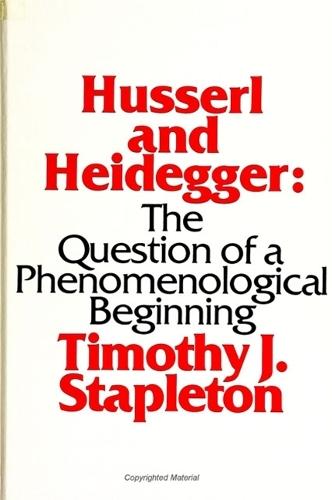
OverviewThe phenomenology of Edmund Husserl has decisively influenced much of contemporary philosophy. Yet Husserl's philosophy has come under such criticism that today it is viewed as little more than a historical relic. One of the most important and influential critiques of Husserl's transcendental phenomenology was launched by Martin Heidegger in Being and Time, which radically reinterpreted phenomenology. Timothy Stapleton returns to the origin of phenomenology to provide a clear, concise perspective on where it has been and on where it ought to be heading. This book is a careful reexamination of the internal development of Husserl's thought as well as of the ways in which Heidegger used and transformed the phenomenological method. It begins with an interpretation of the ""transcendental"" dimension of Husserl's philosophy, stressing the importance of the ontological rather than the epistemological problematic in determining the unfolding of Husserlian thought. The work progresses to an account of Heidegger's early works, viewed as a radicalization of Husserl's phenomenology both in name and substance. Stapleton concludes by contrasting a transcendental origin with a hermeneutic beginning point in terms of their respective ideals of intelligibility, meaning, and being; and then looks at some of the consequences of the idea of a hermeneutic philosophy. Full Product DetailsAuthor: Timothy J. StapletonPublisher: State University of New York Press Imprint: State University of New York Press Dimensions: Width: 15.20cm , Height: 2.50cm , Length: 22.90cm Weight: 0.236kg ISBN: 9780873957458ISBN 10: 0873957458 Pages: 160 Publication Date: 30 June 1984 Audience: College/higher education , Professional and scholarly , Undergraduate , Postgraduate, Research & Scholarly Format: Paperback Publisher's Status: Active Availability: In Print This item will be ordered in for you from one of our suppliers. Upon receipt, we will promptly dispatch it out to you. For in store availability, please contact us. Table of Contents"Acknowledgments Introduction: The Nature of the Problem Chapter 1. Absolute Consciousness in Ideas I The Prephilosophical and Philosophical Attitudes The Problem of the Reduction The Way to the Reduction in Ideas I The Absolute of Consciousness 2. Philosophical Science and the Idea of Evidence That Which Makes a Beginning Possible The Question of the Beginning The Beginning of Philosophy 3. Toward a Logic of the Transcendental Reduction The Concept of Foundation Transcendental Subjectivity as Absolute Concretum Thing, World, and Transcendental Subjectivity Motives for the Transcendental Turn 4. Transcendental Subjectivity and Being-in-the-World Intentionality The ""Subjective"" Turn in Husserl and Heidegger Posing the Question of Being Transcendence and World 5. Phenomenological Beginnings A Summary A Transcendental or Hermeneutic Beginning? Notes Selected Bibliography Index"ReviewsAuthor InformationTimothy J. Stapleton is Assistant Professor of Philosophy at Loyola College in Maryland. Tab Content 6Author Website:Countries AvailableAll regions |
||||