Overview
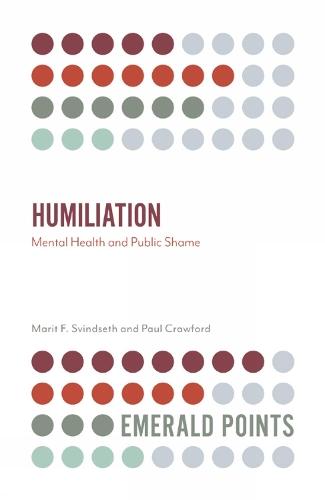
There is a global appetite to humiliate or publicly shame others and this has even become a source of entertainment for many. The growth and all-encompassing influence of social media has made the phenomenon of humiliation even more apparent and possible.This book examines the damaging impact of humiliation in human society. The relationship between humiliation and shame is explored in depth with a particular focus on the way this relationship affects people's self-image, self-esteem and memory. By using case studies of observed humiliation, the book discusses the power play between individuals, groups, organizations and nations. It shows how public shame can lead to damaging psychological states and violent responses amongst vulnerable people. This topical book presents an important and timely discussion for today's world, not least in showing the links between humiliation, terrorism and poor mental health. By offering strategies for responding to feelings of humiliation in a range of contexts, this book will prove a valuable resource for professionals concerned with mental health, public health, education and social care. Importantly, this is a book for all those affected by humiliation who want to take action and find new solutions for dealing with it.
Full Product Details
Author: Marit F. Svindseth (The Norwegian University of Science and Technology, Norway) ,
Paul Crawford (The University of Nottingham, UK)
Publisher: Emerald Publishing Limited
Imprint: Emerald Publishing Limited
Dimensions:
Width: 12.90cm
, Height: 0.80cm
, Length: 19.80cm
Weight: 0.151kg
ISBN: 9781838671013
ISBN 10: 1838671013
Pages: 136
Publication Date: 20 May 2019
Audience:
Professional and scholarly
,
Professional & Vocational
Format: Paperback
Publisher's Status: Active
Availability: In Print

This item will be ordered in for you from one of our suppliers. Upon receipt, we will promptly dispatch it out to you. For in store availability, please contact us.
Reviews
Svindseth and Crawford, experts in human mental health, explore humiliation-its impact, mitigation and people's reaction to it-through media and society in their professional work. They consider better strategies of responding in the selection of diverse cases. They believe it to be that humiliation may be society's greatest challenge yet. It can engender violence across individuals, groups, organizations, and nations. Citing the need to help young people develop compassion and empathy for themselves and others, they emphasize that humiliation severely challenges the health and well-being of people. -- Annotation (c)2019 * (protoview.com) *
Svindseth and Crawford, experts in human mental health, explore humiliation-its impact, mitigation and people's reaction to it-through media and society in their professional work. They consider better strategies of responding in the selection of diverse cases. They believe it to be that humiliation may be society's greatest challenge yet. It can engender violence across individuals, groups, organizations, and nations. Citing the need to help young people develop compassion and empathy for themselves and others, they emphasize that humiliation severely challenges the health and well-being of people. -- Annotation ©2019 * (protoview.com) *
Author Information
Marit F. Svindseth is Professor in Mental Health at the Norwegian University of Science and Technology. She has fifteen years of clinical experience of working in both secure in-patient and community mental health settings. Her research focuses on mental health, with a focus on how service users perceive their care. Paul Crawford is the world's first Professor of Health Humanities, pioneering the field and launching multiple new research, educational and practice initiatives worldwide. He directs the Centre for Social Futures at the Institute of Mental Health and co-directs the Health Humanities Research Priority Area at The University of Nottingham, UK.