Overview
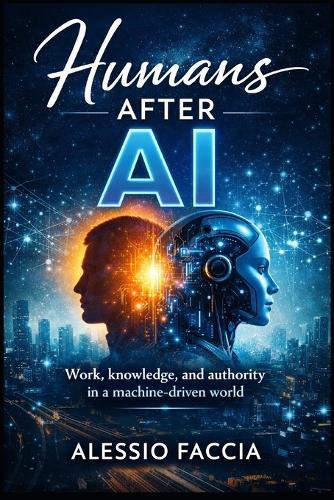
What happens to work, knowledge, and authority when machines no longer assist only at the margins, but enter the very core of thinking, writing, judging, classifying, and deciding? Humans After AI: Work, Knowledge, and Authority in a Machine-Driven World examines one of the defining shifts of the present era. Artificial intelligence is no longer a niche technical matter reserved for engineers, data scientists, or software firms. It now shapes offices, classrooms, professional services, public administration, research, management, and everyday communication. The central issue is no longer whether AI exists in professional life. The real issue concerns what remains distinctly human once systems produce text, structure analysis, rank priorities, frame decisions, and influence institutional judgement. This book offers a rigorous and accessible examination of how AI is reshaping labour, education, expertise, and social power. It studies the redesign of tasks and professions, the weakening of traditional learning paths, the collapse of old signals of competence, and the growing pressure placed on human judgement in environments flooded with synthetic output. It also addresses deeper institutional questions. Who holds authority when machines produce the answer first? What happens to accountability when decision pathways become opaque? Why does trust shift from experts to systems? How does platform dependence reshape economic power and social inequality? Across six substantial chapters, the book analyses the movement from labour power to cognitive supervision, the erosion of memory and deep attention, the spread of synthetic reasoning, the instability of credentials and academic merit, the rise of managerial control in automated workflows, and the ethical limits of delegation where rights, dignity, and professional responsibility are at stake. Special attention is given to education, public institutions, high-skill professions, and the long-term consequences of replacing human formation with machine-assisted performance. Rather than offering empty alarmism or shallow optimism, this work develops a clear argument. AI is not only a productivity tool. It is a force reorganising the meaning of work, the structure of knowledge, and the foundations of legitimacy in modern institutions. Faster output does not automatically produce stronger judgement. More information does not automatically produce understanding. Formal human oversight does not automatically preserve real human authority. Written for scholars, professionals, policymakers, university lecturers, doctoral students, institutional leaders, and serious general readers, Humans After AI provides a critical framework for understanding the machine-driven transformation of society. It asks what kinds of skills, institutions, and human capacities must be protected if responsibility, judgement, and intellectual maturity are not to be reduced to procedural shells around algorithmic systems. For readers interested in artificial intelligence, the future of work, higher education, professional identity, institutional governance, digital ethics, social theory, public administration, management, and the political economy of technology, this book offers a sharp and timely analysis of one pressing question: how human beings retain purpose, responsibility, and authority in a world increasingly organised around machine output.
Full Product Details
Author: Alessio Faccia
Publisher: Independently Published
Imprint: Independently Published
Dimensions:
Width: 15.20cm
, Height: 1.30cm
, Length: 22.90cm
Weight: 0.322kg
ISBN: 9798251586770
Pages: 238
Publication Date: 10 March 2026
Audience:
General/trade
,
General
Format: Paperback
Publisher's Status: Active
Availability: Available To Order

We have confirmation that this item is in stock with the supplier. It will be ordered in for you and dispatched immediately.