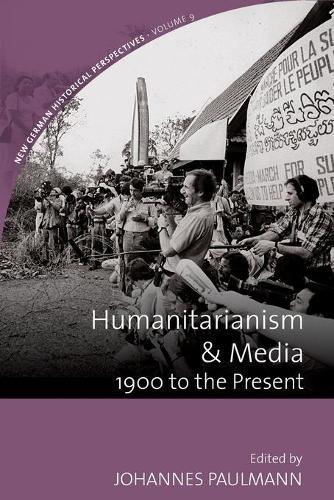
Full Product Details
Author: Johannes Paulmann
Publisher: Berghahn Books
Imprint: Berghahn Books
Volume: 9
ISBN: 9781789208085
ISBN 10: 1789208084
Pages: 316
Publication Date: 21 January 2020
Audience:
Professional and scholarly
,
Professional & Vocational
Format: Paperback
Publisher's Status: Active
Availability: In Print

This item will be ordered in for you from one of our suppliers. Upon receipt, we will promptly dispatch it out to you. For in store availability, please contact us.
Reviews
This very readable volume must be considered as an important contribution to a history of humanitarian activities. The contributors managed to use productively theories from media- and communication studies and, in addition, offer methodically fresh ideas for historical picture and film analysis. - H-Soz-Kult Nationalsocialst concentration camps and aerial warfare, famines during postcolonialism and the Spanish Civil War, all of which prevent comparable analysis for good reasons, remain separated because of borders, linguistic barriers or academic specialization, find here in pictures of the pain of others (Susan Sontag) their common point of reference. Not only specialists of human right (as well as Childhood Studies) and the history of photography would benefit from the thoughts and reflections offered here: in the age of visual communication this volume has set new standards. - Sehepunkte Based on substantial archival research and informed by relevant theoretical debates, this thought-provoking volume engages the reader in an interdisciplinary exploration of the central role the media have played for humanitarian initiatives, contributing significantly to recent scholarship on the subject . - Nina Berman, Arizona State University This volume consists of timely, useful, original contributions by historians, media scholars and anthropologists that will be essential reading for students . - Davide Rodogno, Graduate Institute of Geneva
Humanitarianism & Media proves to be a very insightful, well-written, and interesting book, which is recommendable to students and researchers involved in history and media and communication sciences in general, and the fields of humanitarianism, advocacy, journalism, and their intersections in particular. While the work does not really offer any completely new theories or concepts, it questions existing ones and lays an inspiring foundation for more in-depth, structural and critical historical research on the theme. * Communications This very readable volume must be considered as an important contribution to a history of humanitarian activities. The contributors managed to use productively theories from media- and communication studies and, in addition, offer methodically fresh ideas for historical picture and film analysis. * H-Soz-Kult Nationalsocialst concentration camps and aerial warfare, famines during postcolonialism and the Spanish Civil War, all of which prevent comparable analysis for good reasons, remain separated because of borders, linguistic barriers or academic specialization, find here in pictures of the pain of others (Susan Sontag) their common point of reference. Not only specialists of human right (as well as Childhood Studies) and the history of photography would benefit from the thoughts and reflections offered here: in the age of visual communication this volume has set new standards. * Sehepunkte Based on substantial archival research and informed by relevant theoretical debates, this thought-provoking volume engages the reader in an interdisciplinary exploration of the central role the media have played for humanitarian initiatives, contributing significantly to recent scholarship on the subject . * Nina Berman, Arizona State University This volume consists of timely, useful, original contributions by historians, media scholars and anthropologists that will be essential reading for students . * Davide Rodogno, Graduate Institute of Geneva
Author Information
Johannes Paulmann is Director of the Leibniz Institute of European History at Mainz (Germany). He was Richard von Weizsäcker Fellow 2014-15 at St Antony’s College, Oxford, and he edited Dilemmas of Humanitarian Aid in the Twentieth Century (2016).