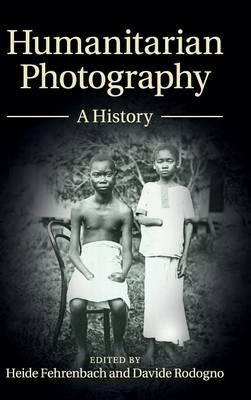
Full Product Details
Author: Heide Fehrenbach (Northern Illinois University) ,
Davide Rodogno
Publisher: Cambridge University Press
Imprint: Cambridge University Press
Dimensions:
Width: 15.20cm
, Height: 2.10cm
, Length: 22.90cm
Weight: 0.740kg
ISBN: 9781107064706
ISBN 10: 1107064708
Pages: 366
Publication Date: 23 February 2015
Audience:
Professional and scholarly
,
Professional & Vocational
Format: Hardback
Publisher's Status: Active
Availability: Manufactured on demand

We will order this item for you from a manufactured on demand supplier.
Reviews
Advance praise: 'This beautifully edited volume shows how absolutely central visual culture must be to our understanding of modern humanitarianism. Whether on atrocity, famine, or genocide, these essays explore photography's enduring power to shape the moral and political dynamics of international crises.' J. P. Daughton, Stanford University Advance praise: 'This collection of essays offers a most inspiring conceptualization of the use of photography for humanitarian purposes - for all historians in the burgeoning field of humanitarianism and related subjects as well as for those working in media studies. It enriches contemporary debates on humanitarian aid and humanitarian intervention, which have been and are still being strongly shaped by the visual representation of suffering and relief.' Johannes Paulmann, Director, Leibniz Institute of European History, Mainz Advance praise: 'The history of humanitarian aid and of humanitarianism is closely associated with the development of modern media, yet few have demonstrated critically the role of a technology or aesthetic approach like this tightly edited volume under the stewardship of Heide Fehrenbach and Davide Rodogno. This book is a pioneering and essential read for anyone interested in the growth and globalization of humanitarian consciousness. The images this book contains remain as disturbing and as shocking as they were intended to be decades ago, but the text sets them back in their context and tells their hidden stories. The book is essential reading for all historians of the twentieth century and today's humanitarians who now have to represent sufferings without losing their own soul.' Bertrand Taithe, Humanitarian and Conflict Response Institute, University of Manchester
'This beautifully edited volume shows how absolutely central visual culture must be to our understanding of modern humanitarianism. Whether on atrocity, famine, or genocide, these essays explore photography's enduring power to shape the moral and political dynamics of international crises.' J. P. Daughton, Stanford University 'This collection of essays offers a most inspiring conceptualization of the use of photography for humanitarian purposes - for all historians in the burgeoning field of humanitarianism and related subjects as well as for those working in media studies. It enriches contemporary debates on humanitarian aid and humanitarian intervention, which have been and are still being strongly shaped by the visual representation of suffering and relief.' Johannes Paulmann, Director, Leibniz Institute of European History, Mainz 'The history of humanitarian aid and of humanitarianism is closely associated with the development of modern media, yet few have demonstrated critically the role of a technology or aesthetic approach like this tightly edited volume under the stewardship of Heide Fehrenbach and Davide Rodogno. This book is a pioneering and essential read for anyone interested in the growth and globalization of humanitarian consciousness. The images this book contains remain as disturbing and as shocking as they were intended to be decades ago, but the text sets them back in their context and tells their hidden stories. The book is essential reading for all historians of the twentieth century and today's humanitarians who now have to represent sufferings without losing their own soul.' Bertrand Taithe, Humanitarian and Conflict Response Institute, University of Manchester 'The most important contribution of this volume is the development of a new historically useful concept with ramifications for the history of photography and, more broadly, for the visual history of the contemporary world ... By the end of the volume, readers will have gained a thorough historical overview of a distinct photographic practice, with case studies from Africa, Asia, the Middle East, Europe, and the United States.' Ana Maria Mauad, Society for U.S. Intellectual History, Book Reviews (https://s-usih.org/)
'This beautifully edited volume shows how absolutely central visual culture must be to our understanding of modern humanitarianism. Whether on atrocity, famine, or genocide, these essays explore photography's enduring power to shape the moral and political dynamics of international crises.' J. P. Daughton, Stanford University 'This collection of essays offers a most inspiring conceptualization of the use of photography for humanitarian purposes - for all historians in the burgeoning field of humanitarianism and related subjects as well as for those working in media studies. It enriches contemporary debates on humanitarian aid and humanitarian intervention, which have been and are still being strongly shaped by the visual representation of suffering and relief.' Johannes Paulmann, Director, Leibniz Institute of European History, Mainz 'The history of humanitarian aid and of humanitarianism is closely associated with the development of modern media, yet few have demonstrated critically the role of a technology or aesthetic approach like this tightly edited volume under the stewardship of Heide Fehrenbach and Davide Rodogno. This book is a pioneering and essential read for anyone interested in the growth and globalization of humanitarian consciousness. The images this book contains remain as disturbing and as shocking as they were intended to be decades ago, but the text sets them back in their context and tells their hidden stories. The book is essential reading for all historians of the twentieth century and today's humanitarians who now have to represent sufferings without losing their own soul.' Bertrand Taithe, Humanitarian and Conflict Response Institute, University of Manchester 'The most important contribution of this volume is the development of a new historically useful concept with ramifications for the history of photography and, more broadly, for the visual history of the contemporary world ... By the end of the volume, readers will have gained a thorough historical overview of a distinct photographic practice, with case studies from Africa, Asia, the Middle East, Europe, and the United States.' Ana Maria Mauad, Society for U.S. Intellectual History, Book Reviews (https://s-usih.org/) This beautifully edited volume shows how absolutely central visual culture must be to our understanding of modern humanitarianism. Whether on atrocity, famine, or genocide, these essays explore photography's enduring power to shape the moral and political dynamics of international crises. J. P. Daughton, Stanford University This collection of essays offers a most inspiring conceptualization of the use of photography for humanitarian purposes - for all historians in the burgeoning field of humanitarianism and related subjects as well as for those working in media studies. It enriches contemporary debates on humanitarian aid and humanitarian intervention, which have been and are still being strongly shaped by the visual representation of suffering and relief. Johannes Paulmann, Director, Leibniz Institute of European History, Mainz The history of humanitarian aid and of humanitarianism is closely associated with the development of modern media, yet few have demonstrated critically the role of a technology or aesthetic approach like this tightly edited volume under the stewardship of Heide Fehrenbach and Davide Rodogno. This book is a pioneering and essential read for anyone interested in the growth and globalization of humanitarian consciousness. The images this book contains remain as disturbing and as shocking as they were intended to be decades ago, but the text sets them back in their context and tells their hidden stories. The book is essential reading for all historians of the twentieth century and today's humanitarians who now have to represent sufferings without losing their own soul. Bertrand Taithe, Humanitarian and Conflict Response Institute, University of Manchester 'The most important contribution of this volume is the development of a new historically useful concept with ramifications for the history of photography and, more broadly, for the visual history of the contemporary world ... By the end of the volume, readers will have gained a thorough historical overview of a distinct photographic practice, with case studies from Africa, Asia, the Middle East, Europe, and the United States.' Ana Maria Mauad, Society for U.S. Intellectual History, Book Reviews (https://s-usih.org/)
Author Information
Heide Fehrenbach is Board of Trustees Professor and Distinguished Research Professor in the history department at Northern Illinois University. She is the author of three books: Cinema in Democratizing Germany, Race after Hitler: Black Occupation Children in Postwar Germany and America and After the Nazi Racial State: Difference and Democracy in Germany and Europe (with Rita Chin, Geoff Eley, and Atina Grossmann). She is also co-editor, with Uta Poiger, of Transactions, Transgressions, Transformations: American Culture in Western Europe and Japan (2000). Davide Rodogno is Professor of International History at the Graduate Institute of International and Developmental Studies in Geneva, Switzerland. His books include Fascism's European Empire, Against Massacre: Humanitarian Interventions in the Ottoman Empire, 1815-1914, and, as co-editor, Shaping the Transnational Sphere: Transnational Networks of Experts in the Long Nineteenth Century.