Overview
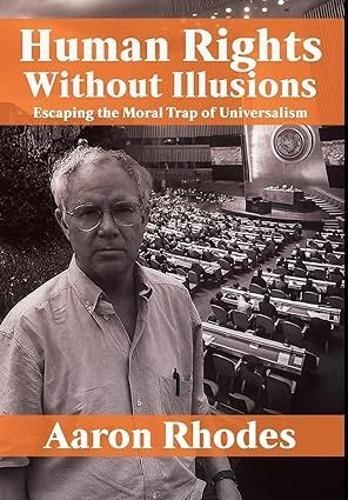
In Human Rights Without Illusions, leading human rights advocate Aaron Rhodes traces the political and religious traditions that have led to prioritizing consensus among diverse nations as a prerequisite for upholding universal principles. The modern, global human rights regime sits on the foundation of Hellenistic stoicism and medieval Christendom, where natural law morally unified all of humanity. Drawing upon subsequent efforts to implement a secularized law of nations as promulgated natural law, and inspired by political progressivism, the international human rights system initiated in 1948 envisions a process of moral transformation on the basis of bureaucratic cooperation with institutions of the United Nations. By contrast, the natural rights tradition reflects a different form of universalism, one that focuses on a common understanding of human nature rather than intergovernmental consensus. The philosophy of natural rights, as crystallized in the Enlightenment, is skeptical of international formations, holding that interactions between governments occur in a state of nature without any overarching authority. Therefore, protecting human rights is possible only in nation-states, where the rules of civil society are legally enforceable. That does not render futile a campaign for improving respect for human rights around the world, however. Rhodes considers defending human rights and freedoms to be a moral duty, but human rights advocacy needs to free itself from the inevitable corruption of institutionalized universalism. Rhodes argues instead for a “human rights without illusions” consistent with the classical liberal principles that inspired America’s Founding Fathers and shaped their belief that basic freedoms are realized in a bottom-up process, not a top-down one. Progress toward a spontaneous order of global human rights can be made if liberal societies project inherent freedom as a compelling moral principle, rather than subjecting it to legalistic rationalization and compromise in inclusive global institutions.
Full Product Details
Author: Aaron Rhodes
Publisher: Academica Press
Imprint: Academica Press
ISBN: 9781680533514
ISBN 10: 1680533517
Pages: 150
Publication Date: 31 August 2025
Audience:
Professional and scholarly
,
Professional & Vocational
Format: Hardback
Publisher's Status: Active
Availability: Manufactured on demand

We will order this item for you from a manufactured on demand supplier.
Reviews
""In Human Rights Without Illusions, Aaron Rhodes chronicles how the West's greatest political legacy--the notion of fundamental freedoms, grounded in natural law, Judeo-Christian ethics, and Enlightenment reason--has been corrupted and displaced by the modern counterfeit of political universalism. In exchange for its birthrights of liberty and virtue, the West embraced utopian visions that subordinate the individual to the demands of the state and a retinue of collectivist causes. With the crystalline prose and searing logic of a legal brief, Rhodes documents how ideas that emerged in and defined the West became the means of its own 'moral disarmament.' His book is a clarion call to reject the top-down universalism of Rousseau and Kant and re-embrace the legacy of Hobbes, Locke, Montesquieu, Adams and Burke. Anyone who wants an honest appraisal of what the West has forfeited, and a roadmap for how to set things back on the right track, should read this book.""- A. Wess Mitchell, former U.S. Assistant Secretary of State for European and Eurasian Affairs
Author Information
Aaron Rhodes was born and raised in the Southern Tier of New York State, where he attended a public school. He was further educated at Reed College and the University of Chicago, where he was awarded a Ph.D. in the Committee on Social Thought. After serving as Assistant to the President of Boston University, he worked on higher education reform projects in post-communist societies at the Institute for Human Sciences in Vienna. In 1993, Rhodes was named Executive Director of the International Helsinki Federation for Human Rights, a post he held until 2007. He was subsequently a co-founder of both the International Campaign for Human Rights in Iran and the Freedom Rights Project and was President of the Forum for Religious Freedom-Europe, from 2014 to 2025. Rhodes is the author of The Debasement of Human Rights (2018). His numerous articles and editorials have appeared in the Wall Street Journal, New York Times, Newsweek, Die Zeit, Law & Liberty, the National Interest, and elsewhere. The Republic of Austria made Rhodes an honorary citizen for his human rights work, and he has received the University of Chicago Alumni Association's Public Service Citation as ""one of the leading human rights activists in the world."" He lives in Hamburg, Germany with his family.