Overview
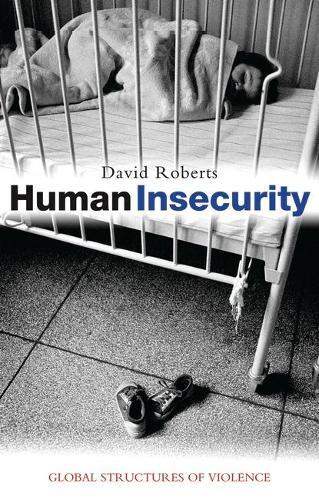
Human Insecurity is concerned with our refusal to confront the millions of avoidable deaths of women and children each year. Those missing millions are rarely the subject of conventional security studies, yet such avoidable deaths are a vital part of the notion of 'security' more broadly understood. The book argues that such deaths are caused by the man-made structures of neoliberalism and 'andrarchy' and argues that the debate on human security can be reinvigorated by looking at the unarmed, civilian role in causing the deaths of millions of innocent people; from child deaths from preventable disease to honour killings. David Roberts claims that by facing up to this relationship between social structures and massive avoidable human suffering we can create another system less prone to global violence. This book is a powerful intervention in the debate on human security and an urgent call to face up to our responsibilities to the millions killed needlessly each year.
Full Product Details
Author: David Roberts
Publisher: Bloomsbury Publishing PLC
Imprint: Zed Books Ltd
Dimensions:
Width: 13.80cm
, Height: 13.80cm
, Length: 21.60cm
Weight: 0.386kg
ISBN: 9781842778241
ISBN 10: 1842778242
Pages: 224
Publication Date: 30 November 2007
Audience:
College/higher education
,
Professional and scholarly
,
Tertiary & Higher Education
,
Professional & Vocational
Format: Hardback
Publisher's Status: Out of Stock Indefinitely
Availability: Out of stock

Reviews
'David Roberts makes a powerful plea for rethinking the notion of security. In the process, he not only lays siege to the intellectual structure of 'realism' but makes the compelling empirical case that until and when the world deals with the increasingly large gap between the few haves and the many have nots, it will remain a deeply disturbed place. A book that will hopefully provoke others - possibly even policy-makers - to reassess their views on the key questions facing the international system in the early part of the 21st century.' Michael Cox, London School of Economics and Political Science 'Roberts' work offers a careful and comprehensive re-reading of the contemporary security literature and offers us tragic, shocking, and ultimately avoidable, examples of the threats, fear and violence which affect humanity on a daily basis. As Roberts states more attention needs to be paid to 'why' such acts of violence occur on such a vast scale. This book makes an invaluable contribution to helping us answer that question.' Pauline Eadie, University of Nottingham 'Roberts has brought organized scholarship to a field of study in global politics, which deserves much attention. The principle contribution of this book comes from the detailed and wonderful explanation of the underlying causes of human security both in the developing as well as underdeveloped nations' 'This project entails a ray of hope for change, reconstruction, and above all, for peace.' Journal of Global Change and Governance
'David Roberts makes a powerful plea for rethinking the notion of security. In the process, he not only lays siege to the intellectual structure of 'realism' but makes the compelling empirical case that until and when the world deals with the increasingly large gap between the few haves and the many have nots, it will remain a deeply disturbed place. A book that will hopefully provoke others - possibly even policy-makers - to reassess their views on the key questions facing the international system in the early part of the 21st century.' Michael Cox, London School of Economics and Political Science 'Roberts' work offers a careful and comprehensive re-reading of the contemporary security literature and offers us tragic, shocking, and ultimately avoidable, examples of the threats, fear and violence which affect humanity on a daily basis. As Roberts' states more attention needs to be paid to 'why' such acts of violence occur on such a vast scale. This book makes an invaluable contribution to helping us answer that question.' Pauline Eadie, University of Nottingham 'Roberts has brought organized scholarship to a field of study in global politics, which deserves much attention. The principle contribution of this book comes from the detailed and wonderful explanation of the underlying causes of human security both in the developing as well as underdeveloped nations' 'This project entails a ray of hope for change, reconstruction, and above all, for peace.' - Journal of Global Change and Governance
Author Information
David Roberts is a lecturer in the School of History and International Affairs at the University of Ulster. He has previously published Power, Elitism and Democracy: Political Transition in Cambodia 1991-1999 (2000) and over thirty articles on human security; statebuilding; democratisation and Cambodia.