Overview
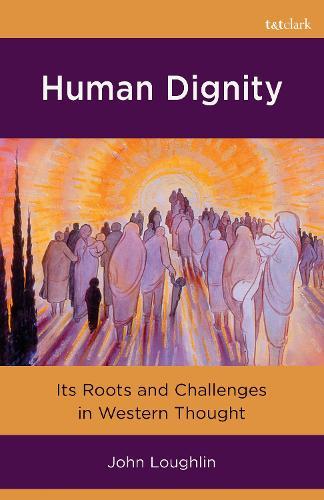
A bold reappraisal of the concept of human dignity through the lens of Catholic tradition. Drawing on the biblical notion that human beings are made in the image and likeness of God (Imago Dei), John Loughlin traces the development of this idea from antiquity to modernity. He examines key moments of continuity and rupture—from the Church Fathers to the Renaissance, the Reformation to Enlightenment secularism, and 20th-century renewal to today's contested bioethical landscape. Integrating theology, philosophy, and political thought, the book engages contemporary moral debates while presenting a constructive Catholic anthropology. This is a timely and provocative contribution for scholars, students, and general readers concerned with the future of human dignity in a fragmented world.
Full Product Details
Author: Professor John Loughlin (University of Oxford, UK)
Publisher: Bloomsbury Publishing PLC
Imprint: T.& T.Clark Ltd
Dimensions:
Width: 15.00cm
, Height: 1.30cm
, Length: 22.40cm
Weight: 0.360kg
ISBN: 9780567726407
ISBN 10: 0567726401
Pages: 256
Publication Date: 30 April 2026
Audience:
Professional and scholarly
,
Professional & Vocational
Format: Paperback
Publisher's Status: Forthcoming
Availability: To order

Reviews
At a time when answering the question of what it means to be human is more and more urgent, the idea of ‘human dignity’ is increasingly offered as an influential response, but what does it mean? John Loughlin’s book provides a welcome assessment of current debates on what the concept means from a Catholic perspective, tracing its origins in Imago Dei and its subsequent complex and contested history, through to contemporary debates on its meaning and functions. The book is a timely and penetrating reassessment of this critical concept from a scholar immersed in the diversity of Catholic thought but sensitive also to other religious and non-religious narratives that challenge that tradition. A tour de force. -- Christopher McCrudden * Professor of Human Rights and Equality Law, Queen's University, Belfast, Ireland * This work offers a panoramic vision of the Catholic understanding of human dignity, following the twists and turns in the intellectual and political history of some two millennia. It will make an excellent introduction to the field for students of political philosophy, jurisprudence and church history. The author has a gift for making clear the movements in human thought that intersect, for better or worse, with the Catholic teaching. -- Tracey Rowland * St. John Paul II Chair of Theology, University of Notre Dame (Australia) *
This work offers a panoramic vision of the Catholic understanding of human dignity, following the twists and turns in the intellectual and political history of some two millennia. It will make an excellent introduction to the field for students of political philosophy, jurisprudence and church history. The author has a gift for making clear the movements in human thought that intersect, for better or worse, with the Catholic teaching. * Tracey Rowland, St. John Paul II Chair of Theology, University of Notre Dame (Australia) *
Author Information
John Loughlin is a Senior Research Fellow of Blackfriars Hall, University of Oxford, an Emeritus Fellow of St Edmund’s College, University of Cambridge, and Emeritus Professor of Politics, Cardiff University. He previously held the Chair of European Politics at Cardiff and was an Affiliated Lecturer of Politics at the University of Cambridge. A former Cistercian monk, he has published volumes with Oxford University Press, Bloomsbury, and Routledge. He is a Fellow of the UK’s Academy of Social Sciences and of the Learned Society of Wales and has advised several European governments and international institutions.