Overview
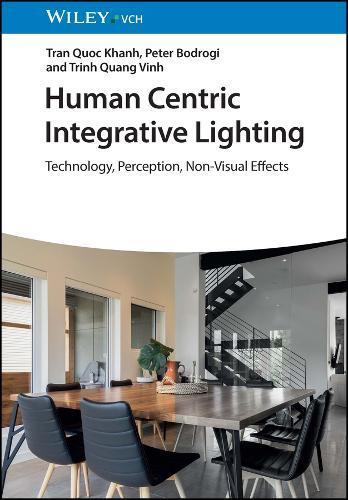
Human Centric Integrative Lighting Detailed presentation of the technical and non-technical aspects of modern lighting and its effect on humans Human Centric Integrative Lighting provides a highly comprehensive overview of the subject, also referred to as human-centered indoor lighting technology; taking a practice-oriented approach, scientific findings in the field are condensed into models that can be directly used by developers. Written by leading scientists in the field of lighting technology, Human Centric Integrative Lighting includes detailed information on: Fundamentals of lighting technology as it interacts with human perception and the current state of interior lighting today Basic principles of human centric integrative lighting and its various aspects, such as visual performance, color quality, emotional impact, and correlation of relevant parameters Comprehensive lighting quality models and subsequently derived recommendations for the practical implementation of concepts Relevant research findings from journals, patent specifications, and standards to provide a unified outlook on the field Providing a comprehensive overview of the current state of development in the field, Human Centric Integrative Lighting discusses validated physiological and psychological perceptual models on which manufacturers of lighting products and suppliers of lighting technology solutions can base key design and development decisions. lighting products; lighting technology solutions; lighting design; lighting development; human-centered indoor lighting technology; lighting color quality; lighting principles; lighting emotional impact; lighting quality; lighting research
Full Product Details
Author: Tran Quoc Khanh (TU Darmstadt, Germany) , Peter Bodrogi (ERCO GmbH, Germany) , Trinh Quang Vinh (TU Darmstadt, Germany)
Publisher: Wiley-VCH Verlag GmbH
Imprint: Blackwell Verlag GmbH
Dimensions:
Width: 17.00cm
, Height: 3.10cm
, Length: 24.40cm
Weight: 0.992kg
ISBN: 9783527414000
ISBN 10: 3527414002
Pages: 496
Publication Date: 30 August 2023
Audience:
Professional and scholarly
,
Professional & Vocational
Format: Hardback
Publisher's Status: Active
Availability: Out of stock 
The supplier is temporarily out of stock of this item. It will be ordered for you on backorder and shipped when it becomes available.
Table of Contents
1. INTRODUCTION History of Lighting Engineering Illuminating Engineering: Technological Challenges and Relevance to Society Aims and Motivations of the Present Book 2. FUNDAMENTALS OF LIGHTING ENGINEERING - VISUAL AND NON-VISUAL ASPECTS The Human Eye Basic Quantities of Lighting Engineering: V(Lambda) Function, 2° and 10° Colour Matching Functions, Basics of Colorimetry, Colour Spaces, Colour Appearance Models, Colour Rendition Indices, Colour Gamut Non-Visual Aspects: CIE 2015, DIN Spec 5031-100, Spectral Sensitivity Functions for Melanopsin, Melatonin Suppression According to Brainard and Thapan The Metrics Amel According to DIN Spec 5031-100 Receptor Signals According to CIE 2018 Aging of the Human Eye According to DIN 5031-10 3. CONVENTIONAL INTERIOR LIGHTING PRINCIPLES Design Recommendations According to CIE and DIN EN 12464 Lighting Quality Criteria, Specifications About Cri, Glare, Modelling Index, Homogeneity, Luminous Efficacy, Shifts of White Point, Illuminance, Luminance 4. HCL PRINCIPLES FOR INTERIOR LIGHTING What Is HCL: Definition with Three Components (Visual Performance, Psychological-Emotional Aspects and Non-Visual Aspects) Visual and Non-Visual Mechanisms Input and Output Parameters of the HCL System Influencing Factors of the Effect of Light on Humans (Time of the Day, Time of the Year, Weather, Age, Gender) from the Lighting Engineer's Point of View 5. VISUAL PERFORMANCE Visual Performance with the V(Lambda) Function: Relative Visual Performance (RVP) Model, Luminance Contrast, Reaction Time, Effect of Age Modern Aspects of Brightness and Visual Clarity: New Experiments About Brightness and Visual Clarity, Models of Brightness and Visual Clarity, Comparison of Brightness Models 6. COLOUR QUALITY AND EMOTIONAL ASPECTS Colour Quality: Colour Quality and Chroma Enhancement, Visual Experiments in a Viewing Booth and in a Real Room, Modelling of Colour Quality, Modelling of Colour Quality According to Luo, Houser, Wei, Royer, Effect of Red Oversaturation Preferred White Points Preferred Correlated Colour Temperatures Preferred Ranges of Colour Temperature and Illuminance 7. CORRELATION ANALYSIS OF THE NUMERIC METRICS OF HCL Mathematical Analysis of the Correlations Between the Three Groups of Metrics: Visual Performance, Colour Quality Metrics and the Descriptors of Non-Visual Effects the Um Numeric Method (Um1-Um2) Characterizing the Usefulness of Light Sources Correlation Between Brightness Metrics and Cs 8. NEW MODELS OF LIGHTING QUALITY FOR VISUAL AND NON-VISUAL EFFECTS New Models of Lighting Quality of the Tu Darmstadt 2019 Predicting Visual Clarity, Colour Preference and Scene Preference from Illuminance Level, Correlated Colour Temperature, Circadian Stimulus and A Measure of Object Chroma Enhancement 9. CAUSE-EFFECT RELATIONSHIPS IN HUMAN CENTRIC LIGHTING Evaluation of HCL Literature from 1990 Until Today Analysis and Summary of Field Studies About HCL in Offices, Schools, Hospitals, Industrial Lighting and the Practice of Light Therapy Identification of Relevant Cause-Effect Relationships Recommendations for Practical Lighting Engineering Design 10. PRACTICAL LIGHT MEASUREMENT METHODS FOR HCL APPLICATIONS Computational Method for the Value of the Circadian Stimulus (Cs) from Conventional Illuminance, Tristimulus and Correlated Colour Temperature Measurements Personal Dosimetry: Measurement of Cs with Colorimeters Spatially Resolved Light Measurements in Interior Space 11. DAYLIGHT Exterior Measurements - Spectral Distribution of Radiation As A Function of Time of the Day and Time of the Year Dynamics, Colorimetric and Circadian Characteristics Effect of Daylight on Sleeping Quality, Alertness and Vitality Detection and Reconstruction of Daylight Daylight Compensation in Interior Space in Case of Different Weather Conditions Studies Investigating the Effect of the Possibility of Seeing Exterior Space Through Windows 12. HCL TECHNOLOGY IN BUILDINGS Full Spectrum and Sunlight Spectrum: A Spectral Analysis Spectral Optimisation for Best Colour Quality and Optimum Total HCL Effect Smart Lighting, Connectivity Principles of Data Semantics to Process Different Formats to Achieve A Unique Computational Method in Cloud Servers Network Architecture to Integrate Luminaire Systems with Other Building Systems Building Sensor Technology: Co2 Sensors, Light and Colour Sensors, Motion Sensors, Ir Sensor Array, Weather Data User Preference of Temperature and Air Quality in Interior Spaces Dynamic Light and Lighting Control in Buildings 13. SUMMARY AND OUTLOOK
Reviews
Author Information
Tran Quoc Khanh is University Professor and Head of the Laboratory of Adaptive Lighting Systems and Visual Processing at TU Darmstadt in Darmstadt, Germany. He received his PhD in Lighting Engineering from the TU Ilmenau, Germany. He received his Degree of Lecture Qualification (Habilitation) from the same university for his in colorimetry and color image processing. He gained industrial experience as a project manager at ARRI CineTechnik in München (Germany). Tran Quoc Khanh has authored and co-authored numerous scientific publications and invented several patents in various fields of lighting technology. Peter Bodrogi was a Senior Research Fellow at the Laboratory of Adaptive Lighting Systems and Visual Processing at the TU Darmstadt in Darmstadt, Germany. He now works for the ERCO GmbH in Lüschenscheid, Germany, in the field of lighting engineering. He received his PhD in Information Technology. He obtained his postdoctoral qualification at the TU Darmstadt for his thesis on the optimization of modern visual technologies. He is co-author of numerous scientific publications and holds patents in the field of self-luminous display technology and lighting technology. Trinh Quang Vinh is a Senior Research Fellow at the Laboratory of Adaptive Lighting Systems and Visual Processing at TU Darmstadt in Darmstadt, Germany. He received his M.Sc. degree in control engineering. He obtained his Dr.-Ing. degree from TU Darmstadt in 2013. His research topic is the complex mathematical modeling of high-power (phosphor-converted) LEDs, including their electrical, thermal, and optical behavior, as well as their light and color quality. He is co-author of several scientific publications and holds patents in the field of LED lighting technology.
Tab Content 6
Author Website:
Countries Available
All regions
|