Overview
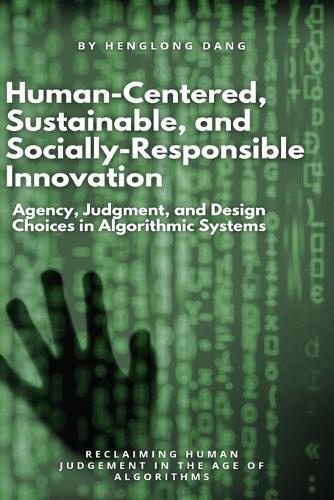
This book is a provocative and timely exploration of the ""Great Outsourcing""-the moment humanity stands on the precipice of surrendering its most vital faculty: judgment. As we move from using machines as simple tools to treating them as decision-making partners, we are entering what author Henglong Dang calls the ""Algorithmic Eclipse,"" where the cold efficiency of code begins to shade the warm autonomy of the human spirit. A Roadmap for the Human Signature This is not a Luddite rejection of technology, but a sophisticated reclaiming of human agency. Human-Centered, Sustainable, and Socially-Responsible Innovation challenges the narrative of ""automated perfection"" and asks the uncomfortable questions that leaders, designers, and citizens can no longer ignore: Is ""Assistance"" Quietly Becoming Authority? Explore how subtle ""nudges,"" default settings, and ranked lists steer professional choices long before a human ever clicks a button. The Myth of the ""Human in the Loop"" Why being the ""final signature"" on a machine-generated report doesn't make you the ""final thinker""-and how humans are being used as ""moral crumple zones"" for system errors. Decision Atrophy: What happens to professional expertise when the ""muscles"" of critical thinking are no longer practiced?. Designing for Dissent: Learn why the future of innovation requires ""friction-heavy"" systems that invite disagreement rather than blind compliance. A Living Proof of Concept In a stunning meta-cognitive twist, the book itself is a performance of its own thesis. Forged through a human-AI partnership, it serves as a ""symbiotic wisdom"" demonstration. The machine provided the data synthesis and linguistic articulation, while the human provided the moral compass, lived experience, and qualitative framework. It proves that technology, when steered by a firm human hand, does not replace the author-it amplifies the intent. Who Is This For? Whether you are a leader navigating the ethics of AI adoption, a designer building the next generation of interfaces, or a thinker concerned about the erosion of choice in a system-mediated world, this book offers a dense, demanding, and deliberately deep roadmap back to yourself. Stop asking what machines can do. Start asking what they cause us to stop doing. The most important decision you will make today is the decision to think for yourself. Welcome to the architecture of your own choice. Introducing the Author Henglong Dang is a researcher working at the intersection of Artificial Intelligence, Human-Computer Interaction (HCI), and AI ethics. As a Strategic Operations Lead at DFDraw Lab, and a member of the Association for the Advancement of Artificial Intelligence (AAAI), he operates across academic, organizational, and conceptual domains, challenging the traditional boundaries of age, discipline, and authority. His work centers on how algorithmic systems reshape meaning, trust, and intellectual infrastructure. He is the founder of Synaperge (""where synapses converge""), a platform for public-facing scholarship and collaborative innovation, and his independent research has been accepted at major conferences and published in open-access scientific venues. From UX design theory to semantic drift in large language models, his contributions reflect a core preoccupation: not what machines can do, but what they cause us to stop doing. You may follow Henglong Dang's LinkedIn profile: https: //www.linkedin.com/in/henglongdang/
Full Product Details
Author: Henglong Dang
Publisher: Independently Published
Imprint: Independently Published
Dimensions:
Width: 15.20cm
, Height: 1.40cm
, Length: 22.90cm
Weight: 0.349kg
ISBN: 9798248682874
Pages: 258
Publication Date: 17 February 2026
Audience:
General/trade
,
General
Format: Paperback
Publisher's Status: Active
Availability: Available To Order

We have confirmation that this item is in stock with the supplier. It will be ordered in for you and dispatched immediately.