Overview
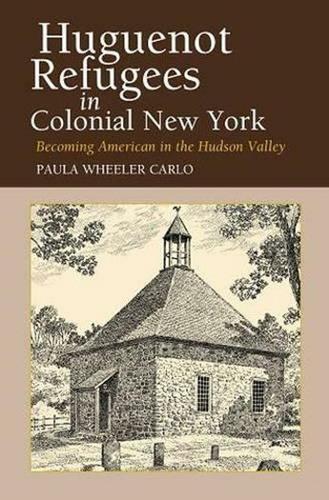
Drawing comparisons with the broader Huguenot diaspora, this book reassesses the prevailing view that Huguenots in North America quickly conformed to Anglicanism and abandoned the French language and other distinctive characteristics in order to assimilate into Anglo-American culture. Although the standard interpretation may still be true for Huguenots in heterogeneous urban communities, it should be modified for Huguenots in ethnically and religiously homogeneous rural settlements like New Paltz and New Rochelle, where the process was more akin to a gradual acculturation.
Full Product Details
Author: Paula Wheeler Carlo
Publisher: Liverpool University Press
Imprint: Liverpool University Press
Dimensions:
Width: 15.20cm
, Height: 1.50cm
, Length: 22.90cm
Weight: 0.412kg
ISBN: 9781845190606
ISBN 10: 1845190602
Pages: 280
Publication Date: 17 September 2007
Audience:
General/trade
,
General
Format: Paperback
Publisher's Status: Active
Availability: In Print

This item will be ordered in for you from one of our suppliers. Upon receipt, we will promptly dispatch it out to you. For in store availability, please contact us.
Reviews
Paula Wheeler Carlo has produced a concise, richly detailed, and thoroughly researched account of rural New York Huguenots that gives us a more nuanced understanding of this groups role in colonial America Essential reading for anyone studying the Huguenot experience in colonial America, and an important reminder that much of rural colonial America consisted of ethnic and religious communities that resisted, with varying degrees of success, the forces of homogenisation. -- Journal of American History Carlo observes a gradual process of acculturation in these two rural areas not a quick assimilation and bases her observation on the continued use of French in the private sphere, such as manuscript sermons, church records, and business and family records. Chapters on family structure, inheritance patterns (testators in both communities adhered to French and Dutch practices rather than English), slaveholding, and the run-up to the Revolution (both were pro-Independence) are full of interesting detail that places these two communities squarely into the context of other colonial communities, while also establishing some differences. -- De Halve Maen a much needed contribution to the historiography of North American Huguenot communities which have rarely been studied in such detail. Carlos original and thorough study of these two New York Huguenot communities is a welcome addition to the growing yet still small body of academic literature on the Refuge in British North America. Her thesis of gradual and incomplete assimilation, which parallels findings in South Carolina, is compelling. -- Proceedings of The Huguenot Society
Paula Wheeler Carlo has produced a concise, richly detailed, and thoroughly researched account of rural New York Huguenots that gives us a more nuanced understanding of this groups role in colonial America Essential reading for anyone studying the Huguenot experience in colonial America, and an important reminder that much of rural colonial America consisted of ethnic and religious communities that resisted, with varying degrees of success, the forces of homogenisation. -- Journal of American History Carlo observes a gradual process of acculturation in these two rural areas not a quick assimilation and bases her observation on the continued use of French in the private sphere, such as manuscript sermons, church records, and business and family records. Chapters on family structure, inheritance patterns (testators in both communities adhered to French and Dutch practices rather than English), slaveholding, and the run-up to the Revolution (both were pro-Independence) are full of interesting detail that places these two communities squarely into the context of other colonial communities, while also establishing some differences. -- De Halve Maen a much needed contribution to the historiography of North American Huguenot communities which have rarely been studied in such detail. Carlos original and thorough study of these two New York Huguenot communities is a welcome addition to the growing yet still small body of academic literature on the Refuge in British North America. Her thesis of gradual and incomplete assimilation, which parallels findings in South Carolina, is compelling. -- Proceedings of The Huguenot Society
Author Information
Paula Wheeler Carlo is Assistant Professor of History at Nassau Community College, State University of New York. Her doctoral dissertation received the 2001 book award from the National Huguenot Society. In 2003 she was given a Faculty Distinguished Achievement Award from Nassau Community College and in 2004 she received the prestigious State University of New York Chancellor's Award for Excellence in Teaching.