Overview
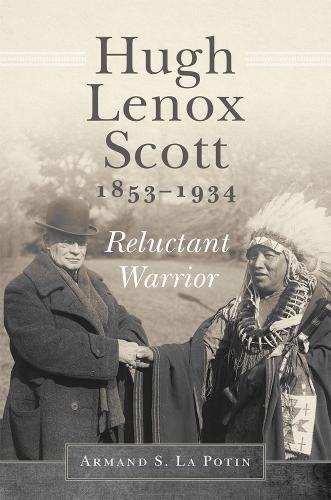
A newly minted second lieutenant fresh from West Point, Hugh Lenox Scott arrived on the northern Great Plains in the wake of the Little Bighorn debacle. The Seventh Cavalry was seeking to subdue the Plains tribes and confine them to reservations, and Scott adopted the role of negotiator and advocate for the Indian “adversaries.” He thus embarked on a career unique in the history of the U.S. military and the western frontier. Hugh Lenox Scott, 1853-1934: Reluctant Warrior is the first book to tell the full story of this unlikely, self-avowed “soldier of peace,” whose career, stretching from Little Bighorn until after World War I, reflected profound historical changes. The taste for adventure that drew Scott to the military also piqued his interest in the tenacity of Native cultures in an environment rife with danger and uncertainty. Armand S. La Potin describes how Scott embraced the lifeways of the Northern Plains peoples, making a study of their cultures, their symbols, and most notably, their use of an intertribal sign language to facilitate trade. Negotiating with dissident bands of Indians whose lands were threatened by Anglo settlers and commercial interests, he increasingly found himself advocating federal responsibility for tribal welfare and assuming the role of “Indian reformer.” La Potin makes clear that “reform” was understood within the context of Scott’s own culture, which scaled “civilization” to the so-called Anglo race. Accordingly, Scott promoted the “civilization” of Native Americans through assimilation into Anglo-American society-an approach he continued in his later interactions with the Moro Muslims of the southern Philippines, where he served as a military governor. Although he eventually rose to the rank of army chief of staff, over time Scott the peacemaker and Indian reformer saw his career stall as Native tribes ceased to be seen as a military threat and military merit was increasingly defined by battlefield experience. From these pages the picture emerges of an uncommon figure in American military history, at once at odds with and defined by his times.
Full Product Details
Author: Armand S. La Potin
Publisher: University of Oklahoma Press
Imprint: University of Oklahoma Press
Dimensions:
Width: 15.20cm
, Height: 2.00cm
, Length: 22.80cm
Weight: 0.333kg
ISBN: 9780806175744
ISBN 10: 0806175745
Pages: 290
Publication Date: 09 September 2021
Audience:
Professional and scholarly
,
General/trade
,
Professional & Vocational
,
General
Format: Hardback
Publisher's Status: Active
Availability: Manufactured on demand

We will order this item for you from a manufactured on demand supplier.
Reviews
La Potin gives us a good look at the man and his career within his times, and also gives us profiles of many of the people with whom he worked; Native Americans and Anglo-Americans. Hugh Lenox Scott is a very good account of a very unusual soldier. --Strategy Page Soldier, ethnologist, bureaucrat, and diplomat. Scott was a man of many talents. This is a well-researched and fluently written book that should appeal to anyone interested in the Old Army of the frontier. --Western Writers of America, The Roundup The career of Major General Hugh Lenox Scott is one of the most remarkable among America's frontier officers. Armand S. La Potin has written a wonderful biography of this amazing soldier and diplomat. --John H. Monnett, author of Tell Them We Are Going Home: The Odyssey of the Northern Cheyennes Through this masterful biography, La Potin offers a prism for understanding the transformation of a nation and an army. Hugh Lenox Scott's evolution as a soldier and human being mirrored the turmoil and complexities confronting the United States as it embarked on a troubled path toward empire. --James Leiker, author of The Northern Cheyenne Exodus in History and Memory
The career of Major General Hugh Lenox Scott is one of the most remarkable among America's frontier officers. Armand S. La Potin has written a wonderful biography of this amazing soldier and diplomat. --John H. Monnett, author of Tell Them We Are Going Home: The Odyssey of the Northern Cheyennes Through this masterful biography, La Potin offers a prism for understanding the transformation of a nation and an army. Hugh Lenox Scott's evolution as a soldier and human being mirrored the turmoil and complexities confronting the United States as it embarked on a troubled path toward empire. --James Leiker, author of The Northern Cheyenne Exodus in History and Memory
""La Potin has written an important biography of Hugh Lenox Scott, a little-remembered military officer whose service during the Gilded Age and Progressive Era contributed to the creation of a modern army and the popular image of the Western frontier. He demonstrates well why Scott deserves to be remembered, and while his story is often of a path not taken, Scott's character and ideas will merit further consideration in the coming years.""--Nebraska History ""La Potin's notes reveal the breadth of research and resources undertaken for this work, her wealth of knowledge, and her care for the topic that makes this story so enticing...The complex life of Hugh Lenox Scott has been masterfully used here to illuminate the evolution of American domestic and foreign policy at the turn of the twentieth century.""--South Dakota History ""La Potin gives us a good look at the man and his career within his times, and also gives us profiles of many of the people with whom he worked; Native Americans and Anglo-Americans. Hugh Lenox Scott is a very good account of a very unusual soldier.""--Strategy Page ""Soldier, ethnologist, bureaucrat, and diplomat. Scott was a man of many talents. This is a well-researched and fluently written book that should appeal to anyone interested in the Old Army of the frontier.""--Western Writers of America, The Roundup ""The career of Major General Hugh Lenox Scott is one of the most remarkable among America's frontier officers. Armand S. La Potin has written a wonderful biography of this amazing soldier and diplomat.""--John H. Monnett, author of Tell Them We Are Going Home: The Odyssey of the Northern Cheyennes ""Through this masterful biography, La Potin offers a prism for understanding the transformation of a nation and an army. Hugh Lenox Scott's evolution as a soldier and human being mirrored the turmoil and complexities confronting the United States as it embarked on a troubled path toward empire.""--James Leiker, author of The Northern Cheyenne Exodus in History and Memory
Soldier, ethnologist, bureaucrat, and diplomat. Scott was a man of many talents. This is a well-researched and fluently written book that should appeal to anyone interested in the Old Army of the frontier. --Western Writers of America, The Roundup The career of Major General Hugh Lenox Scott is one of the most remarkable among America's frontier officers. Armand S. La Potin has written a wonderful biography of this amazing soldier and diplomat. --John H. Monnett, author of Tell Them We Are Going Home: The Odyssey of the Northern Cheyennes Through this masterful biography, La Potin offers a prism for understanding the transformation of a nation and an army. Hugh Lenox Scott's evolution as a soldier and human being mirrored the turmoil and complexities confronting the United States as it embarked on a troubled path toward empire. --James Leiker, author of The Northern Cheyenne Exodus in History and Memory
Author Information
Armand S. La Potin is Professor Emeritus of History at the State University of New York College at Oneonta and the author of Native American Voluntary Organizations.