Overview
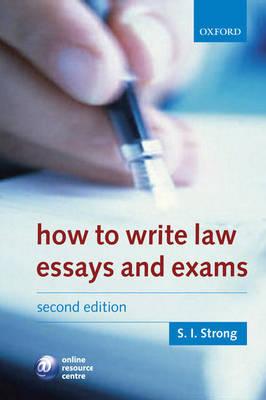
""How to Write Law Essays and Exams"" provides law students with a practical and proven method of analysing and answering essay and exam questions. The book focuses on those questions that give students the most trouble, namely problem questions, but its techniques are equally applicable to other types of essays. Designed for law students of all levels, including those on A-level, university, conversion, and vocational courses, the text helps students understand their substantive courses, while at the same time teaching vital writing and analytical skills. In addition to providing a framework for analysing and writing law essays, the book teaches students how to identify relevant legal authorities, distinguish and harmonise conflicting legal precedents and evaluate the applicability of the law to the facts of the question at hand. The book also contains specific law-related revision techniques and general writing tips. Numerous worked examples help students avoid common errors, while a dedicated chapter on professional practice helps ease the transition to pupillage and traineeships. The tried and tested techniques contained in this book have increased numerous students' understanding and enjoyment of their law courses, while simultaneously improving their marks. The Online Resource Centre includes student resources, which provide a discussion of different citation styles and referencing; a breakdown of a case; and also answers to frequently asked questions.
Full Product Details
Author: S. I. Strong
Publisher: Oxford University Press
Imprint: Oxford University Press
Edition: 2nd Revised edition
Dimensions:
Width: 15.60cm
, Height: 1.50cm
, Length: 23.40cm
Weight: 0.403kg
ISBN: 9780199287550
ISBN 10: 0199287554
Pages: 272
Publication Date: 01 April 2006
Audience:
College/higher education
,
Undergraduate
Replaced By: 9780199533572
Format: Paperback
Publisher's Status: Active
Availability: To order

Stock availability from the supplier is unknown. We will order it for you and ship this item to you once it is received by us.
Reviews
Review of the first edition: There really is no other book that addresses so completely the issues tackled in this one. Many Question and Answer books will give subject-based guidance on how to tackle certain topics, but this book provides a tactical approach which can be adapted to fit virtually any type of legal problem or essay. An essential book for the library and, arguably, for all first year student's reading lists.' --The Law Quarterly Review<br>
Review of the first edition There really is no other book that addresses so completely the issues tackled in this one. Many Question and Answer books will give subject-based guidance on how to tackle certain topics, but this book provides a tactical approach which can be adapted to fit virtually any type of legal problem or essay. An essential book for the library and, arguably, for all first year student's reading lists.' --The Law Quarterly Review Review of the first edition: There really is no other book that addresses so completely the issues tackled in this one. Many Question and Answer books will give subject-based guidance on how to tackle certain topics, but this book provides a tactical approach which can be adapted to fit virtually any type of legal problem or essay. An essential book for the library and, arguably, for all first year student's reading lists.' --The Law Quarterly Review Review of the first edition: There really is no other book that addresses so completely the issues tackled in this one. Many Question and Answer books will give subject-based guidance on how to tackle certain topics, but this book provides a tactical approach which can be adapted to fit virtually any type of legal problem or essay. An essential book for the library and, arguably, for all first year student's reading lists.' --The Law Quarterly Review Review of the first edition: There really is no other book that addresses so completely the issues tackled in this one. Many Question and Answer books will give subject-based guidance on how to tackle certain topics, but this book provides a tactical approach which can be adapted to fit virtually any type of legal problem or essay. An essential book for the library and, arguably, for all first year student's reading lists.' --The Law Quarterly Review Review of the first edition: There really is no other book that addresses so completely the issues tackled in this one. Many Question and Answer books will give subject-based guidance on how to tackle certain topics, but this book provides a tactical approach which can be adapted to fit virtually any type of legal problem or essay. An essential book for the library and, arguably, for all first year student's reading lists.' --The Law Quarterly Review
"Review of the first edition: ""There really is no other book that addresses so completely the issues tackled in this one. Many ""Question and Answer"" books will give subject-based guidance on how to tackle certain topics, but this book provides a tactical approach which can be adapted to fit virtually any type of legal problem or essay. An essential book for the library and, arguably, for all first year student's reading lists.'""--The Law Quarterly Review"
Author Information
Dr S I Strong has over ten years' experience teaching law at the Universities of Oxford and Cambridge, and practising as a solicitor in London and as an attorney in New York and Chicago. Dr Strong has additional experience as an editor and as a teacher of writing, and holds numerous awards for her writing and legal analysis, including the Yorke Prize for outstanding doctoral dissertation from the University of Cambridge. Dr Strong currently acts as counsel with Baker & McKenzie LLP, where she specializes in resolving international commercial disputes.