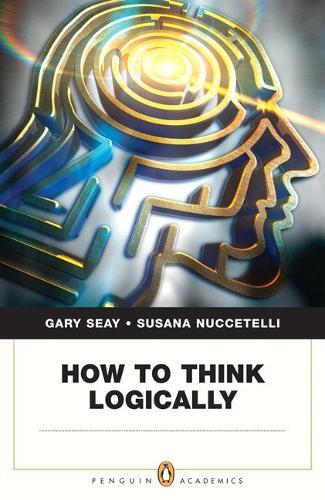
How to Think Logically

Author:   Gary Seay ,  Susana Nuccetelli
Publisher:   Pearson Education (US)
ISBN:  

9780321337771


Pages:   592
Publication Date:   07 September 2007
Replaced By:   9780205154982
Format:   Paperback
Availability:   In Print   Availability explained
Limited stock is available. It will be ordered for you and shipped pending supplier's limited stock.

Our Price $90.29 Quantity:  
Add to Cart

Share |

How to Think Logically


Overview

This concise, affordable, and engaging new text is designed for introductory courses on logic and critical thinking.  This unique book covers the basic principles of informal logic while also raising substantive issues in other areas of philosophy: epistemology, ethics, philosophy of language, and philosophy of science.     The author’s presentation strikes a careful balance: it offers clear, jargon-free writing while preserving rigor.  Brimming with numerous pedagogical features this accessible text assists students with analysis, reconstruction, and evaluation of arguments and helps them become independent, analytical thinkers.  Introductory students are exposed to the basic principles of reasoning while also having their appetites whetted for future courses in philosophy.  

Full Product Details

Author:   Gary Seay ,  Susana Nuccetelli
Publisher:   Pearson Education (US)
Imprint:   Pearson
Dimensions:   Width: 20.90cm , Height: 2.20cm , Length: 13.40cm
Weight:   0.533kg
ISBN:  

9780321337771


ISBN 10:   0321337778
Pages:   592
Publication Date:   07 September 2007
Audience:   Professional and scholarly ,  Professional & Vocational
Replaced By:   9780205154982
Format:   Paperback
Publisher's Status:   Out of Print
Availability:   In Print   Availability explained
Limited stock is available. It will be ordered for you and shipped pending supplier's limited stock.

Table of Contents

  Preface Acknowledgments About the Authors     PART I: THE BUILDING BLOCKS OF REASONING    CHAPTER ONE What Is Logical Thinking? And Why Should We Care?    1.1       The Study of Reasoning                         Inference or Argument 1.2       Logic and Reasoning                         Dimensions of the Subject                         Formal Logic                         Informal Logic                         EXERCISES 1.3       Arguments and Non-Arguments 1.4         Argument Analysis                         Reconstructing and Evaluating Arguments                         Identifying Premises and Conclusion                         Premise and Conclusion Indicators                         Arguments with No Premise or Conclusion Indicator                         EXERCISES 1.5       The Philosopher’s Corner                         What is Philosophical About All This                         EXERCISES                         WRITING PROJECT 1.6       Chapter Summary 1.7       Key Words   CHAPTER TWO Thinking Logically and Speaking One’s Mind  2.1       Rational Acceptability                         Logical Connectedness                         Evidential Support                         Truth and Evidence 2.2       Beyond Rational Acceptability                         Linguistic Merit                         Retorical Power                         Rhetoric vs. Logical Thinking                         EXERCISES 2.3       From Belief to Statement                         Propositions 2.4       Uses of Language                         Types of Sentence                         Declarative Sentences 2.5       Indirect and Non-Literal Language                         Indirect Language                         Non-Literal Language                         EXERCISES 2.6       The Philosopher’s Corner                         The Study of Language and Its Dimensions                         Type and Token                         Use and Mention                         EXERCISES                         WRITING PROJECT 2.7       Chapter Summary 2.8       Key Words   CHAPTER THREE The Virtues of Belief  3.1       Belief, Disbelief, and Non-Belief                         EXERCISES 3.2       Beliefs’ Virtues and Vices 3.3       Accuracy and Truth                         Accuracy and Inaccuracy                         Truth and Falsity 3.4       Reasonableness                         Empirical and Conceptual Reasonableness 3.5       Consistency                         Defining `Consistency’ and `Inconsistency’                         Logically Possible Propositions                         Logically Impossible Propositions                         Consistency and Possible Worlds                         Consistency in Logical Thinking 3.6       Conservatism and Revisability                         Conservatism Without Dogmatism                         Revisability Without Relativism 3.7       Rationality vs. Irrationality                         EXERCISES 3.8       The Philosopher’s Corner                         Evaluative Reasons                         EXERCISES                         WRITING PROJECT 3.9       Chapter Summary 3.10     Key Words   PART II: REASON AND ARGUMENT   CHAPTER FOUR Tips for Argument Analysis 4.1       A Principled Way of Reconstructing Arguments                         Faithfulness                         Charity                         When Faithfulness and Charity Conflict 4.2       Missing Premises 4.3       Extended Arguments                         EXERCISES 4.4       Types of Reason and Types of Argument                         Deductive vs. Inductive Arguments 4.5       Evaluative Arguments with Missing Premises                         Evaluative Arguments                         Moral Arguments and Moral Principles                         Implicit Evaluative Premises                         EXERCISES 4.6       The Philosopher’s Corner                         Can `Ought’ Follow Deductively from `Is’? Hume’s Position                         Searle’s Reply                         EXERCISES                         WRITING PROJECT 4.7       Chapter Summary 4.8       Key Words   CHAPTER FIVE Evaluating Deductive Arguments  5.1       Valid Arguments                         `Validity’ as a Technical Term                         EXERCISES                         Some Valid Propositional Argument Forms                         Some Valid Syllogistic Argument Forms                         The Cash Value of Validity                         EXERCISES 5.2       Sound vs. Unsound Arguments                         The Cash Value of Soundness 5.3       Cogent vs. Non-Cogent Arguments                         The Cash Value of Cogency                         EXERCISES 5.4       The Philosopher’s Corner                         Deductive Arguments and the A Priori/A Posteriori Distinction                         EXERCISES                         WRITING PROJECT 5.5       Chapter Summary 5.6       Key Words    CHAPTER SIX Analyzing Inductive Arguments  6.1       Reconstructing Inductive Arguments                         What Is an Inductive Argument? 6.2       Some Types of Inductive Argument                         Enumerative Induction                         Statistical Syllogism                         Causal Argument                         Analogy                         EXERCISES 6.3       Evaluating Inductive Arguments                         Inductive Reliability                         Inductive Strength                         EXERCISES 6.4       The Philosopher’s Corner                         Is Natural Science Inductive?                         EXERCISES                         WRITING PROJECT 6.5       Chapter Summary 6.6       Key Words   PART III: INFORMAL FALLACIES   CHAPTER SEVEN Some Ways an Argument Can Fail  7.1       What Is a Fallacy? 7.2       Classification of Informal Fallacies 7.3       When Inductive Arguments Go Wrong                         Hasty Generalization                         Weak Analogy                         False Cause                         Appeal to Ignorance                         Appeal to Unqualified Authority                         EXERCISES 7.4       The Philosopher’s Corner                         Appeal to Ignorance in Philosophical Arguments                         EXERCISES                         WRITING PROJECT 7.5       Chapter Summary 7.6       Key Words   CHAPTER EIGHT Avoiding Ungrounded Assumptions  8.1       Fallacies of Presumption 8.2       Begging the Question                         Circular Reasoning                         The Burden of Proof 8.3       Begging-the-Question-Against                         EXERCISES 8.4       Complex Question 8.5       False Alternatives 8.6       Accident                         EXERCISES 8.7       The Philosopher’s Corner                         Is the Open Question Argument Viciously Circular?                         EXERCISES                         WRITING PROJECT 8.8       Chapter Summary 8.9       Key Words   CHAPTER NINE From Unclear Language to Unclear Reasoning 9.1       Unclear Language and Argument Failure 9.2       Semantic Unclarity 9.3       Vagueness                         The Sorites Paradox                         The Slippery Slope Fallacy 9.4       Ambiguity                         Equivocation                         Amphiboly 9.5       Confused Predication                         Composition                         Division 9.6       Antidote to Unclear Language: Semantic Definitions                         Reportive Definitions                         The Method of Counterexample                         Ostensive and Contextual Definitions 9.7       The Philosopher’s Corner                         Real Definitions                         Philosophical Analysis                         EXERCISES                         WRITING PROJECT 9.8       Chapter Summary 9.9       Key Words   CHAPTER TEN Avoiding Irrelevant Premises   10.1     Fallacies of Relevance 10.2     Appeal to Pity 10.3     Appeal to Force 10.4     Appeal to Emotion                         The Bandwagon Appeal                         Appeal to Vanity 10.5     Ad Hominem                         The Abusive Ad Hominem                         Tu Quoque                         Non-Fallacious Ad Hominem 10.6     Beside the Point 10.7     Straw Man                         EXERCISES 10.8     The Philosopher’s Corner                         Is the Appeal to Emotion Always Fallacious?                         EXERCISES                         WRITING PROJECT 10.9     Chapter Summary 10.10   Key Words   PART IV: MORE ON DEDUCTIVE REASONING   CHAPTER ELEVEN Compound Propositions    11.1     Argument as a Relation Between Propositions 11.2     Simple and Compound Propositions                         Negation                         Conjunction                         Disjunction                         Material Conditional                         Material Biconditional 11.3     A Closer Look at Compound Propositions                         Punctuation Symbols                         Well-Formed Formulas                         EXERCISES 11.4     Defining Connectives with Truth Tables 11.5     Truth Tables for Compound Propositions 11.6     Logically Necessary and Logically Contingent Propositions                         Tautologies                         Contradictions                         Contingencies                         EXERCISES 11.7     The Philosopher’s Corner                         Tautologies and Other Necessary Propositions                         EXERCISES                         WRITING PROJECT 11.8     Chapter Summary 11.9     Key Words   CHAPTER TWELVE Checking the Validity of Propositional Arguments  12.1     Checking Validity with Truth Tables                         EXERCISES 12.2     Reviewing Some Standard Argument Forms                         Modus Ponens                         Modus Tollens                         Contraposition                         Hypothetical Syllogism                         Disjunctive Syllogism                         EXERCISES 12.3     Formal Fallacies                         Affirming the Consequent                         Denying the Antecedent                         Affirming a Disjunct                         EXERCISES 12.4     An Informal Approach to Proofs of Validity                         The Basic Rules                         What Is a Proof of Validity                         How to Construct a Proof of Validity                         Proofs vs. Truth Tables                         EXERCISES 12.5     The Philosopher’s Corner                         Reductio ad Absurdum Arguments                         Reductio in Philosophy                         EXERCISES                         WRITING PROJECT 12.6     Chapter Summary 12.7     Key Words   CHAPTER THIRTEEN Categorical Propositions    13.1     What Is a Categorical Proposition?                         Categorical Propositions                         Standard Form Categorical Propositions                         Non-Standard Categorical Propositions                         EXERCISES 13.2     Venn Diagrams for Categorical Propositions                         EXERCISES 13.3     The Square of Opposition                         The Traditional Square of Opposition                         Existential Import                         The Modern Square of Opposition                         EXERCISES 13.4     Other Immediate Inferences                         Conversion                         Obversion                         Contraposition                         EXERCISES 13.5     The Philosopher’s Corner                         Generalization and the Appeal to Counterexample                         EXERCISES                         WRITING PROJECT 13.6     Chapter Summary 13.7     Key Words   CHAPTER FOURTEEN Categorical Syllogisms  14.1     What Is a Categorical Syllogism                         Recognizing Categorical Syllogisms 14.2     Mood and Figure                         EXERCISES 14.3     Testing for Valid ity with Venn Diagrams                         EXERCISES 14.4     Distribution of Terms 14.5     Rules of Validity and Fallacies                         EXERCISES 14.6     The Philosopher’s Corner                         Standard Syllogisms and Singular Propositions                         EXERCISES                         WRITING PROJECT 14.7     Chapter Summary 14.8     Key Words   Appendix: Summary of Informal Fallacies Answers to Selected Exercises Glossary/Index

Reviews

Author Information

Gary Seay has taught logic at the City University of New York since 1979 and is currently Associate Professor of Philosophy at Medgar Evers College. He is the author of journal articles on moral philosophy and bioethics. With Susana Nuccetelli, he is the editor of Latin American Philosophy (Prentice Hall, 2004).   Susana Nuccetelli is Associate Professor of Philosophy at St. Cloud State University in Minnesota. She is editor of New Essays on Semantic Externalism and Self-Knowledge (MIT Press, 2003) and author of many journal articles on epistemology and philosophy of language. She has also written on Latin American philosophy.

Tab Content 6

Author Website:  

Countries Available

All regions
Latest Reading Guide

NOV RG 20252


Shopping Cart
Your cart is empty
Shopping cart
Mailing List