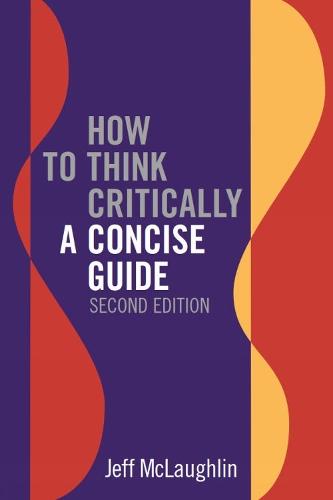
Full Product Details
Author: Jeff McLaughlin
Publisher: Broadview Press Ltd
Imprint: Broadview Press Ltd
Edition: 2nd Revised edition
Dimensions:
Width: 15.20cm
, Height: 1.40cm
, Length: 22.90cm
Weight: 0.441kg
ISBN: 9781554815333
ISBN 10: 1554815339
Pages: 294
Publication Date: 18 August 2023
Audience:
Professional and scholarly
,
Professional & Vocational
Format: Paperback
Publisher's Status: Active
Availability: Available To Order

We have confirmation that this item is in stock with the supplier. It will be ordered in for you and dispatched immediately.
Reviews
“How to Think Critically is an ideal book for introductory critical thinking courses. Jeff McLaughlin recognizes that the academic study of reasoning is new to most students and that it can prove to be daunting and difficult. He embraces the challenge of presenting philosophical concepts and methods to beginner audiences and succeeds in making the material accessible without compromising rigor and detail.” — Glen Baier, University of the Fraser Valley Comments on the 1st Edition “Jeff McLaughlin’s How to Think Critically covers all of the topics important for introductory courses in Critical Thinking, and it does so without bogging down the reader or instructor with extraneous material. The examples and illustrations will, I believe, resonate well with students, and, in particular, with students at Canadian universities. I look forward to using this text the next time I offer Critical Thinking.” — G.K.D. Crozier, Laurentian University “How to Think Critically is a very good text. It is clear and comprehensive and includes an abundance of examples. It provides a plausible and sensible take on arguments as they really do occur.” — Michael Stack, University of Manitoba “McLaughlin’s book is clearly written and infused with an engaging sense of humour that sustains interest in a subject area that too often is presented in a dry and uninteresting fashion. McLaughlin uses pedagogically sound techniques and strategies to build competency and confidence in thinking critically.” — Jill Hunter, Athabasca University
"COMMENTS on the 1st Edition ""Jeff McLaughlin's How to Think Critically covers all of the topics important for introductory courses in Critical Thinking, and it does so without bogging down the reader or instructor with extraneous material. The examples and illustrations will, I believe, resonate well with students, and, in particular, with students at Canadian universities. I look forward to using this text the next time I offer Critical Thinking."" -- G.K.D. Crozier, Laurentian University ""How to Think Critically is a very good text. It is clear and comprehensive and includes an abundance of examples. It provides a plausible and sensible take on arguments as they really do occur."" -- Michael Stack, University of Manitoba ""McLaughlin's book is clearly written and infused with an engaging sense of humour that sustains interest in a subject area that too often is presented in a dry and uninteresting fashion. McLaughlin uses pedagogically sound techniques and strategies to build competency and confidence in thinking critically."" -- Jill Hunter, Athabasca University"
COMMENTS on the 1st Edition Jeff McLaughlin's How to Think Critically covers all of the topics important for introductory courses in Critical Thinking, and it does so without bogging down the reader or instructor with extraneous material. The examples and illustrations will, I believe, resonate well with students, and, in particular, with students at Canadian universities. I look forward to using this text the next time I offer Critical Thinking. -- G.K.D. Crozier, Laurentian University How to Think Critically is a very good text. It is clear and comprehensive and includes an abundance of examples. It provides a plausible and sensible take on arguments as they really do occur. -- Michael Stack, University of Manitoba McLaughlin's book is clearly written and infused with an engaging sense of humour that sustains interest in a subject area that too often is presented in a dry and uninteresting fashion. McLaughlin uses pedagogically sound techniques and strategies to build competency and confidence in thinking critically. -- Jill Hunter, Athabasca University
Reviews on the First Edition: “Jeff McLaughlin’s How to Think Critically covers all of the topics important for introductory courses in Critical Thinking, and it does so without bogging down the reader or instructor with extraneous material. The examples and illustrations will, I believe, resonate well with students, and, in particular, with students at Canadian universities. I look forward to using this text the next time I offer Critical Thinking.” - G.K.D. Crozier, Laurentian University “How to Think Critically is a very good text. It is clear and comprehensive and includes an abundance of examples. It provides a plausible and sensible take on arguments as they really do occur.” - Michael Stack, University of Manitoba “McLaughlin’s book is clearly written and infused with an engaging sense of humour that sustains interest in a subject area that too often is presented in a dry and uninteresting fashion. McLaughlin uses pedagogically sound techniques and strategies to build competency and confidence in thinking critically.” - Jill Hunter, Athabasca University
Author Information
Jeff McLaughlin is Professor of Philosophy at Thompson Rivers University.