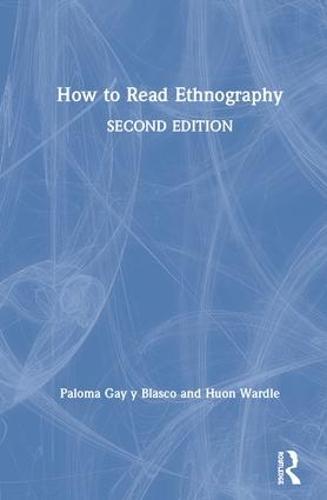
Full Product Details
Author: Paloma Gay Blasco (University of St. Andrews, UK) ,
Huon Wardle
Publisher: Taylor & Francis Ltd
Imprint: Routledge
Edition: 2nd edition
Weight: 0.520kg
ISBN: 9781138126244
ISBN 10: 1138126241
Pages: 234
Publication Date: 24 April 2019
Audience:
College/higher education
,
Tertiary & Higher Education
,
Undergraduate
Format: Hardback
Publisher's Status: Active
Availability: In Print

This item will be ordered in for you from one of our suppliers. Upon receipt, we will promptly dispatch it out to you. For in store availability, please contact us.
Reviews
'This is a fine book and a superb guide for students reading ethnographic texts. Drawing upon a judicious sampling of ethnographies from many epochs and parts of the world, the authors succeed brilliantly in disclosing the complex character if every essay in human understanding, as well as inspiring anthropologists to ponder the notion of comparison in radically new ways.' Michael D. Jackson, Harvard University, USA 'With veritable cartographic genius, the authors lead us across the fascinating terrain of ethnography and its diverse interlocuters. This second edition moves some important new horizons into sight. As surefooted and perspicacious as ever, the way our guides have us pause to take bearings on the journey gives fresh impetus to teaching and learning.' Marilyn Strathern, University of Cambridge, UK 'There is a major and dominant image of anthropology presenting it as the result of a sequence of progressive and ascending stages (fieldwork, ethnography, anthropological theory) toward a `science of mankind'. How to Read Ethnography documents, analyses, and exposes another image of the discipline - minor, interstitial, and much more interesting: the practice of anthropology as a movement of continuous and reversible variations between the dimensions of a knowledge that can only be built at the crossroads of what we learn in the field and what we read in the library.' Marcio Goldman, Federal University of Rio de Janeiro, Brazil
'This is a fine book and a superb guide for students reading ethnographic texts. Drawing upon a judicious sampling of ethnographies from many epochs and parts of the world, the authors succeed brilliantly in disclosing the complex character of every essay in human understanding, as well as inspiring anthropologists to ponder the notion of comparison in radically new ways.' Michael D. Jackson, Harvard University, USA 'With veritable cartographic genius, the authors lead us across the fascinating terrain of ethnography and its diverse interlocuters. This second edition moves some important new horizons into sight. As surefooted and perspicacious as ever, the way our guides have us pause to take bearings on the journey gives fresh impetus to teaching and learning.' Marilyn Strathern, University of Cambridge, UK 'There is a major and dominant image of anthropology, presenting it as the result of a sequence of progressive and ascending stages (fieldwork, ethnography, anthropological theory) toward a `science of mankind'. How to Read Ethnography documents, analyses, and exposes another image of the discipline - minor, interstitial, and much more interesting: the practice of anthropology as a movement of continuous and reversible variations between the dimensions of a knowledge that can only be built at the crossroads of what we learn in the field and what we read in the library.' Marcio Goldman, Federal University of Rio de Janeiro, Brazil
This is a fine book and a superb guide for students reading ethnographic texts. Drawing upon a judicious sampling of ethnographies from many epochs and parts of the world, the authors succeed brilliantly in disclosing the complex character if every essay in human understanding, as well as inspiring anthropologists to ponder the notion of comparison in radically new ways Michael D. Jackson, Harvard University, USA With veritable cartographic genius, the authors lead us across the fascinating terrain of ethnography and its diverse interlocuters. This second edition moves some important new horizons into sight. As surefooted and perspicacious as ever, the way our guides have us pause to take bearings on the journey gives fresh impetus to teaching and learning. Marilyn Strathern, University of Cambridge, UK There is a major and dominant image of anthropology presenting it as the result of a sequence of progressive and ascending stages (fieldwork, ethnography, anthropological theory) toward a `science of mankind'. How to Read Ethnography documents, analyses, and exposes another image of the discipline - minor, interstitial, and much more interesting: the practice of anthropology as a movement of continuous and reversible variations between the dimensions of a knowledge that can only be built at the crossroads of what we learn in the field and what we read in the library. Marcio Goldman, Federal University of Rio de Janeiro, Brazil
Author Information
Paloma Gay y Blasco is a Senior Lecturer in Social Anthropology at the University of St Andrews, UK. Huon Wardle is a Senior Lecturer in Social Anthropology and Director of the Centre for Cosmopolitan Studies at the University of St Andrews, UK.