Overview
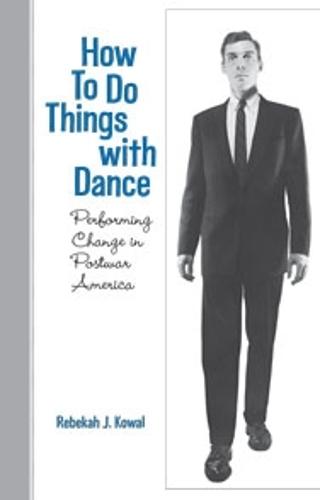
In postwar America, any assertion of difference from the mainstream anticommunist culture carried professional and personal risks. For this reason, modern dance artists left much of what they thought unsaid. Instead they expressed themselves in movement. How To Do Things with Dance positions modern dance as a vital critical discourse, and suggests that dances of the late 1940s and the 1950s can be seen as compelling agents of social change. Concentrating on choreographers whose artistic work conceived dance in terms of action, Rebekah J. Kowal shows how specific choreographic projects demonstrated increasing awareness of the stage as a penetrable space, one on which socially suspect or marginalized modes of being could be performed with relative impunity and exerted in the real world. Artists covered include Martha Graham, José Limón, Anna Sokolow, Katherine Dunham, Pearl Primus, Merce Cunningham, Paul Taylor, Donald McKayle, Talley Beatty, and Anna Halprin.
Full Product Details
Author: Rebekah J Kowal
Publisher: Wesleyan University Press
Imprint: Wesleyan University Press
Dimensions:
Width: 15.20cm
, Height: 3.00cm
, Length: 22.90cm
Weight: 0.662kg
ISBN: 9780819568977
ISBN 10: 081956897
Pages: 348
Publication Date: 01 September 2010
Audience:
Professional and scholarly
,
Professional & Vocational
Format: Hardback
Publisher's Status: Out of Print
Availability: In Print

Limited stock is available. It will be ordered for you and shipped pending supplier's limited stock.
Reviews
(T)his book is an important read for the dance community at large. --Bernadine Jennings, Attitude: The Dancer's Magazine
As a vibrant blend of dance history and cultural context, this study offers precisely the sort of deep yet broad analysis I hope my students will emulate. --Jessica Van Oort, Dance Chronicle
. ..Kowal nails it: she discusses Merce Cunningham, Paul Taylor, Anna Sokolow, and others in intriguing art/social/political/sexual contexts. Highly recommended. --T.K. Hagood, Choice Dance Research Journal Montreal Hour The Drama Review Theatre Journal It is exemplary in its scholarship, historical method, and originality. Above all, it speaks of a historical period and, in the way that it considers the period, exemplifies dance history research at its best. ... Kowal's daring scholarship illuminates a period now a half century distant, and, in doing so, she says much about the continuing possibilities that dance offers. --Michael Huxley Dance Research Journal (12/1/2012 12:00:00 AM) A stimulating scholarly book blending U.S. history and an engaged active arts practice... --Philip Szporer Montreal Hour (12/16/2010 12:00:00 AM) The premise of the book is fascinating. ... It would be a shame if this book were only seen as a contribution to the field of Dance Studies and not also within American Studies. --Kate Elswit The Drama Review (9/1/2012 12:00:00 AM) Kowal's claim that dance did not simply represent change taking place elsewhere but actually enacted change is a compelling argument that choreographers and dance scholars will want to invoke when challenging the marginalization of dance.--Claire Croft Theatre Journal (5/1/2011 12:00:00 AM) As a vibrant blend of dance history and cultural context, this study offers precisely the sort of deep yet broad analysis I hope my students will emulate. --Jessica Van Oort, Dance Chronicle .. .Kowal nails it: she discusses Merce Cunningham, Paul Taylor, Anna Sokolow, and others in intriguing art/social/political/sexual contexts. Highly recommended. --T.K. Hagood, Choice (T)his book is an important read for the dance community at large. --Gernadine Jennings, Attitude: The Dancer's Magazine Kowal's claim that dance did not simply represent change taking place elsewhere but actually enacted change is a compelling argument that choreographers and dance scholars will want to invoke when challenging the marginalization of dance. --Claire Croft, Theatre Journal As a vibrant blend of dance history and cultural context, this study offers precisely the sort of deep yet broad analysis I hope my students will emulate. Jessica Van Oort, Dance Chronicle ...Kowal nails it: she discusses Merce Cunningham, Paul Taylor, Anna Sokolow, and others in intriguing art/social/political/sexual contexts. Highly recommended. T.K. Hagood, Choice The premise of the book is fascinating. ... It would be a shame if this book were only seen as a contribution to the field of Dance Studies and not also within American Studies. Kate Elswit, The Drama Review A stimulating scholarly book blending U.S. history and an engaged active arts practice Philip Szporer, Montreal Hour It is exemplary in its scholarship, historical method, and originality. Above all, it speaks of a historical period and, in the way that it considers the period, exemplifies dance history research at its best. Kowal's daring scholarship illuminates a period now a half century distant, and, in doing so, she says much about the continuing possibilities that dance offers. Michael Huxley, Dance Research Journal
Author Information
REBEKAH J. KOWAL is an associate professor of dance at the University of Iowa. She has published articles in TDR (The Journal of Performance Studies) and The Returns of Alwin Nikolais: Bodies, Boundaries and the Dance Canon, edited by Randy Martin and Claudia Gitelman (Wesleyan, 2007). Kowal won the 2008 Gertrude Lippincott Award from Society of Dance History Scholars for her article on Pearl Primus, a version of which appears in How to Do Things with Dance.