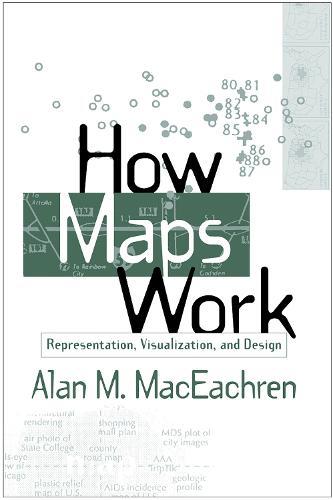
Full Product Details
Author: Alan M. MacEachren (Pennsylvania State University, United States)
Publisher: Guilford Publications
Imprint: Guilford Publications
Edition: 2nd Revised edition
Dimensions:
Width: 15.20cm
, Height: 3.20cm
, Length: 22.90cm
Weight: 0.784kg
ISBN: 9781572300408
ISBN 10: 157230040
Pages: 513
Publication Date: 19 August 2004
Audience:
College/higher education
,
Undergraduate
Format: Paperback
Publisher's Status: Active
Availability: Manufactured on demand

We will order this item for you from a manufactured on demand supplier.
Reviews
This clearly is an important book....This is a thoughtful and thought-provoking intellectual treatise on the role of graphic representation in human perception, cognition, visualization, and communication. Although the vehicle for this journey is the geographic map, you will learn a great deal about yourself and your interaction with the environment along the way....Should help guide environmental mapping creatively and productively into the exciting age of visualization. -- URISA Journal <br> I used the book in a graduate seminar series....The book created a fabric for discussion which was rich enough and broad enough to support extensive and intensive scrutiny....Would I use the book in another graduate seminar? Absolutely. I recommend it to mapping-science and GIS professionals, to scientists working in computer vision, to everyone whose work involves creation of, or inference about, representations of spatial information. -- Environment and Planning B: Planning and Design (review by Barbara P. Buttenfield) <br> The book is well produced and extensively illustrated. -- Mapping Awareness <br>
Should be required reading for anyone making maps.--C. E. Tiedemann, University of Illinois at Chicago Alan MacEachren has made a significant and important contribution to our understanding of cartography. The map is as old as societies themselves and is a fundamental building block of human knowledge. This book should be mandatory reading for all those interested in the role of maps in the emerging information era.--D. R. F. Taylor, past president, International Cartographic Association I believe this book to be a milestone in the literature of cartography. There have been texts on the history, on the production/design and to aid the teaching of maps and mapping but there has never been such a comprehensive and balanced examination of maps as tools....With its rich array of subtopics, levels of treatment and specialized sections worthy of deep quarrying, and also its extensive and fascinating range of illustrations, I believe that this book can command a wide and varied readership. It will certainly become a foundation stone in my own teaching and research library.--Michael Wood, Centre for Remote Sensing and Mapping Science, Department of Geography, University of Aberdeen, Scotland In looking at maps as spatial representations that stimulate other spatial representations, Alan MacEachren provides an insightful and coherent examination of the cognitive mechanisms underlying map reading and map analysis. How Maps Work is a tour de force for academic cartography and other fields concerned with perceptual, cognitive, and metaphysical aspects of spatial information--a masterful synthesis of interest to anyone curious about the map as a unique and valuable tool for exploration, discovery, and hypothesis testing.--Mark Monmonier, Department of Geography, Syracuse University - This clearly is an important book....A thoughtful and thought-provoking intellectual treatise on the role of graphic representation in human perception, cognition, visualization, and communication. Although the vehicle for this journey is the geographic map, you will learn a great deal about yourself and your interaction with the environment along the way. --URISA Journal, 6/23/2004ff I used the book in a graduate seminar series....The book created a fabric for discussion which was rich enough and broad enough to support extensive and intensive scrutiny....I recommend it to mapping science and GIS professionals, to scientists working in computer vision, to everyone whose work involves creation of, or inference about, representations of spatial information. --Environment and Planning B: Planning and Design, 6/23/2004
Should be required reading for anyone making maps.--C. E. Tiedemann, University of Illinois at Chicago Alan MacEachren has made a significant and important contribution to our understanding of cartography. The map is as old as societies themselves and is a fundamental building block of human knowledge. This book should be mandatory reading for all those interested in the role of maps in the emerging information era.--D. R. F. Taylor, past president, International Cartographic Association I believe this book to be a milestone in the literature of cartography. There have been texts on the history, on the production/design and to aid the teaching of maps and mapping but there has never been such a comprehensive and balanced examination of maps as tools....With its rich array of subtopics, levels of treatment and specialized sections worthy of deep quarrying, and also its extensive and fascinating range of illustrations, I believe that this book can command a wide and varied readership. It will certainly become a foundation stone in my own teaching and research library.--Michael Wood, Centre for Remote Sensing and Mapping Science, Department of Geography, University of Aberdeen, Scotland In looking at maps as spatial representations that stimulate other spatial representations, Alan MacEachren provides an insightful and coherent examination of the cognitive mechanisms underlying map reading and map analysis. How Maps Work is a tour de force for academic cartography and other fields concerned with perceptual, cognitive, and metaphysical aspects of spatial information--a masterful synthesis of interest to anyone curious about the map as a unique and valuable tool for exploration, discovery, and hypothesis testing.--Mark Monmonier, Department of Geography, Syracuse University -This clearly is an important book....A thoughtful and thought-provoking intellectual treatise on the role of graphic representation in human perception, cognition, visualization, and communication. Although the vehicle for this journey is the geographic map, you will learn a great deal about yourself and your interaction with the environment along the way.--URISA Journal, 6/23/2004ffI used the book in a graduate seminar series....The book created a fabric for discussion which was rich enough and broad enough to support extensive and intensive scrutiny....I recommend it to mapping science and GIS professionals, to scientists working in computer vision, to everyone whose work involves creation of, or inference about, representations of spatial information.--Environment and Planning B: Planning and Design, 6/23/2004
Should be required reading for anyone making maps. --C. E. Tiedemann, University of Illinois at Chicago Alan MacEachren has made a significant and important contribution to our understanding of cartography. The map is as old as societies themselves and is a fundamental building block of human knowledge. This book should be mandatory reading for all those interested in the role of maps in the emerging information era. --D. R. F. Taylor, past president, International Cartographic Association I believe this book to be a milestone in the literature of cartography. There have been texts on the history, on the production/design and to aid the teaching of maps and mapping but there has never been such a comprehensive and balanced examination of maps as tools....With its rich array of subtopics, levels of treatment and specialized sections worthy of deep quarrying, and also its extensive and fascinating range of illustrations, I believe that this book can command a wide and varied readership. It will certainly become a foundation stone in my own teaching and research library. --Michael Wood, Centre for Remote Sensing and Mapping Science, Department of Geography, University of Aberdeen, Scotland In looking at maps as spatial representations that stimulate other spatial representations, Alan MacEachren provides an insightful and coherent examination of the cognitive mechanisms underlying map reading and map analysis. How Maps Work is a tour de force for academic cartography and other fields concerned with perceptual, cognitive, and metaphysical aspects of spatial information--a masterful synthesis of interest to anyone curious about the map as a unique and valuable tool for exploration, discovery, and hypothesis testing. --Mark Monmonier, Department of Geography, Syracuse University
Should be required reading for anyone making maps. --C. E. Tiedemann, University of Illinois at Chicago Alan MacEachren has made a significant and important contribution to our understanding of cartography. The map is as old as societies themselves and is a fundamental building block of human knowledge. This book should be mandatory reading for all those interested in the role of maps in the emerging information era. --D. R. F. Taylor, past president, International Cartographic Association I believe this book to be a milestone in the literature of cartography. There have been texts on the history, on the production/design and to aid the teaching of maps and mapping but there has never been such a comprehensive and balanced examination of maps as tools....With its rich array of subtopics, levels of treatment and specialized sections worthy of deep quarrying, and also its extensive and fascinating range of illustrations, I believe that this book can command a wide and varied readership. It will certainly become a foundation stone in my own teaching and research library. --Michael Wood, Centre for Remote Sensing and Mapping Science, Department of Geography, University of Aberdeen, Scotland In looking at maps as spatial representations that stimulate other spatial representations, Alan MacEachren provides an insightful and coherent examination of the cognitive mechanisms underlying map reading and map analysis. How Maps Work is a tour de force for academic cartography and other fields concerned with perceptual, cognitive, and metaphysical aspects of spatial information--a masterful synthesis of interest to anyone curious about the map as a unique and valuable tool for exploration, discovery, and hypothesis testing. --Mark Monmonier, Department of Geography, Syracuse University
Author Information
Alan M. MacEachren is currently Professor of Geography and Director of the GeoVISTA Center at The Pennsylvania State University. In addition to researching cognitive and semiotic aspects of how maps work, he is active in the development of interactive systems for geographic visualization and in understanding and enabling group work with geospatial information and technologies. He is the author of Some Truth with Maps and coeditor of Visualization in Modern Cartography.