Overview
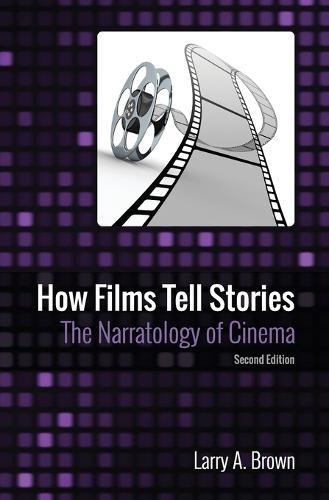
"""How Films Tell Stories"" (2nd ed.) presents a concise and engaging introduction to the narrative strategies of cinema. In part one, Aspects of Story, major theories of plot structure, character, and fictional worlds are applied to cinema. Part two, Aspects of Discourse, discusses how the story is communicated, examining techniques of cinematic narration such as time manipulation, perspective, cinematography, editing, and sound. Each chapter concludes with questions encouraging readers to produce their own analyses of the narrative strategies of films. A supplemental website provides video links to many of the film scenes discussed in the book."
Full Product Details
Author: Larry a Brown
Publisher: Creative Arts Press
Imprint: Creative Arts Press
Edition: 2nd ed.
Dimensions:
Width: 13.30cm
, Height: 1.20cm
, Length: 20.30cm
Weight: 0.240kg
ISBN: 9781945527142
ISBN 10: 1945527145
Pages: 226
Publication Date: 23 March 2018
Audience:
General/trade
,
General
Format: Paperback
Publisher's Status: Active
Availability: Available To Order

We have confirmation that this item is in stock with the supplier. It will be ordered in for you and dispatched immediately.
Reviews
In this much needed teaching tool, Larry Brown distills the best of narratology, strips it of jargon, overcomes its polemics, and shows how exciting an approach it can provide to film. But film in return has a lot to teach narratology, as the second part demonstrates. Far from reducing filmic discourse to the categories defined for written narrative fiction, this study eloquently demonstrates its medium-specific properties. ... Reading this book was pure pleasure. Marie-Laure Ryan, narratology scholar and author/editor of Storyworlds across Media (2014) As a long-time Hollywood film editor, I've seldom had the inclination to return to the academic evaluation of filmmaking that I left behind at UCLA nearly 40 years ago. But when Professor Brown asked me to look at his new book How Films Tell Stories, I found myself fascinated by his dissection of ideas I'd either taken for granted or never really analyzed in the day-to-day application of editing. Dr. Brown's presentation is not only scholarly; it turns academic analysis into a great read for anyone interested in storytelling. Robert Gordon, film editor of The Blue Lagoon (1980) and Toy Story (1995) Larry A. Brown's How Films Tell Stories is a highly readable introduction to film narratology. The book is designed for students who are interested in the question of how to apply narratology in the context of the analysis of movies. How Films Tell Stories covers all the important meaning-making elements of film: individual events, plot structures, the characters, the represented worlds, issues of chronology, the film's overall perspective (including captions, voice-over narration, the so-called 'cinematic narrator, ' focalization, and unreliable narration), the process of editing, and also does justice to the active role of the reader or viewer. Brown is particularly good at illustrating the usefulness of narratology on the basis of examples of well-known Hollywood movies. The book is rather well-designed from a didactic perspective: each chapter is followed by a list of questions for analysis that invite the readers of the book to check whether they understand - and are able to apply - the introduced concepts. Finally, How Films Tell Stories does justice to the affordances of the medium of film: it shows how the auditory and visual signs used by movies shape the worlds they evoke and thus the stories they tell. Jan Alber, Aarhus Institute of Advanced Studies and author of Unnatural Narrative: Impossible Worlds in Fiction and Drama (2016)
"""In this much needed teaching tool, Larry Brown distills the best of narratology, strips it of jargon, overcomes its polemics, and shows how exciting an approach it can provide to film. But film in return has a lot to teach narratology, as the second part demonstrates. Far from reducing filmic discourse to the categories defined for written narrative fiction, this study eloquently demonstrates its medium-specific properties. ... Reading this book was pure pleasure."" Marie-Laure Ryan, narratology scholar and author/editor of Storyworlds across Media (2014) ""As a long-time Hollywood film editor, I've seldom had the inclination to return to the academic evaluation of filmmaking that I left behind at UCLA nearly 40 years ago. But when Professor Brown asked me to look at his new book How Films Tell Stories, I found myself fascinated by his dissection of ideas I'd either taken for granted or never really analyzed in the day-to-day application of editing. Dr. Brown's presentation is not only scholarly; it turns academic analysis into a great read for anyone interested in storytelling."" Robert Gordon, film editor of The Blue Lagoon (1980) and Toy Story (1995) ""Larry A. Brown's How Films Tell Stories is a highly readable introduction to film narratology. The book is designed for students who are interested in the question of how to apply narratology in the context of the analysis of movies. How Films Tell Stories covers all the important meaning-making elements of film: individual events, plot structures, the characters, the represented worlds, issues of chronology, the film's overall perspective (including captions, voice-over narration, the so-called 'cinematic narrator, ' focalization, and unreliable narration), the process of editing, and also does justice to the active role of the reader or viewer. Brown is particularly good at illustrating the usefulness of narratology on the basis of examples of well-known Hollywood movies. The book is rather well-designed from a didactic perspective: each chapter is followed by a list of questions for analysis that invite the readers of the book to check whether they understand - and are able to apply - the introduced concepts. Finally, How Films Tell Stories does justice to the affordances of the medium of film: it shows how the auditory and visual signs used by movies shape the worlds they evoke and thus the stories they tell."" Jan Alber, Aarhus Institute of Advanced Studies and author of Unnatural Narrative: Impossible Worlds in Fiction and Drama (2016)"