Overview
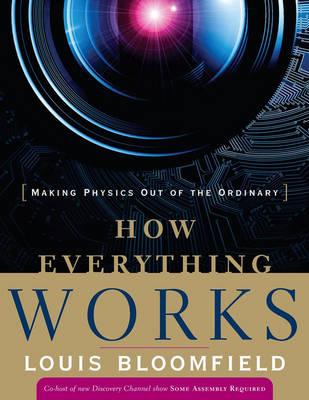
By explaining the physics behind ordinary objects, this book unravels the mysteries of how things work. Using familiar examples from everyday life and modern technology, this book explains the seemingly inexplicable phenomena we encounter all around us. As it examines everything from roller coasters to radio, musical instruments to makeup, and knuckleballs to nuclear weapons, How Everything Works provides the answers to such questions as why the sky is blue, why metal is a problem in microwave ovens, and why some clothes require dry cleaning. With fascinating and fun real-life examples that provide the answers to scores of questions, How Everything Works is nothing short of a user's manual to our everyday world.
Full Product Details
Author: Louis A. Bloomfield (The University of Virginia)
Publisher: John Wiley & Sons Inc
Imprint: John Wiley & Sons Inc
Dimensions:
Width: 21.30cm
, Height: 3.60cm
, Length: 27.40cm
Weight: 1.429kg
ISBN: 9780470170663
ISBN 10: 0470170662
Pages: 736
Publication Date: 19 October 2007
Audience:
Professional and scholarly
,
Professional & Vocational
Format: Paperback
Publisher's Status: Active
Availability: Out of stock

The supplier is temporarily out of stock of this item. It will be ordered for you on backorder and shipped when it becomes available.
Reviews
Books on how things work often adopt a format that gives equal space to each device described. So the flush toilet, say, might get the same number of words devoted to it as the internal-combustion engine, even though the latter is far more complicated. In How Everything Works: Making Physics Out of the Ordinary, Louis Bloomfield avoids that trap by taking just as long as he needs to explain things. And that's exactly what he does, explain things, his chapters having such titles as Things That Involve Light, Things That Move With Fluids, Things That Involve Chemical Physics and so forth. The result is something of a cross between those familiar (and often less-than-satisfying) how-it-works guides and a full-blown physics textbook. <p> Although Bloomfield demonstrates considerable knowledge about the history of science and technology, his aim is clearly to explain how things work rather than how they were developed. Thus his treatment of the transistor very appropriately jumps straight to the field-effect transistor, which is fairly easy to understand, without first explaining its more complex predecessor, the bipolar transistor. <p> Bloomfield also shows excellent judgment about how far to dive in. (One exception here is his cursory treatment of magnetic resonance imaging, a technology that is admittedly very difficult to explain in anything other than a superficial manner.) His section on the microwave oven, for example, helped me finally to understand how a cavity magnetron works. Bloomfield also straightened me out on the difference between a turbojet engine (above, right) and a turbofan engine (left), a distinction I hadn't at all appreciated. And he even clued me in on why thefront fork of a child's bike isn't curved forward. All but the most hard-core technophile should find many similar moments of enlightenment in this delightfully informative book.-- David Schneider
Books on how things work often adopt a format that gives equal space to each device described. So the flush toilet, say, might get the same number of words devoted to it as the internal-combustion engine, even though the latter is far more complicated. In How Everything Works: Making Physics Out of the Ordinary, Louis Bloomfield avoids that trap by taking just as long as he needs to explain things. And that's exactly what he does, explain things, his chapters having such titles as Things That Involve Light, Things That Move With Fluids, Things That Involve Chemical Physics and so forth. The result is something of a cross between those familiar (and often less-than-satisfying) how-it-works guides and a full-blown physics textbook. Although Bloomfield demonstrates considerable knowledge about the history of science and technology, his aim is clearly to explain how things work rather than how they were developed. Thus his treatment of the transistor very appropriately jumps straight to the field-effect transistor, which is fairly easy to understand, without first explaining its more complex predecessor, the bipolar transistor. Bloomfield also shows excellent judgment about how far to dive in. (One exception here is his cursory treatment of magnetic resonance imaging, a technology that is admittedly very difficult to explain in anything other than a superficial manner.) His section on the microwave oven, for example, helped me finally to understand how a cavity magnetron works. Bloomfield also straightened me out on the difference between a turbojet engine (above, right) and a turbofan engine (left), a distinction I hadn't at all appreciated. And he even clued me in on why thefront fork of a child's bike isn't curved forward. All but the most hard-core technophile should find many similar moments of enlightenment in this delightfully informative book.-- David Schneider
Author Information
No one is better at making physics come to life than Louis Bloomfield. Widely recognized for his teaching of physics and science to non-science students at the University of Virginia, Professor Bloomfield is the co-host of the Discovery Channel television show “Some Assembly Required,” premiering in the fall of 2007.