Overview
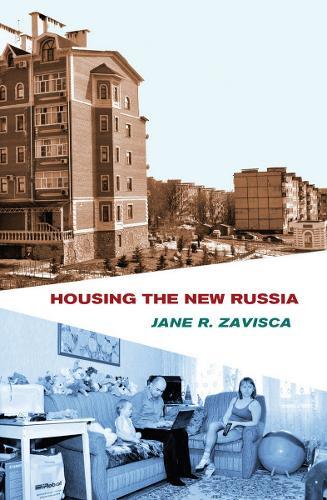
In Housing the New Russia, Jane R. Zavisca examines Russia's attempts to transition from a socialist vision of housing, in which the government promised a separate, state-owned apartment for every family, to a market-based and mortgage-dependent model of home ownership. In 1992, the post-Soviet Russian government signed an agreement with the United States to create the Russian housing market. The vision of an American-style market guided housing policy over the next two decades. Privatization gave socialist housing to existing occupants, creating a nation of homeowners overnight. New financial institutions, modeled on the American mortgage system, laid the foundation for a market. Next the state tried to stimulate mortgages-and reverse the declining birth rate, another major concern-by subsidizing loans for young families. Imported housing institutions, however, failed to resonate with local conceptions of ownership, property, and rights. Most Russians reject mortgages, which they call ""debt bondage,"" as an unjust ""overpayment"" for a good they consider to be a basic right. Instead of stimulating homeownership, privatization, combined with high prices and limited credit, created a system of ""property without markets."" Frustrated aspirations and unjustified inequality led most Russians to call for a government-controlled housing market. Under the Soviet system, residents retained lifelong tenancy rights, perceiving the apartments they inhabited as their own. In the wake of privatization, young Russians can no longer count on the state to provide their house, nor can they afford to buy a home with wages, forcing many to live with extended family well into adulthood. Zavisca shows that the contradictions of housing policy are a significant factor in Russia's falling birth rates and the apparent failure of its pronatalist policies. These consequences further stack the deck against the likelihood that an affordable housing market will take off in the near future.
Full Product Details
Author: Jane R. Zavisca
Publisher: Cornell University Press
Imprint: Cornell University Press
Dimensions:
Width: 15.50cm
, Height: 2.20cm
, Length: 23.50cm
Weight: 0.907kg
ISBN: 9780801450372
ISBN 10: 0801450373
Pages: 264
Publication Date: 15 May 2012
Audience:
College/higher education
,
Postgraduate, Research & Scholarly
Format: Hardback
Publisher's Status: Active
Availability: Manufactured on demand

We will order this item for you from a manufactured on demand supplier.
Reviews
<p> Zavisca's book examines how and why the attempt to import American-style housing finance institutions failed in a system she characterises as 'property without markets.' What is strikingly refreshing about this book is the injection of sociology into a debate and in international terms and agenda that has been dominated by economists. Zavisca highlights the legacy of socialist tenures as one reason for a strong cultural resistance to western-style mortgages, and this helps to explain why the 'transition' country that has attempted to adopt the American system most closely has ended up with possibly the smallest mortgage market of any of these countries. Mark Stephens, Research and Policy Blog, Institute for Housing, Urban, and Real Estate Research (11 February 2013)
<p> The link between homeownership and mortgages is unquestioned in the United States; homeownership is an essential part of the American dream, and mortgages have been institutionalized as a path to become a homeowner. Jane R. Zavisca highlights the fact that this assumption is a product of a particular cultural and historical poque and does not fit contemporary Russia. Housing the New Russia is an insightful and thoroughly documented account of an attempt to create a housing market in a culture where housing is viewed as a right rather than an (overpriced) commodity. A must-read for anyone interested in the cultural foundations of emerging markets, housing policy, and the postcommunist region. -Alya Guseva, Boston University, author of Into the Red: The Birth of the Credit Card Market in Postcommunist Russia
Zavisca successfully demonstrates the complexity and richness of using housing as a measure of large-scale social change. The book is accessibly and engagingly written; even the most technical parts of the analysis are clearly communicated. It manages to speak to a wide range of audiences, including economic and cultural sociologists interested in markets, area specialists on Russia, anthropologists studying family and kinships structures, and demographers examining fertility . . . the book is highly recommended to all who seek to gain a better understanding of contemporary Russian society. Virag Molnar, The Russian Review (October 2012)
Author Information
Jane R. Zavisca is Assistant Professor of Sociology at the University of Arizona.