Awards
- Winner of Athenaeum Literary Award (for Art and Architecture), The Athenaeum of Philadelphia 2015
- Winner of Historic Preservation Book Prize, University of Mary Washington's Center for Historic Preservation 2016
- Winner of PROSE Award in Architecture & Urban Planning, Association of American Publishers 2016
Overview
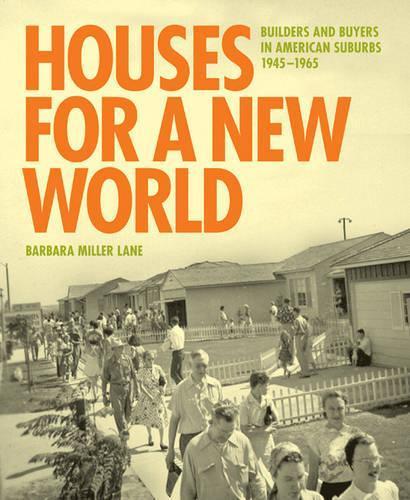
While the work of Frank Lloyd Wright, Richard Neutra, and their contemporaries frequently influences our ideas about house design at the midcentury, most Americans during this period lived in homes built by little-known builders who also served as developers of the communities. Often dismissed as ""little boxes, made of ticky-tacky,"" the tract houses of America's postwar suburbs represent the twentieth century's most successful experiment in mass housing. Houses for a New World is the first comprehensive history of this uniquely American form of domestic architecture and urbanism. Between 1945 and 1965, more than thirteen million houses--most of them in new ranch and split-level styles--were constructed on large expanses of land outside city centers, providing homes for the country's rapidly expanding population. Focusing on twelve developments in the suburbs of Boston, Philadelphia, Chicago, and Los Angeles, Barbara Miller Lane tells the story of the collaborations between builders and buyers, showing how both wanted houses and communities that espoused a modern way of life--informal, democratic, multiethnic, and devoted to improving the lives of their children.The resulting houses differed dramatically from both the European International Style and older forms of American domestic architecture. Based on a decade of original research, and accompanied by hundreds of historical images, plans, and maps, this book presents an entirely new interpretation of the American suburb. The result is a fascinating history of houses and developments that continue to shape how tens of millions of Americans live. Featured housing developments in Houses for a New World: Boston area: * Governor Francis Farms (Warwick, RI) * Wethersfield (Natick, MA) * Brookfield (Brockton, MA) Chicago area: * Greenview Estates (Arlington Heights, IL) * Elk Grove Village * Rolling Meadows * Weathersfield at Schaumburg Los Angeles and Orange County area: * Cinderella Homes (Anaheim, CA)* Panorama City (Los Angeles) * Rossmoor (Los Alamitos, CA) Philadelphia area: * Lawrence Park (Broomall, PA)* Rose Tree Woods (Broomall, PA)
Full Product Details
Author: Barbara Miller Lane
Publisher: Princeton University Press
Imprint: Princeton University Press
Dimensions:
Width: 20.30cm
, Height: 2.80cm
, Length: 24.80cm
Weight: 1.077kg
ISBN: 9780691167619
ISBN 10: 0691167613
Pages: 320
Publication Date: 06 October 2015
Audience:
College/higher education
,
College/higher education
,
Undergraduate
,
Postgraduate, Research & Scholarly
Format: Hardback
Publisher's Status: Active
Availability: Temporarily unavailable

The supplier advises that this item is temporarily unavailable. It will be ordered for you and placed on backorder. Once it does come back in stock, we will ship it out to you.
Language: English
Reviews
Lane uses original research, images, plans, and maps to illustrate the American suburb. --Shannon Sharpe, Metropolis To her credit, Ms. Lane stoutly rebuts ... Slurs, encapsulated in the popular song about 'Little boxes made of ticky tacky' and shows that 'these generalizations were largely false'. Far from being the refuge of white middle-class 'Men in the Gray Flannel Suit,' their neurotic wives and delinquent children, and built by 'rapacious entrepreneurs, in the business of wringing the last penny out of substandard construction,' the houses were well-built and generously equipped and the developments by and large models of societal inclusiveness... [T]hey represent a lost golden age of opportunity. --Martin Rubin, Washington Times Illuminating. --Anthony Paletta, The Daily Beast
Lane uses original research, images, plans, and maps to illustrate the American suburb. --Shannon Sharpe, Metropolis
Author Information
Barbara Miller Lane is Andrew W. Mellon Professor Emeritusin the Humanities and Research Professor in Growth and Structure of Cities at Bryn Mawr College. Her books include Architecture and Politics in Germany, 19181945, National Romanticism and Modern Architecture, and Housing and Dwelling.