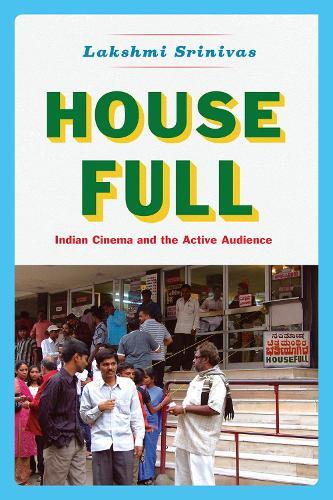
Full Product Details
Author: Lakshmi Srinivas
Publisher: The University of Chicago Press
Imprint: University of Chicago Press
Dimensions:
Width: 1.60cm
, Height: 0.20cm
, Length: 2.30cm
Weight: 0.482kg
ISBN: 9780226361567
ISBN 10: 022636156
Pages: 312
Publication Date: 31 August 2016
Audience:
Professional and scholarly
,
Professional & Vocational
Format: Paperback
Publisher's Status: Active
Availability: Manufactured on demand

We will order this item for you from a manufactured on demand supplier.
Reviews
That such practices of reception, even in darkened cinema halls of the late twentieth century, remained quite 'normal' for a significant segment of humanity has been richly documented by sociologist Lakshmi Srinivas in House Full, her engaging study of the 'active audience' of South Asian popular cinema. Based on extensive fieldwork, primarily in the late 1990s, in the burgeoning metropolis of Bangalore (now officially Bengaluru) in Karnataka state, Srinivas's book turns its focus away from the 'reading' of films as 'texts'--the predominant mode of cinematic analysis, which, she argues, is itself a byproduct of the learned discipline of silent, individualized reading--to look seriously at audience reception and its attendant practices, permitting her to conceptualize and examine the presentation of films as collectively-staged 'performance events.' . . . The examination of . . . messages must remain, in my view, a desideratum of comprehensive film studies, though additional and supplemental research on the context of film reception--so excellently pioneered in House Full--should be equally welcomed. --Philip Lutgendorf Asian Ethnology
Srinivas's originality starts with her fundamental insight that understanding film requires understanding every aspect of film: its distribution as well as its production, and, especially, the role of the audience in choosing, buying tickets for, sitting through, and reacting to movies. Srinivas makes clear that differences in film viewing make us aware that something we have taken for granted as a fixed, unchanging aspect of filmgoing is actually a variable quantity, whose variations shape specific film experiences for real people in various places and times. In so doing, she outlines a vast field of study of comparative film experience in different social and cultural circumstances. This is an excellent book. --Howard S. Becker, author of What About Mozart? What About Murder? This book is a wonderful, nuanced portrait of one of the chief creators of popular Indian cinema: its audience of hundreds of millions. Srinivas's writing is as lively as the phenomena she so richly details. --Sudhir Kakar Srinivas powerfully demonstrates that in India, cinema-going is foremost a social event undertaken and experienced in often large groups. The book has eight captivating chapters that offer the reader detailed observations of the organization of making and consuming Indian films as well as a discussion of the theoretical contribution of the study to a sociology of cinema-going in particular and a sociology of film in general. . . . Also fascinating is Srinivas's treatment of the importance of space and locality for the film experience. In short, the book provides a deluge of resources to fundamentally rethink reception as conceived by scholars in media and cultural studies that thus far have often focused on the individual viewer of film as an interpreter or 'reader' of content preproduced by film creators. Srinivas's ethnography powerfully demonstrates that film consumption is not simply amatter of individual viewers' interpretations but an interactional process through which experiences emerge that feed back into the production of films. Therewith, it offers numerous points of connections to interactionist debates about media production and media consumption. --Symbolic Interaction Srinivas's book is a refreshing contribution to the study of popular south Asian film, by its acknowledgement of the ways in which different actors, including the audiences, make films, but also by its focus on the social spaces that go beyond the theater itself. It offers a rich ethnographic account on the practices and experiences that surround cinemagoing and its social situatedness. The book knits together rich fieldwork data, personal experiences, theory and analysis and shows how the trivia of cinemagoing do matter. One of the most innovative points made in the book is how spatial cultures define cinemagoing, something barely touched upon in earlier accounts on cinema in South Asia and beyond. Taking this together the book offers a range of material and observations to reflect on the cultural production of film. --Visual Anthropology This is urban ethnography at its best! Srinivas has immersed herself in the filmgoing activities of a large city, engaging at the same time with the film industry, the contemporary Indian urban class structure, the heterogeneity of a city's population, and the negotiations that occur between different social elements on a daily basis. Few books on the Indian cinema range so widely to pull together the observations and obligations of film stars, producers, distributors, theater managers, ushers, guards, moviegoers, film critics, fans, and the 'low-life' scalpers and hangers-on who congregate around Bangalore's dozens of cinemas. The detail of personal interaction that Srinivas offers is unparalleled and her breadth of reading on the film industry and grasp of pertinent theory is impressive. --Paul Hockings, editor, Visual Anthropology In House Full, Srinivas provides us with a rich, insightful, and evocative ethnography of cinema audiences in India, in a time when the place and role of cinema in this hugely diverse and dynamic country is rapidly changing as a consequence of the globalization of the multiplex. Far from being an individualized, anonymous experience, as is the case predominantly in the West, the cinema experience in India is pictured by Srinivas as a deeply social, collective, and performative act. --Ien Ang, author of Desperately Seeking the Audience Drawing on over fifteen years of observation, employing innovative research methods, and collecting an exceptional breadth of data, Srinivas reveals provocative sociological lessons in mundane activities that most of us would miss, such as the ticket queue, or the mahurat ritual that marks the official start to filming. Her methodological and conceptual insights can be applied to any large city in India, not only those sites as linguistically and culturally diverse or as cosmopolitan as Bangalore, and they offer fruitful models for other scholars of urban India. --Sara Dickey, author of Cinema and the Urban Poor in South India House Full is a welcome addition to research on Indian cinema in general and audiences in particular. This is the most detailed record yet of an important moment in the history of cinema and urban cultures in India. . .The book is well-researched and is accessible to scholars and students alike. --Economic and Political Weekly A most enjoyable and even fun read (rare in sociology) that provides both an acutely immersive and profoundly empathetic rendering. . .Drawing from a small, but potent, body of work on ethnographic studies of film reception, Srinivas formulates an impressive research design in Bangalore, India. . .House Full is an impressive, necessary, and innovative study that pushes conventional sociological renderings of media toward their social realities.--American Journal of Sociology That such practices of reception, even in darkened cinema halls of the late twentieth century, remained quite 'normal' for a significant segment of humanity has been richly documented by sociologist Lakshmi Srinivas in House Full, her engaging study of the 'active audience' of South Asian popular cinema. Based on extensive fieldwork, primarily in the late 1990s, in the burgeoning metropolis of Bangalore (now officially Bengaluru) in Karnataka state, Srinivas's book turns its focus away from the 'reading' of films as 'texts'--the predominant mode of cinematic analysis, which, she argues, is itself a byproduct of the learned discipline of silent, individualized reading--to look seriously at audience reception and its attendant practices, permitting her to conceptualize and examine the presentation of films as collectively-staged 'performance events.' . . . The examination of . . . messages must remain, in my view, a desideratum of comprehensive film studies, though additional and supplemental research on the context of film reception--so excellently pioneered in House Full--should be equally welcomed. --Philip Lutgendorf Asian Ethnology
Author Information
Lakshmi Srinivas is associate professor of sociology at the University of Massachusetts, Boston.