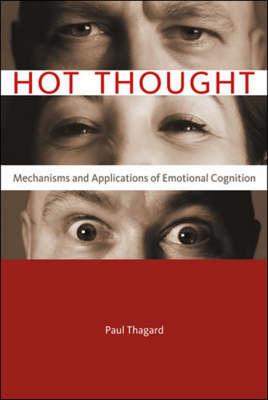
Hot Thought: Mechanisms and Applications of Emotional Cognition

Awards:   Winner of <i>Choice</i> Outstanding Academic Title, 2007. 2007 Winner of <PrizeName>Choice Outstanding Academic Title, 2007.</PrizeName> 2007 Winner of Choice Outstanding Academic Title, 2007. 2007 Winner of Choice Outstanding Academic Title, 2007.</PrizeName> 2007
Author:   Paul Thagard (Professor, University of Waterloo)
Publisher:   MIT Press Ltd
ISBN:  

9780262701242


Pages:   320
Publication Date:   01 September 2008
Recommended Age:   From 18 years
Format:   Paperback
Availability:   Out of stock   Availability explained


Our Price $58.08 Quantity:  
Add to Cart

Share |

Hot Thought: Mechanisms and Applications of Emotional Cognition


Awards

  • Winner of <i>Choice</i> Outstanding Academic Title, 2007. 2007
  • Winner of <PrizeName>Choice Outstanding Academic Title, 2007.</PrizeName> 2007
  • Winner of Choice Outstanding Academic Title, 2007. 2007
  • Winner of Choice Outstanding Academic Title, 2007.</PrizeName> 2007

Overview

Contrary to standard assumptions, reasoning is often an emotional process. Emotions can have good effects, as when a scientist gets excited about a line of research and pursues it successfully despite criticism. But emotions can also distort reasoning, as when a juror ignores evidence of guilt just because the accused seems like a nice guy. In Hot Thought, Paul Thagard describes the mental mechanisms—cognitive, neural, molecular, and social—that interact to produce different kinds of human thinking, from everyday decision making to legal reasoning, scientific discovery, and religious belief, and he discusses when and how thinking and reasoning should be emotional. Thagard argues that an understanding of emotional thinking needs to integrate the cognitive, neural, molecular, and social levels. Many of the chapters employ computational models of various levels of thinking, including HOTCO (hot cognition) models and the more neurologically realistic GAGE model. Thagard uses these models to illuminate thinking in the domains of law, science, and religion, discussing such topics as the role of doubt and reasonable doubt in legal and other contexts, valuable emotional habits for successful scientists, and the emotional content of religious beliefs. Identifying and assessing the impact of emotion, Thagard argues, can suggest ways to improve the process of reasoning.

Full Product Details

Author:   Paul Thagard (Professor, University of Waterloo)
Publisher:   MIT Press Ltd
Imprint:   Bradford Books
Dimensions:   Width: 15.20cm , Height: 1.40cm , Length: 22.90cm
Weight:   0.454kg
ISBN:  

9780262701242


ISBN 10:   0262701243
Pages:   320
Publication Date:   01 September 2008
Recommended Age:   From 18 years
Audience:   Professional and scholarly ,  Professional & Vocational
Format:   Paperback
Publisher's Status:   Out of Stock Indefinitely
Availability:   Out of stock   Availability explained

Table of Contents

Reviews

Impressively comprehensive, unfailingly sensible, and made all the more appealing by its hip-pocket readability, Hot Thought will be a godsend to instructors in philosophy and cognitive science. - Patricia S. Churchland, UC President's Professor of Philosophy, University of California, San Diego


Author Information

Paul Thagard is Professor of Philosophy at the University of Waterloo, Ontario. He is the author of The Cognitive Science of Science (MIT Press, 2012) and many other books.

Tab Content 6

Author Website:  

Countries Available

All regions
Latest Reading Guide

NOV RG 20252


Shopping Cart
Your cart is empty
Shopping cart
Mailing List