Overview
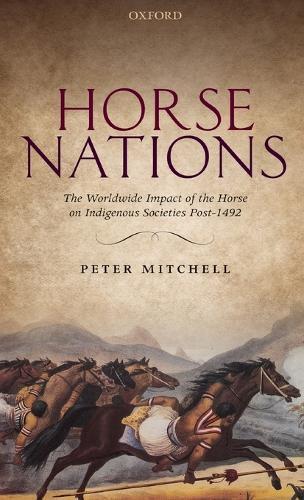
The Native American on a horse is an archetypal Hollywood image, but though such equestrian-focused societies were a relatively short-lived consequence of European expansion overseas, they were not restricted to North America's Plains. Horse Nations provides the first wide-ranging and up-to-date synthesis of the impact of the horse on the Indigenous societies of North and South America, southern Africa, and Australasia following its introduction as a result of European contact post-1492. Drawing on sources in a variety of languages and on the evidence of archaeology, anthropology, and history, the volume outlines the transformations that the acquisition of the horse wrought on a diverse range of groups within these four continents. It explores key topics such as changes in subsistence, technology, and belief systems, the horse's role in facilitating the emergence of more hierarchical social formations, and the interplay between ecology, climate, and human action in adopting the horse, as well as considering how far equestrian lifestyles were ultimately unsustainable.
Full Product Details
Author: Peter Mitchell (Professor of African Archaeology, Professor of African Archaeology, University of Oxford)
Publisher: Oxford University Press
Imprint: Oxford University Press
Dimensions:
Width: 14.80cm
, Height: 2.90cm
, Length: 22.20cm
Weight: 0.792kg
ISBN: 9780198703839
ISBN 10: 019870383
Pages: 464
Publication Date: 26 March 2015
Audience:
College/higher education
,
Undergraduate
,
Postgraduate, Research & Scholarly
Format: Hardback
Publisher's Status: Active
Availability: To order

Stock availability from the supplier is unknown. We will order it for you and ship this item to you once it is received by us.
Reviews
highly interesting for historians or others interested in understanding continuity and change and not the least researchers interested in colonial impact and interaction between Europeans and indigenous people. * Susanna Hedenborg, idrottsforum.org (Nordic Sports Science web journal) * Mining an impressive collection of ... sources in multiple languages, Mitchell has produced an interpretative compilation full of information and insight that should be an important reference for researchers who are continuing to blaze new trails in our knowledge and understanding of indigenous peoples' reception and integration of the horse. ... Mitchell's work should spark and stoke even more scholarship that situates this region's rich history in its global context. * John P. Husmann, Great Plains Quarterly * Horse Nations provides the first in-depth synthesis of the impact that horses had on indigenous groups located on the periphery of European colonialismin the post-1442 period ... presents interesting comparative fodder for researchers studying the adoption of new commodities or domesticates from any time period and also to those interested in exploring the diverse ways indigenous societies interacted with colonial processes. * Sarah Newstead, Medieval Archaeology * a long awaited work that fills a significant lacuna in equine literature. The book adeptly mines an abundance of relevant, but often previously unrecognized, geographic, archaeological, ethnographic and historical references to reconstruct the complex conditions that grew out of the appearance of the horse in North and South America, South Africa and Australasia from the late 15th century on. Eloquently woven, the story unfolds in a captivating manner that expertly leads the reader through the tangled web of history like a native guide through a rainforest ... this volume certainly will not disappoint. It has the ingredients to become an oft-referenced guide for historic periods in which the horse burst out of Eurasia and surprised countless indigenous peoples with its peculiar looks and amazing swiftness. It shall, no doubt, earn a favorite spot in the libraries of equine experts and enthusiasts internationally. * Sandra L. Olsen, Journal of African Archaeology * essential reading for all those interested in the study of human-animal relations, offering valuable access to documentary, iconographic, and bibliographic sources taken from colonial and contemporary history, archaeology, and anthropology. * Messias Basques, Current Anthropology * As well as offering a template for the melding of historical, anthropological and archaeological data, methods and perspectives, Horse Nations is a substantial contribution to the study of borderland environments, middle grounds and hybrid societies. It is also a major addition to the field of horse history * Times Literary Supplement, Peter Coates *
As well as offering a template for the melding of historical, anthropological and archaeological data, methods and perspectives, Horse Nations is a substantial contribution to the study of borderland environments, middle grounds and hybrid societies. It is also a major addition to the field of horse history Times Literary Supplement, Peter Coates
Author Information
Peter Mitchell is Professor of African Archaeology and Fellow at St. Hugh's College, Oxford, and Honorary Research Fellow at the University of the Witwatersrand in South Africa.