Overview
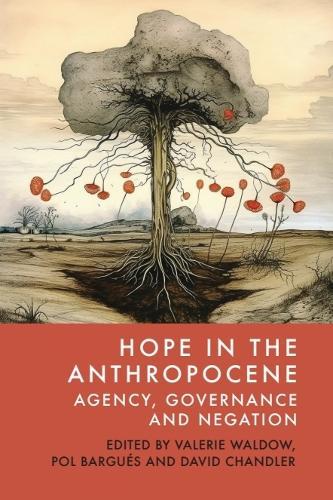
New modes of Hope have emerged in the Anthropocene, increasingly grounded in an ethics of attentiveness and responsibility. Through incorporating contemporary approaches to both theory and policy practice, including critical, feminist, black and indigenous perspectives, this book analyses how Hope works with the uncertainties and interdependencies of human agency and interaction. It draws out the problems of integrating Hope into governance and policy management, and engages with Hope as a potentially negating force, in a world which can be seen as one of unending catastrophe.
Full Product Details
Author: Valerie Waldow (Lecturer, Otto-von-Guericke University of Magdeburg, Germany) ,
Pol Bargués (Senior Research Fellow, Barcelona Centre for International Affairs, Spain) ,
David Chandler (Professor of International Relations, Doshisha University)
Publisher: Edinburgh University Press
Imprint: Edinburgh University Press
ISBN: 9781399529860
ISBN 10: 1399529862
Pages: 296
Publication Date: 28 February 2026
Audience:
College/higher education
,
Postgraduate, Research & Scholarly
Format: Paperback
Publisher's Status: Forthcoming
Availability: Not yet available

This item is yet to be released. You can pre-order this item and we will dispatch it to you upon its release.
Reviews
An invaluable source and an inspiring new contribution that will be of interest to anyone researching the concept of hope in the political world.--Ayşem Mert, Stockholm University ""International Affairs"" Hope is not commonly associated with the Anthropocene and its catastrophic implications. Without some positive hope - that is, recognition, planning, experimentation, invention and, above all, a new relation to the earth - we cannot face the unknowns that lie ahead. This book explores what a guarded and strategic hope, a 'dark hope, ' might add to our understanding of what lies ahead. --Elizabeth Grosz, author of The Incorporeal: Ontology, Ethics and the Limits of Materialism
Hope is not commonly associated with the Anthropocene and its catastrophic implications. Without some positive hope – that is, recognition, planning, experimentation, invention and, above all, a new relation to the earth – we cannot face the unknowns that lie ahead. This book explores what a guarded and strategic hope, a ‘dark hope,’ might add to our understanding of what lies ahead. -- Elizabeth Grosz, author of The Incorporeal: Ontology, Ethics and the Limits of Materialism An invaluable source and an inspiring new contribution that will be of interest to anyone researching the concept of hope in the political world. -- Ayşem Mert, Stockholm University * International Affairs *
Author Information
Valerie Waldow is Lecturer at the Department of Political Science at Otto-von-Guericke University of Magdeburg, Germany. Her research interests include international political theory, rationalities of international interventions and governance, Anthropocene discourses, and prospects for hope and critique in IR. Pol Bargués is Senior Research Fellow at Barcelona Centre for International Affairs, Spain. Over the years he has developed an interest in the intersection of philosophy, critical theory and International Relations. In particular, he has critically interrogated international interventions in conflict-affected societies and explored the increasing prevalence of the ideas of resilience, hybridity, and hope. David Chandler is Professor of International Relations at the University of Westminster, UK. He edits the open access journal Anthropocenes: Human, Inhuman, Posthuman. His recent books include: The World as Abyss: The Caribbean and Critical Thought in the Anthropocene (2023); International Relations in the Anthropocene: New Agendas, New Agencies and New Approaches (2021); and Anthropocene Islands: Entangled Worlds (2021).