Overview
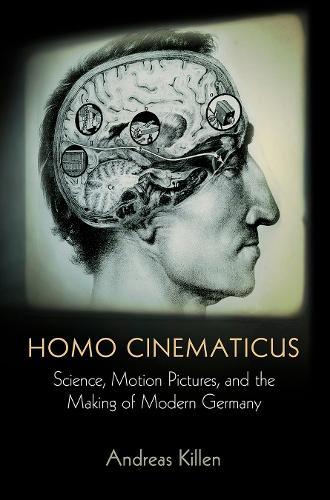
In the early decades of the twentieth century, two intertwined changes began to shape the direction of German society. The baptism of the German film industry took place amid post-World War I conditions of political and social breakdown, and the cultural vacuum left by collapsing institutions was partially filled by moving images. At the same time, the emerging human sciences-psychiatry, neurology, sexology, eugenics, industrial psychology, and psychoanalysis-began to play an increasingly significant role in setting the terms for the way Germany analyzed itself and the problems it had inherited from its authoritarian past, the modernizing process, and war. Moreover, in advancing their professional and social goals, these sciences became heavily reliant on motion pictures. Situated at the intersection of film studies, the history of science and medicine, and the history of modern Germany, Homo Cinematicus connects the rise of cinema as a social institution to an inquiry into the history of knowledge production in the human sciences. Taking its title from a term coined in 1919 by commentator Wilhelm Stapel to identify a new social type that had been created by the emergence of cinema, Killen's book explores how a new class of experts in these new disciplines converged on the figure of the ""homo cinematicus"" and made him central to many of that era's major narratives and social policy initiatives. Killen traces film's use by the human sciences as a tool for producing, communicating, and popularizing new kinds of knowledge, as well as the ways that this alliance was challenged by popular films that interrogated the truth claims of both modern science and scientific cinema. In doing so, Homo Cinematicus endeavors to move beyond the divide between scientific and popular film, examining their historical coexistence and coevolution.
Full Product Details
Author: Andreas Killen
Publisher: University of Pennsylvania Press
Imprint: University of Pennsylvania Press
Dimensions:
Width: 15.20cm
, Height: 1.90cm
, Length: 22.90cm
Weight: 0.567kg
ISBN: 9780812249279
ISBN 10: 0812249275
Pages: 280
Publication Date: 20 June 2017
Audience:
College/higher education
,
Tertiary & Higher Education
Format: Hardback
Publisher's Status: Active
Availability: Manufactured on demand

We will order this item for you from a manufactured on demand supplier.
Reviews
Among Homo Cinematicus's many strengths is its outstanding ability to situate film in larger discursive contexts, iconographies, and social agendas, as well as its comprehensive discussion of these relationships. To reexamine this era of German cinema and the discourse around it on their own terms, and not as a prelude to the Nazi regime, is an absolutely essential task, and Killen does so brilliantly. No other book on this topic matches its scope and ambition. -Scott Curtis, Northwestern University
Homo Cinematicus offers brilliant insights into the emergence of a specific form of German modernity through the lens of nonfiction film. Drawing on archival sources, the book shows how cinema helped shape debates about public health and social policies in the first half of the twentieth century. An indispensable book for anyone interested in the ways in which cinema fostered the pursuit of knowledge in the human sciences. -Anton Kaes, University of California, Berkeley Among Homo Cinematicus's many strengths is its outstanding ability to situate film in larger discursive contexts, iconographies, and social agendas, as well as its comprehensive discussion of these relationships. To reexamine this era of German cinema and the discourse around it on their own terms, and not as a prelude to the Nazi regime, is an absolutely essential task, and Killen does so brilliantly. No other book on this topic matches its scope and ambition. -Scott Curtis, Northwestern University
Homo Cinematicus offers brilliant insights into the emergence of a specific form of German modernity through the lens of nonfiction film. Drawing on archival sources, the book shows how cinema helped shape debates about public health and social policies in the first half of the twentieth century. An indispensable book for anyone interested in the ways in which cinema fostered the pursuit of knowledge in the human sciences. * Anton Kaes, University of California, Berkeley * Among Homo Cinematicus's many strengths is its outstanding ability to situate film in larger discursive contexts, iconographies, and social agendas, as well as its comprehensive discussion of these relationships. To reexamine this era of German cinema and the discourse around it on their own terms, and not as a prelude to the Nazi regime, is an absolutely essential task, and Killen does so brilliantly. No other book on this topic matches its scope and ambition. * Scott Curtis, Northwestern University *
Author Information
Andreas Killen is Professor of History at the City College of New York and the CUNY Graduate Center.