Full Product Details
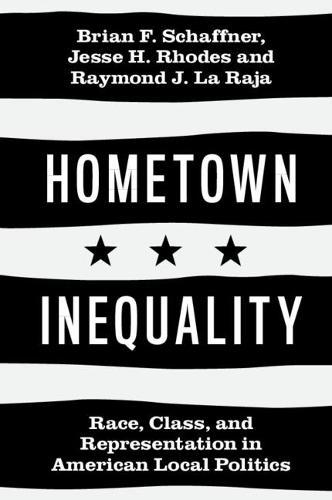
Author: Brian F. Schaffner (Tufts University, Massachusetts) ,
Jesse H. Rhodes (University of Massachusetts, Amherst) ,
Raymond J. La Raja (University of Massachusetts, Amherst)
Publisher: Cambridge University Press
Imprint: Cambridge University Press
Dimensions:
Width: 15.20cm
, Height: 1.50cm
, Length: 22.70cm
Weight: 0.410kg
ISBN: 9781108725378
ISBN 10: 1108725376
Pages: 272
Publication Date: 09 July 2020
Audience:
Professional and scholarly
,
College/higher education
,
Professional & Vocational
,
Tertiary & Higher Education
Format: Paperback
Publisher's Status: Active
Availability: Manufactured on demand

We will order this item for you from a manufactured on demand supplier.
Reviews
'This book is a powerhouse. It revises what we know about American politics using sweeping data, clear theoretical predictions, and careful conclusions. In page after page, Schaffner, Rhodes, and La Raja demonstrate deep racial inequities in local political ideologies, local political representation, and local policy outcomes. Their work will undoubtedly play a starring role in the renaissance of scholarship on cities.' Jessica Trounstine, Professor of Political Science, University of California, Merced 'Citizens in the United States elect hundreds of thousands of local officials across nearly 90,000 local governments. Hometown Inequality seeks to understand how well these officials represent their constituents and whether they represent economic and racial groups differently. To do this, Schaffner, Rhodes, and La Raja combine data from a staggering 260 million adults with ideological and policy data from over a thousand towns and cities. The result is a highly innovative and engaging book that will greatly advance the conversation about representation in the US.' Peter K. Enns, Department of Government, Cornell University 'Hometown Inequality provides an authoritative assessment of representational inequalities in local governments. It finds that local governments do not adequately represent the poor and racial minorities. It also raises a number of ideas to rejuvenate local democracy. This book should be required reading for anyone interested in democratic politics in the United States and how we can make it work better.' Christopher Warshaw, Department of Political Science, George Washington University 'This book is a powerhouse. It revises what we know about American politics using sweeping data, clear theoretical predictions, and careful conclusions. In page after page, Schaffner, Rhodes, and La Raja demonstrate deep racial inequities in local political ideologies, local political representation, and local policy outcomes. Their work will undoubtedly play a starring role in the renaissance of scholarship on cities.' Jessica Trounstine, Professor of Political Science, University of California, Merced 'Citizens in the United States elect hundreds of thousands of local officials across nearly 90,000 local governments. Hometown Inequality seeks to understand how well these officials represent their constituents and whether they represent economic and racial groups differently. To do this, Schaffner, Rhodes, and La Raja combine data from a staggering 260 million adults with ideological and policy data from over a thousand towns and cities. The result is a highly innovative and engaging book that will greatly advance the conversation about representation in the US.' Peter K. Enns, Department of Government, Cornell University 'Hometown Inequality provides an authoritative assessment of representational inequalities in local governments. It finds that local governments do not adequately represent the poor and racial minorities. It also raises a number of ideas to rejuvenate local democracy. This book should be required reading for anyone interested in democratic politics in the United States and how we can make it work better.' Christopher Warshaw, Department of Political Science, George Washington University
'This book is a powerhouse. It revises what we know about American politics using sweeping data, clear theoretical predictions, and careful conclusions. In page after page, Schaffner, Rhodes, and La Raja demonstrate deep racial inequities in local political ideologies, local political representation, and local policy outcomes. Their work will undoubtedly play a starring role in the renaissance of scholarship on cities.' Jessica Trounstine, Professor of Political Science, University of California, Merced 'Citizens in the United States elect hundreds of thousands of local officials across nearly 90,000 local governments. Hometown Inequality seeks to understand how well these officials represent their constituents and whether they represent economic and racial groups differently. To do this, Schaffner, Rhodes, and La Raja combine data from a staggering 260 million adults with ideological and policy data from over a thousand towns and cities. The result is a highly innovative and engaging book that will greatly advance the conversation about representation in the US.' Peter K. Enns, Department of Government, Cornell University 'Hometown Inequality provides an authoritative assessment of representational inequalities in local governments. It finds that local governments do not adequately represent the poor and racial minorities. It also raises a number of ideas to rejuvenate local democracy. This book should be required reading for anyone interested in democratic politics in the United States and how we can make it work better.' Christopher Warshaw, Department of Political Science, George Washington University
'This book is a powerhouse. It revises what we know about American politics using sweeping data, clear theoretical predictions, and careful conclusions. In page after page, Schaffner, Rhodes, and La Raja demonstrate deep racial inequities in local political ideologies, local political representation, and local policy outcomes. Their work will undoubtedly play a starring role in the renaissance of scholarship on cities.' Jessica Trounstine, Professor of Political Science, University of California, Merced 'Citizens in the United States elect hundreds of thousands of local officials across nearly 90,000 local governments. Hometown Inequality seeks to understand how well these officials represent their constituents and whether they represent economic and racial groups differently. To do this, Schaffner, Rhodes, and La Raja combine data from a staggering 260 million adults with ideological and policy data from over a thousand towns and cities. The result is a highly innovative and engaging book that will greatly advance the conversation about representation in the US.' Peter K. Enns, Department of Government, Cornell University 'Hometown Inequality provides an authoritative assessment of representational inequalities in local governments. It finds that local governments do not adequately represent the poor and racial minorities. It also raises a number of ideas to rejuvenate local democracy. This book should be required reading for anyone interested in democratic politics in the United States and how we can make it work better.' Christopher Warshaw, Department of Political Science, George Washington University
'This book is a powerhouse. It revises what we know about American politics using sweeping data, clear theoretical predictions, and careful conclusions. In page after page, Schaffner, Rhodes, and La Raja demonstrate deep racial inequities in local political ideologies, local political representation, and local policy outcomes. Their work will undoubtedly play a starring role in the renaissance of scholarship on cities.' Jessica Trounstine, Professor of Political Science, University of California, Merced 'Citizens in the United States elect hundreds of thousands of local officials across nearly 90,000 local governments. Hometown Inequality seeks to understand how well these officials represent their constituents and whether they represent economic and racial groups differently. To do this, Schaffner, Rhodes, and La Raja combine data from a staggering 260 million adults with ideological and policy data from over a thousand towns and cities. The result is a highly innovative and engaging book that will greatly advance the conversation about representation in the US.' Peter K. Enns, Department of Government, Cornell University 'Hometown Inequality provides an authoritative assessment of representational inequalities in local governments. It finds that local governments do not adequately represent the poor and racial minorities. It also raises a number of ideas to rejuvenate local democracy. This book should be required reading for anyone interested in democratic politics in the United States and how we can make it work better.' Christopher Warshaw, Department of Political Science, George Washington University
Author Information
Brian F. Schaffner is the Newhouse Professor of Civic Studies at Tufts University. He is co-author Campaign Finance and Political Polarization: When Purists Prevail, which was the winner of the 2016 Virginia Gray Best Book Award. He is also co-editor of Winning with Words: The Origins & Impact of Political Framing and co-author of Understanding Political Science Research Methods: The Challenge of Inference. His research has appeared in more than 40 peer-reviewed journal articles and has received over $2 million in external grant funding. Jesse H. Rhodes is Professor of Political Science and Department Chair at University of University of Massachusetts, Amherst and Associate Director of the UMass Poll. His research focuses on struggles over policy development and the consequences of these battles for politics and citizenship. He is the author of An Education in Politics: The Origin and Development of No Child Left Behind and Ballot Blocked: The Political Erosion of the Voting Rights Act, along with more than 20 peer-reviewed journal articles. Raymond J. La Raja is Professor of Political Science and Associate Dean of the College of Social and Behavioral Sciences at University of Massachusetts, Amherst and Associate Director of the UMass Poll. His research focuses on political parties, political participation, and campaign finance. He is co-author of Campaign Finance and Political Polarization: When Purists Prevail, winner of the 2016 Virginia Gray Best Book Award, and a co-author on policy reports from the Brookings Institution. He is founding editor of The Forum, a journal on American politics, and past President of the Political Organizations and Parties section of the American Political Science Association.