Overview
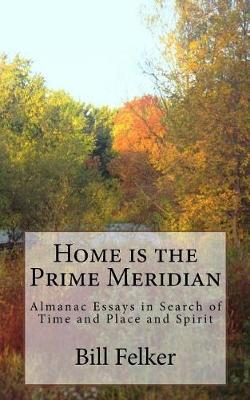
Bill Felker's HOME IS THE PRIME MERIDIAN: ALMANAC ESSAYS ON TIME AND PLACE AND SPIRIT is a collection of forty-one brief essays taken from the nature column and almanac he has has written for several regional and national publications since 1984. The time selections are descriptions of and reflections on the seasons in his village of Yellow Springs, Ohio. The place essays focus on his relationship with the environment in which he has lived much of his life. The spirit essays connect Felker's observations of local events in nature with the awareness of his own fallibility and mortality. He shows how his encounter with the world around him (home) is the path on which he finds meaning in his life.
Full Product Details
Author: Bill Felker
Publisher: Createspace Independent Publishing Platform
Imprint: Createspace Independent Publishing Platform
Dimensions:
Width: 12.70cm
, Height: 0.70cm
, Length: 20.30cm
Weight: 0.136kg
ISBN: 9781544134628
ISBN 10: 1544134622
Pages: 120
Publication Date: 15 November 2017
Audience:
General/trade
,
General
Format: Paperback
Publisher's Status: Active
Availability: Available To Order

We have confirmation that this item is in stock with the supplier. It will be ordered in for you and dispatched immediately.
Author Information
My apprenticeship in almanacking began in 1972 with the gift of a barometer. My wife, Jeanie, gave the instrument to me when I was succumbing to graduate school stress in Knoxville, Tennessee, and it became not only an escape from intense academic work, but the first step on the road to a different kind of awareness about the world. From the start, I was never content just to watch the barometric needle; I had to record its movement then graph it. Eventually, I learned when changes would occur and what kind of weather would take place on most any day. That information was expressed in the language of odds and percentages, and it was surprisingly accurate. Taking into consideration the consistency of certain patterns in the past, I could make fairly successful predictions about the likelihood of the repetition of such patterns in the future. The pulse of the world was more steady than I had ever imagined. From watching the weather, it was an easy step to watching wildflowers. Identifying plants, I saw that flowers were natural allies of my graphs, and that they were parallel measures of the seasons and the passage of time. I kept a list of when each wildflower blossomed and saw how each one consistently opened around a specific day, and that even though a cold year could set blooming back up to two weeks, and unusual warmth accelerate it, average dates were quite useful in establishing sequence of bloom that always showed me exactly where I was in the progress of the year. In the summer of 1978, my wife and I took the family to Yellow Springs, Ohio, a small town just beyond the eastern edge of the Dayton suburbs. We bought a house and planned to stay. I began to write a nature column for the local newspaper. To my weather and wildflower notes I added comments on foliage changes, bird migration dates, farm and gardening cycles, and the rotation of the stars. The microclimate in which I immersed myself gradually became a key to the extended environment; the part unlocked the whole. My engagement with the natural world, which began as an escape from school (and helped me stop smoking, as well), finally turned into a way of getting private bearings. It became a process of spiritual and physical reorientation. In that sense, all the seasonal notes and reflections in this book are the fruit of a strong need to define where I am, who I am and what happens around me.