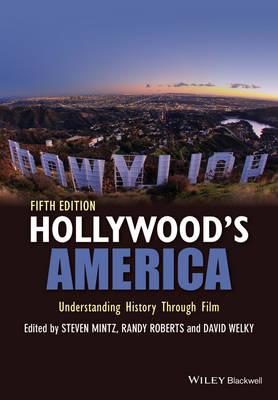
|
Overview
Full Product Details
Author: Steven Mintz (University of Houston) , Randy W. Roberts (Purdue University) , David Welky (University of Central Arkansas)
Publisher: John Wiley and Sons Ltd
Imprint: Wiley-Blackwell
Edition: 5th edition
Dimensions:
Width: 17.30cm
, Height: 2.00cm
, Length: 24.40cm
Weight: 0.689kg
ISBN: 9781118976494
ISBN 10: 1118976495
Pages: 448
Publication Date: 23 February 2016
Audience:
College/higher education
,
Tertiary & Higher Education
Format: Paperback
Publisher's Status: Active
Availability: Available To Order 
We have confirmation that this item is in stock with the supplier. It will be ordered in for you and dispatched immediately.
Table of Contents
List of Illustrations ix Preface xi Introduction: The Social and Cultural History of American Film 1 Part I The Silent Era 31 Introduction: Intolerance and the Rise of the Feature Film 31 1 Workers in Early Film 33 Michael Shull, “Silent Agitators: Militant Labor in the Movies, 1909–1919” 2 Silent Cinema as Historical Mythmaker 42 Eric Niderost, “The Birth of a Nation” 3 The Revolt Against Victorianism 51 Lary May, “Douglas Fairbanks, Mary Pickford, and the New Personality” 4 Primary Sources 63 Edison v. American Mutoscope Company 63 “The Nickel Madness” 65 Mutual Film Corp. v. Industrial Commission of Ohio 68 Fighting a Vicious Film: Protest Against The Birth of a Nation 69 Boston Branch of the National Association for the Advancement of Colored People, 1915 69 Analysis by Francis Hackett 69 “Seeing Our Boys ‘Over There’” 71 Part II Hollywood’s Golden Age 75 Introduction: Backstage During the Great Depression: 42nd Street, Gold Diggers of 1933, and Footlight Parade 75 5 Depression America and its Films 79 Maury Klein, “Laughing Through Tears” 6 The Depression’s Human Toll 86 Peter Roffman and Jim Purdy, “Gangsters and Fallen Women” 7 Depression Allegories 95 Thomas H. Pauly, “Gone with the Wind and The Grapes of Wrath as Hollywood Histories of the Great Depression” 8 African Americans on the Silver Screen 104 Thomas R. Cripps, “The Evolution of Black Film” 9 Primary Sources 116 The Introduction of Sound 116 “Pictures That Talk” 116 Review of Don Juan 117 “Silence is Golden” 118 Film Censorship 120 The Sins of Hollywood, 1922 120 “The Don’ts and Be Carefuls” 122 The Motion Picture Production Code of 1930 123 The State Department on Hollywood in Germany, 1934 133 The State Department on Hollywood in Latin America, 1934 134 Part III Hollywood in the World War II Era 137 Introduction: Hollywood’s World War II Combat Films 137 10 Movies and Great Britain 141 Michael Todd Bennett, “Anglophilia on Film: Creating an Atmosphere for Alliance, 1935–1941” 11 Blockbuster as Propaganda 156 Randy Roberts, “You Must Remember This: The Case of Hal Wallis’s Casablanca” 12 John Wayne and Wartime Hollywood 166 Randy Roberts, “John Wayne Goes to War” 13 The Woman’s Film 184 Jeanine Basinger, “When Women Wept” 14 Primary Sources 191 Sumner Welles to Franklin Roosevelt, 1941 191 The 1941 Academy Awards: Hollywood and the President 192 Correspondence between Walter Wanger and Stephen Early 192 Franklin D. Roosevelt to the Academy Awards Dinner 195 Walter Wanger to Stephen Early 196 Madeleine Carroll to Franklin Roosevelt 196 U.S. Senate Subcommittee Hearings on Motion Picture and Radio Propaganda, 1941 196 Excerpts from The Government Information Manual for the Motion Picture Industry, 1942 200 Bureau of Motion Pictures Report: Casablanca 204 Part IV Postwar Hollywood 207 Introduction: Double Indemnity and Film Noir 207 15 The Red Scare in Hollywood 211 Peter Roffman and Jim Purdy, “HUAC and the End of an Era” 16 Movies Grow Up 219 Jennifer Holt, “Hollywood and Politics Caught in the Cold War Crossfire” 17 The Morality of Informing 229 Kenneth R. Hey, “Ambivalence and On the Waterfront” 18 Science Fiction as Social Commentary 240 Stuart Samuels, “The Age of Conspiracy and Conformity: Invasion of the Body Snatchers (1956)” 19 Primary Sources 250 United States v. Paramount Pictures, Inc. (1947) 250 Hearings Regarding the Communist Infiltration of the Motion Picture Industry 251 U.S. House of Representatives Committee on Un-American Activities, 1947 251 U.S. House of Representatives Committee on Un-American Activities, 1951 251 The Waldorf Statement, 1947 254 Part V Hollywood in an Age of Turmoil 257 Introduction: Bonnie and Clyde 257 20 The Dark Side of the 1960s 259 Charles Bane, “Worrying about the Bomb: Stanley Kubrick and the Nuclear War Film” 21 Films of the Late 1960s and Early 1970s 270 Michael Ryan and Douglas Kelner, “From Counterculture to Counterrevolution, 1967–1971” 22 Film Capital and National Capital 279 Kathryn Cramer Brownell, “‘Politics is Show Business’: Hollywood and the New Politics” 23 Reaffirming Traditional Values 288 Daniel J. Leab, “The Blue Collar Ethnic in Bicentennial America: Rocky” 24 Presenting African Americans on Film 297 Aram Goudsouzian, “The Rise and Fall of Sidney Poitier” 25 Coming to Terms with the Vietnam War 306 Randy Roberts and David Welky, “A Sacred Mission: Oliver Stone and Vietnam” 26 Primary Sources 324 Raymond Caldiero to Herbert L. Porter, 1972 Part VI Hollywood in the Post-studio Era 329 Introduction: A Changing Hollywood 329 27 Feminism and Recent American Film 331 Aspasia Kotsopoulos, “Gendering Expectations: Genre and Allegory in Readings of Thelma and Louise” 28 The Screen and the Cross 349 Donna Bowman, “Christianity, Hollywood, and the Culture Wars” 29 Social Revolution on Screen 357 Thomas Piontek, “Tears for Queers: Ang Lee’s Brokeback Mountain, Hollywood, and American Attitudes toward Homosexuality” 30 Encountering Distant Lands 369 Mark Graham, “The New Great Game: Rambo III, The Beast, and Charlie Wilson’s War” 31 Superheroes for the Twenty-First Century 384 Noel Murray, “Assembling Joss Whedon’s Avengers: The Modern Business of Blockbusters” 32 Movies and the Construction of Historical Memory 392 Steven Mintz, “Movies, History, and the Disneyfication of the Past: The Case of Pocahontas” Bibliography of Recent Books in American Film History 399 Index 425
Reviews
Author Information
Steven Mintz is Professor of History at the University of Texas at Austin and Executive director of the University of Texas System’s Institute for Transformational Learning. He is the author and editor of fourteen books, including The Prime of Life: A History of Modern Adulthood, Huck’s Raft: A History of American Childhood, and Domestic Revolutions: A Social History of American Family Life. He is the editor of African American Voices (4th edition, Wiley-Blackwell, 2009), Mexican American Voices (2nd edition, Wiley-Blackwell, 2009), and Native American Voices (2nd edition, Wiley-Blackwell, 2000). Randy Roberts is Distinguished Professor of History at Purdue University. His publications include John Wayne American (with James S. Olson, 1995), A Line in the Sand: The Alamo in Blood and Memory (with James S. Olson,2000), Joe Louis: Hard Times Man (2010), A Team for America: The Army-Navy Game That Rallied a Nation (2011) and Rising Tide: Bear Bryant, Joe Namath and Dixie’s Last Quarter (with Ed Krzemienski, 2014). Roberts has served frequently as a consultant and on-camera commentator for PBS, HBO, and the History Channel. David Welky is a Professor of History at the University of Central Arkansas. Among his most recent publications are The Moguls and the Dictators: Hollywood and the Coming of World War II (2008), Everything was Better in America: Mainstream Print Culture and the Great Depression (2008), The Thousand-Year Flood: The Ohio-Mississippi Disaster of 1937 (2011), America Between the Wars, 1919–1941: A Documentary Reader (Wiley-Blackwell, 2011), John Wayne (with Randy Roberts, 2012), and Marching Across the Color Line: A. Philip Randolph and Civil Rights in the World War II Era (2013).
Tab Content 6
Author Website:
Countries Available
All regions
|