Overview
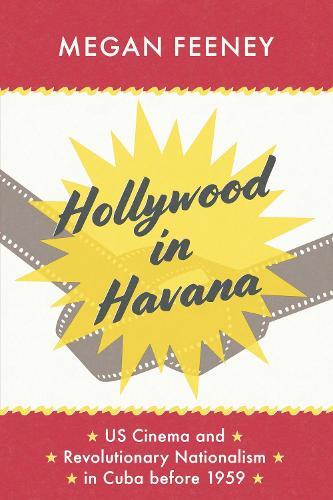
In the 1940s and '50s, Havana was a locus for American movie stars, with glamorous visitors including Errol Flynn, Bette Davis, Joan Crawford, and Marlon Brando. In fact, Hollywood was seemingly everywhere in pre-Castro Havana, with movie theaters three to a block in places, widely circulated silver screen fanzines, and terms like ""cowboy"" and ""gangster"" becoming part of Cuban vernacular speech. Hollywood in Havana takes this historical backdrop as the catalyst for a startling question: Did exposure to half a century of Hollywood pave the way for the Cuban Revolution of 1959? Megan Feeney argues that American movies helped condition Cuban audiences to expect and even demand purer forms of Cuban democracy and national sovereignty after seeing freedom-fighting and rebellious values and behaviors on display in wartime dramas and film noirs. At the same time, influential Cuban intellectuals worked to translate cinematic ethics into revolutionary rhetoric--which, ironically, led to pointed critiques of the US presence in Cuba and which were eventually used to subvert American foreign policy. Hollywood in Havana adds to our evolving notions of how American cinema has been internalized and localized around the world, while also broadening our views of the ongoing history of US-Cuban interactions, both cultural and political.
Full Product Details
Author: Megan Feeney
Publisher: The University of Chicago Press
Imprint: University of Chicago Press
Dimensions:
Width: 1.60cm
, Height: 0.20cm
, Length: 2.30cm
Weight: 0.539kg
ISBN: 9780226593555
ISBN 10: 022659355
Pages: 320
Publication Date: 04 January 2019
Audience:
Professional and scholarly
,
Professional & Vocational
Format: Hardback
Publisher's Status: Active
Availability: Out of stock

The supplier is temporarily out of stock of this item. It will be ordered for you on backorder and shipped when it becomes available.
Reviews
Hollywood in Havana is thoughtful in its conception, astute in its argument, ambitious in its research, and elegant in its articulation. Feeney's argument--that the values and behaviors seen in Hollywood films from the first half of the twentieth century positioned Habaneros to demand new and revolutionary rights and privileges--is original and compelling. This book's transnational border-crossing style is particularly effective and exceedingly relevant as the United States begins to normalize relations with Cuba. Feeney engages with representation, history, criticism, politics, and economics, creating a truly interdisciplinary work. --Ann Marie Stock, College of William & Mary A significant contribution to our evolving understanding of how audiences outside the United States localized American cinema. Hollywood in Havana is well written and well researched, offering an intriguing addition to our knowledge of the cultural relationship between the US and Cuba. --Laura Isabel Serna, University of Southern California
A significant contribution to our evolving understanding of how audiences outside the United States localized American cinema. Hollywood in Havana is well written and well researched, offering an intriguing addition to our knowledge of the cultural relationship between the US and Cuba. --Laura Isabel Serna, University of Southern California Hollywood in Havana is thoughtful in its conception, astute in its argument, ambitious in its research, and elegant in its articulation. Feeney's argument--that the values and behaviors seen in Hollywood films from the first half of the twentieth century positioned Habaneros to demand new and revolutionary rights and privileges--is original and compelling. This book's transnational border-crossing style is particularly effective and exceedingly relevant as the United States begins to normalize relations with Cuba. Feeney engages with representation, history, criticism, politics, and economics, creating a truly interdisciplinary work. --Ann Marie Stock, College of William & Mary
Author Information
Megan Feeney is an independent scholar and was previously assistant professor of history at St. Olaf College.