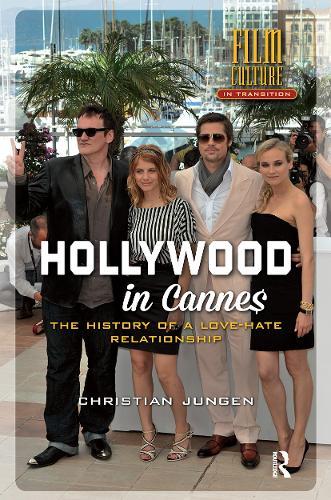
Hollywood in Cannes: The History of a Love-Hate Relationship

Author:   Christian Jungen
Publisher:   Taylor & Francis Ltd
ISBN:  

9781041180920


Pages:   394
Publication Date:   01 December 2025
Format:   Paperback
Availability:   Manufactured on demand   Availability explained
We will order this item for you from a manufactured on demand supplier.

Our Price $119.00 Quantity:  
Add to Cart

Share |

Hollywood in Cannes: The History of a Love-Hate Relationship


Overview

Full Product Details

Author:   Christian Jungen
Publisher:   Taylor & Francis Ltd
Imprint:   Routledge
Weight:   0.730kg
ISBN:  

9781041180920


ISBN 10:   1041180926
Pages:   394
Publication Date:   01 December 2025
Audience:   Professional and scholarly ,  Professional & Vocational
Format:   Paperback
Publisher's Status:   Active
Availability:   Manufactured on demand   Availability explained
We will order this item for you from a manufactured on demand supplier.

Table of Contents

Acknowledgments, Introduction 1 The Festival as a means to promote European national cultures, 1939–1968 1.1 With Hollywood against Hollywood 1.2 The Festival as a definitional context for national cinema 1.3 Hollywood’s handicap on the diplomatic scene 1.4 The art vs. commerce conflict 1.4.1 The false allure of the free visa 1.5 US government interests in the Cold War 2 The star as a symbiosis between Hollywood and Cannes 2.1 Stars as means of market control 2.2 Cannes legitimates itself with Hollywood stars 2.3 The rise of Brigitte Bardot 2.4 Fear of scandal: Hollywood skimps on stars 2.4.1 Warner Brothers loses interest in Cannes: What ever happened to Bette Davis? 3 The auteur in commercial Hollywood 3.1 The emergence of the politique des auteurs in Cahiers du Cinéma 3.2 The politique at the Festival 3.2.1 The Nouvelle Vague becomes a brand at Cannes 3.2.2 Alfred Hitchcock: The “Father of the Nouvelle Vague” as publicity genius 3.3 Criticism of the fora for critical reception 3.3.1 Hollywood’s hegemonic claims 3.3.2 The American score with the jury 3.3.3 Film critics as spoilsports 3.3.4 Preemption by film programmers 4 A new harmony courtesy of New Hollywood, 1969–1981 4.1 The selection process is reformed 4.1.2 Denationalization through coproductions 4.2.2 The end of an era: 1968 interrupts the festival 4.4 Cannes as a success story for Hollywood in crisis 4.4.1 The film market 4.4.2 Columbia’s success with EASY RIDER 4.4.3 With M*A*S*H, Fox becomes the first major to win the Palme d’Or 4.4.4 Warner Brothers celebrates its fiftieth anniversary at Cannes 4.4.5 Artistic grounds for success 4.5 What can films do for the festival? 4.5.1 American critics discover Cannes 4.5.2 Hollywood’s industry press 4.5.3 Cannes on American TV: Dreams for breakfast 4.6 Trans-Atlantic harmony ends 4.6.1 Coppola triumphs with APOCALYPSE NOW 4.6.2 Cimino fails with HEAVEN’S GATE 5 Perils and possibilities for blockbusters, 1975–1997 5.1 Cannes as an avoidable risk 5.1.1 High-concept blockbusters drive out auteur films; marketing neutralizes critics 5.1.2 The multiplex and MTV revolution 5.1.3 “Pictures that people in Kansas City want to see” from Paramount 5.1.4 The Palme d’Or as an art film stigma for THE MISSION 5. 2 Hollywood’s strategies to exploit media concentration 5.2.1 Out of competition, outside criticism 5.2.1.1 E.T. feels at home at Cannes 5.2.2 The politique des acteurs 5.2.2.1 Muscular action heroes 5.2.2.2 Arnold Schwarzenegger makes his movie career on the beach 5.2.2.3 Schwarzenegger’s flop with LAST ACTION HERO 5.2.2.4 Consequences of the strategy of “with Cannes against Cannes” 5.3 The Festival’s politique des acteurs 5.3.1 The Montée des Marches 5.3.2 Sharon Stone becomes a star overnight 5.4 The independents conquer Cannes 6 Cultural exception versus monoculture, 1994–2008 6.1 The new ice age, 1994-2000 6.1.1 Hollywood makes Hollyworld 6.1.2 The GATT negotiations 6.1.3 Cannes as a means to promote cultural diversity 6.1.4. No US blockbusters in competition 6.2 The festival as launch pad, 2001–2008 6.2.1 Global launches 6.2.2 Cannes as gateway to the world market 6.2.3 Veni, Vidi, “Vinci”: THE DA VINCI CODE cracks the critics, Conclusion, Bibliography, Appendix, Index,

Reviews

Author Information

Christian Jungen is film critic of Swiss newspaper NZZ am Sonntag, the Sunday edition of Neue Zürcher Zeitung. He is president of the Swiss Film Critics Association. He gave seminars on the history of film festivals at the Ruhr-Universität Bochum. Recipient of the Prix Pathé for excellence in film journalism 2011.

Tab Content 6

Author Website:  

Countries Available

All regions
Latest Reading Guide

April RG 26_2


Shopping Cart
Your cart is empty
Shopping cart
Mailing List