Overview
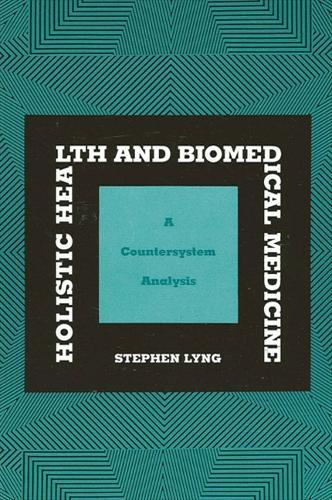
Holistic Health and Biomedical Medicine outlines a new framework for social science research. Illustrated in an analysis of the American health care system, Lyng presents an empirical study of the relationship between medical knowledge and the social structure of medical practice in America. Through a synthesis of ideas from such diverse perspectives as classical Marxian theory and the medical model embraced by the holistic health movement, Lyng articulates a ""medical countersystem"" that is contrasted against the traditional biomedical model of medical practice. What results is an entirely unique Marxian analysis of the U.S. health care system, one that examines how the system evolved historically as well as describes several possibilities for the future of medicine in America.
Full Product Details
Author: Stephen Lyng
Publisher: State University of New York Press
Imprint: State University of New York Press
Dimensions:
Width: 15.20cm
, Height: 2.50cm
, Length: 22.90cm
Weight: 0.372kg
ISBN: 9780791402566
ISBN 10: 0791402568
Pages: 268
Publication Date: 27 August 1990
Audience:
Professional and scholarly
,
Professional and scholarly
,
Professional & Vocational
,
Postgraduate, Research & Scholarly
Format: Paperback
Publisher's Status: Active
Availability: In Print

This item will be ordered in for you from one of our suppliers. Upon receipt, we will promptly dispatch it out to you. For in store availability, please contact us.
Reviews
"""More and more criticisms are being levelled at traditional, allopathic medicine but Lyng's work moves well beyond the normal parameter of criticism. It develops a good argument against positivism, the basic method of traditional medicine and uses the dialectic to present a convincing alternative using the basis of the Marxist approach to the sociology of knowledge. It is a significant and important contribution to the field."" - Derek G. Gill, University of Maryland-Baltimore County ""It is ambitious, creative, and upbeat in style and direction. Although dealing with serious theoretical issues, there is a clarity of thinking and a compelling logic that carries the reader along. I found myself reading it like a detective story at times in anticipation of the punch line."" - Kenneth J. Neubeck, University of Connecticut"
More and more criticisms are being levelled at traditional, allopathic medicine but Lyng's work moves well beyond the normal parameter of criticism. It develops a good argument against positivism, the basic method of traditional medicine and uses the dialectic to present a convincing alternative using the basis of the Marxist approach to the sociology of knowledge. It is a significant and important contribution to the field. - Derek G. Gill, University of Maryland-Baltimore County It is ambitious, creative, and upbeat in style and direction. Although dealing with serious theoretical issues, there is a clarity of thinking and a compelling logic that carries the reader along. I found myself reading it like a detective story at times in anticipation of the punch line. - Kenneth J. Neubeck, University of Connecticut
Author Information
Stephen Lyng is Assistant Professor of Sociology at Virginia Commonwealth University.