|
|
|||
|
||||
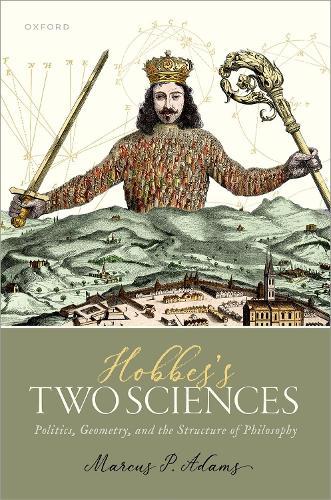
OverviewSeventeenth-Century Thinker Thomas Hobbes maintained that his philosophy constituted a unified system, but in what precise sense did he think that the branches of his philosophy were unified? This question has provoked extensive scholarship over the last half-century. Answering it is essential not only to understanding Hobbes's philosophy generally, but how one answers it significantly impacts our understanding of the Leviathan, his most influential work, and of the Laws of Nature, the foundation of his political philosophy. Hobbes's Two Sciences answers the question of philosophical unificiation by situating Hobbes's politics within his account of scientific knowledge as constructed by humans—an epistemology founded on the idea that makers have special access to causal knowledge—and by demonstrating that the relationship between pure and mixed mathematics provided him with a model for thinking about relationships between geometry and natural philosophy and between politics and history. Marcus P. Adams explores how this understanding of Hobbes's systematic philosophy impacts three long-standing areas of scholarship on Hobbes and the History of Early Modern Philosophy and provides a new view on Hobbes's system . Full Product DetailsAuthor: Marcus P. AdamsPublisher: Oxford University Press Imprint: Oxford University Press Dimensions: Width: 16.40cm , Height: 2.00cm , Length: 24.30cm Weight: 0.494kg ISBN: 9780198924685ISBN 10: 0198924682 Pages: 224 Publication Date: 08 April 2025 Audience: Professional and scholarly , Professional & Vocational Format: Hardback Publisher's Status: Active Availability: To order Stock availability from the supplier is unknown. We will order it for you and ship this item to you once it is received by us. Table of Contents1: Introduction: The Unity of Hobbes's Philosophy 2: Prudential Knowledge from Sense and the Mechanical Mind 3: Scientific Knowledge from Making and the Mechanical Mind 4: Demonstrating Scientific Knowledge in Geometry and Civil Philosophy 5: Hobbesian Natural Philosophy as Mixed Mathematics 6: Experience in Hobbesian Civil Philosophy and Civil HistoryReviewsAuthor InformationMarcus P. Adams is Associate Professor of Philosophy at the State University of New York at Albany and former Associate Editor of the journal Hobbes Studies. His research focuses on perception and natural philosophy in Early Modern Philosophy, in particular these areas in the thought of Thomas Hobbes and Margaret Cavendish. He has edited A Companion to Hobbes (2021), and his papers have appeared in journals such as British Journal for the History of Philosophy, History of Philosophy Quarterly, and Philosophers' Imprint. Tab Content 6Author Website:Countries AvailableAll regions |
||||