Overview
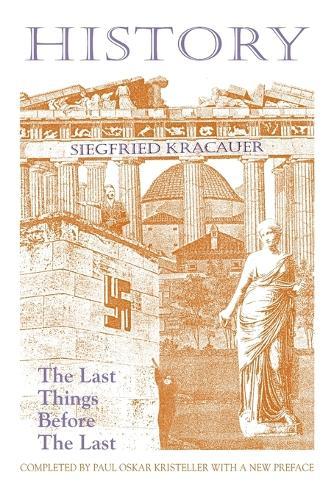
""The late Siegfried Kracauer was best known as a historian and critic of the cinema. His main intellectual preoccupation during the last years of his life was the relation between past and present, and the relation between histories in different levels of generality. Philosophy is concerned with the last things while history seeks to explain 'the last things before the last.' One after another he examined various theories of history and exposed their strengths and weaknesses. Well written and cogently argued."" --Library Journal This edition features a new introduction by editor Paul Oskar Kristeller of Columbia University.
Full Product Details
Author: Siegfried Kracauer ,
Paul Oskar Kristeller (Columbia University, USA)
Publisher: Markus Wiener Publishing Inc
Imprint: Markus Wiener Publishing Inc
Edition: New edition
Dimensions:
Width: 15.20cm
, Height: 1.70cm
, Length: 23.00cm
Weight: 0.426kg
ISBN: 9781558760806
ISBN 10: 1558760806
Pages: 320
Publication Date: 07 September 2013
Audience:
College/higher education
,
Professional and scholarly
,
Undergraduate
,
Postgraduate, Research & Scholarly
Format: Paperback
Publisher's Status: Active
Availability: Available To Order

We have confirmation that this item is in stock with the supplier. It will be ordered in for you and dispatched immediately.
Reviews
Kracauer sees history as a distinct area of reality, much as his Theory of Film stressed the supposedly unique properties of photography. Here he decides that they are both intermediate or anteroom areas. He dwells on the art-nor-science character of the historian's work. But he never comes up with a real Theory. So the book does not provoke the kind of critical attention which resulted in Pauline Kael's attack on his cinematic dogmas and opaque formulations thereof. Not that Kracauer has renounced grandiloquent opacity: take the question as to whether the underlying subjectivity of historical writings may not transcend itself. But if he neglects to unpack questions like this, he declines to press them either. They serve as motifs for a gallery of appraisals and suggestions, a montage of issues and writers. The issues include man's relation to society, the structure of an historical period, notions of time. Writers include Hegel, Marx, Tolstoy, Burckhardt, Croce, Dilthey, Husserl, Collingwood, Bloch, and Levi-Strauss, as well as Proust, who engenders some of the more fruitful remarks. Kracauer pays no attention to current academic philosophers of history (except Mandelbaum). They will find the book passe and muddled. Certainly a dose of analytic rigor would have expedited Kracauer's quest for a redefinition and rehabilitation of certain modes of thought peculiar to historians. Yet the name may attract a certain audience, and students can use the book as a chatty and erudite biography. (Kirkus Reviews)