Overview
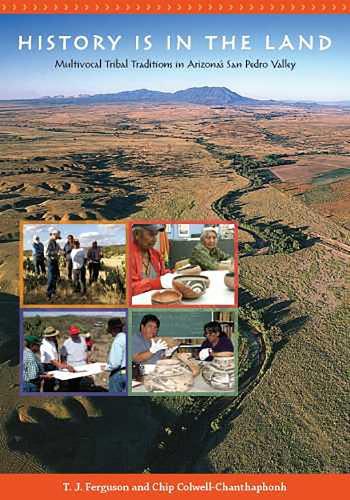
Arizona's San Pedro Valley is a natural corridor through which generations of native peoples have traveled for more than 12,000 years, and today many tribes consider it to be part of their ancestral homeland. This book explores the multiple cultural meanings, historical interpretations, and cosmological values of this extraordinary region by combining archaeological and historical sources with the ethnographic perspectives of four contemporary tribes: Tohono Oodham, Hopi, Zuni, and San Carlos Apache. Previous research in the San Pedro Valley has focused on scientific archaeology and documentary history, with a conspicuous absence of indigenous voices, yet Native Americans maintain oral traditions that provide an anthropological context for interpreting the history and archaeology of the valley. The San Pedro Ethnohistory Project was designed to redress this situation by visiting archaeological sites, studying museum collections, and interviewing tribal members to collect traditional histories. The information it gathered is arrayed in this book along with archaeological and documentary data to interpret the histories of Native American occupation of the San Pedro Valley. This work provides an example of the kind of interdisciplinary and politically conscious work made possible when Native Americans and archaeologists collaborate to study the past. As a methodological case study, it clearly articulates how scholars can work with Native American stakeholders to move beyond confrontations over who owns the past, yielding a more nuanced, multilayered, and relevant archaeology.
Full Product Details
Author: T. J. Ferguson ,
Chip Colwell-Chanthaphonh
Publisher: University of Arizona Press
Imprint: University of Arizona Press
Dimensions:
Width: 17.90cm
, Height: 2.00cm
, Length: 25.40cm
Weight: 0.717kg
ISBN: 9780816525669
ISBN 10: 0816525668
Pages: 336
Publication Date: 30 April 2006
Audience:
College/higher education
,
Postgraduate, Research & Scholarly
Format: Paperback
Publisher's Status: Active
Availability: In Print

This item will be ordered in for you from one of our suppliers. Upon receipt, we will promptly dispatch it out to you. For in store availability, please contact us.
Reviews
Together these scholars cogently lay out a coherent theory, method, and model for conducting collaborative archaeological ethnohistory in Native American communities, which will stand for many years to come as the archetype of interdisciplinary and politically conscious work. <i>Journal of Anthropological Research</i>
The San Pedro Valley is a verdant ribbon of life within the arid environment of southeastern Arizona. Its present tranquility belies the fact that it has been the setting for over 11,000 years of human existence. The alley forms a natural corridor between the Sonoran Desert of northern Mexico and the Gila River of central Arizona. Water is the key to life in the Southwest and the perennial flow of the San Pedro River has insured the almost constant use of the valley by Native American peoples and European immigrants.
Author Information
T. J. Ferguson owns Anthropological Research, LLC, in Tucson, Arizona, where he is also an adjunct professor in the Department of Anthropology at the University of Arizona. Chip Colwell-Chanthaphonh received his PhD from Indiana University and his BA from the University of Arizona. Before coming to the Denver Museum of Nature and Science, he held fellowships with the Center for Desert Archaeology and the American Academy of Arts and Sciences.