Overview
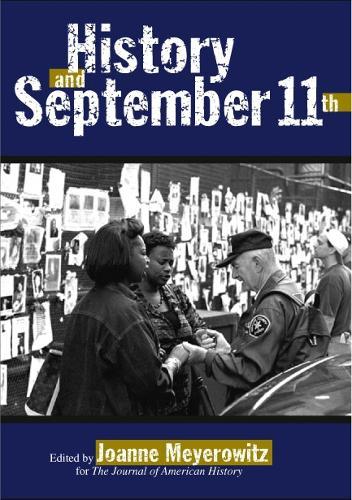
The contributors to this landmark collection set the attacks on the United States in historical perspective. They reject the simplistic notion of an age-old ""clash of civilizations"" and instead examine the particular histories of American nationalism, anti-Americanism, U.S. foreign policy, and Islamic fundamentalism among other topics. With renewed attention to Americans' sense of national identity, they focus on the United States in relation to the rest of the world. A collection of recent and historical documents speeches, articles, and book excerpts supplement the essays. Taken together, the essays and sources in this volume comment on the dangers of seeing the events of September 11 as splitting the nation's history into ""before"" and ""after."" They argue eloquently that no useful understanding of the present is possible without an unobstructed view of the past. Author note: Joanne Meyerowitz is Professor of History at Indiana University and editor of The Journal of American History.
Full Product Details
Author: Joanne Meyerowitz , Journal of American History , Roy Rosenzweig
Publisher: Temple University Press,U.S.
Imprint: Temple University Press,U.S.
Dimensions:
Width: 15.20cm
, Height: 2.30cm
, Length: 22.90cm
Weight: 0.531kg
ISBN: 9781592132027
ISBN 10: 1592132022
Pages: 296
Publication Date: 14 July 2003
Audience:
Professional and scholarly
,
Professional & Vocational
Format: Hardback
Publisher's Status: Active
Availability: Out of stock 
The supplier is temporarily out of stock of this item. It will be ordered for you on backorder and shipped when it becomes available.
Table of Contents
Introduction - Joanne Meyerowtiz1. In the Wake of September 11: The Clash of What? - Michael H. Hunt2. Damming Afghanistan: Modernization in a Buffer State - Nick Cullather3. A Short History of Anti-Americanism and Terrorism: The Turkish Case - Nur Bilge Criss4. Notes on the CIA's Secret War in Afghanistan - John Prados5. Rescuing Women and Children - Emily S. Rosenberg6. A Cultural History of the War without End - Melani McAlister7. The September 11, 2001, Oral History Narrative and Memory Project:8. A First Report - Mary Marshall Clark9. ""Anti-Americanism"" in the Arab World: An Interpretation of a Brief History - Ussama Makdisi10. History in the Fundamentalist Imagination - R. Scott Appleby11. Conjuring with Islam, II - Bruce B. Lawrence12. 9/11, the Great Game, and the Vision Thing: The Need for (and Elements of) a More Comprehensive Bush Doctrine - Bruce R. KuniholmAfterword: The Anteroom of War - Marilyn Blatt YoungPrimary Source DocumentsSamuel P. Huntington, The Clash of Civilizations?, 1993The King-Crane Commission Report, August 28, 1919Sayyid Qutb, Milestones, 1960President Jimmy Carter, State of the Union Address, January 21, 1980Brian Whitaker, The Definition of Terrorism, May 7, 2001President George W. Bush, Address to a Joint Session of Congress and the American People, September 20, 2001Osama bin Laden, Speech on September 11 Attacks, October 7, 2001Pew Global Attitudes Project, Opinion Leaders on America, December 19, 2001Laura Bush, Radio Address on Women in Afghanistan, November 17, 2001President George W. Bush, State of the Union Address, January, 29, 2002Campaign against Sanction with IraqTom Masiello, On September 11th, February 2, 2002
Reviews
The collection of essays serves as an antidote to the amnesia fostered by a passive media and political administrations to provide us with complex multi-perspectival understanding of our world and an imperative to see our local and national milieu in a broader global context... [it] is well organized, with a useful overview by [editor] Meyerowitz. The Indiana Magazine of History This is a splendid collection of essays that helps us make sense of the background and the aftermath of the September 11, 2001, terrorist attacks. Those attacks have resulted in deeper U.S. involvement in the Middle East, but, unfortunately, the nation and the rest of the world have not necessarily come closer together. There is no better way to understand how such a situation has come about than to turn to these thoughtful, clearly written essays by some of the leading historians today. Every piece is excellent without exception. --Akira Iriye, Professor of History, Harvard University, and author of Global Community: The Role of International Organizations in the Making of the Contemporary World This book represents an impressive, important, and timely mobilization of historians. They usefully address the national and international historical meanings the terrible events of 9/11 and the challenges its aftermath poses for American domestic and foreign policies. These essays and documents provide essential material for discussion, whether in the classroom or in the larger public realm. --Tom Bender, Professor of History, New York University, and editor of Rethinking American History in a Global Age This collection of essays, complete with primary sources, by noted scholars in the fields of terrorism, the Middle East, fundamentalist religious movements, anti-Americanism and foreign relations, attempts to provide a deeper and more nuanced understanding of the factors leading up to the terror attacks on September 11. --Publishers Weekly
This is a splendid collection of essays that helps us make sense of the background and the aftermath of the September 11, 2001, terrorist attacks. Those attacks have resulted in deeper U.S. involvement in the Middle East, but, unfortunately, the nation and the rest of the world have not necessarily come closer together. There is no better way to understand how such a situation has come about than to turn to these thoughtful, clearly written essays by some of the leading historians today. Every piece is excellent without exception. -Akira Iriye, Professor of History, Harvard University, and author of Global Community: The Role of International Organizations in the Making of the Contemporary World This book represents an impressive, important, and timely mobilization of historians. They usefully address the national and international historical meanings the terrible events of 9/11 and the challenges its aftermath poses for American domestic and foreign policies. These essays and documents provide essential material for discussion, whether in the classroom or in the larger public realm. -Tom Bender, Professor of History, New York University, and editor of Rethinking American History in a Global Age This collection of essays, complete with primary sources, by noted scholars in the fields of terrorism, the Middle East, fundamentalist religious movements, anti-Americanism and foreign relations, attempts to provide a deeper and more nuanced understanding of the factors leading up to the terror attacks on September 11. -Publishers Weekly The collection of essays serves as an antidote to the amnesia fostered by a passive media and political administrations to provide us with complex multiperspectival understanding of our world and an imperative to see our local and national milieu in a broader global context. ...[it] is well organized, with a useful overview by [editor] Meyerowitz. -The Indiana Magazine of History
""The collection of essays serves as an antidote to the amnesia fostered by a passive media and political administrations to provide us with complex multi-perspectival understanding of our world and an imperative to see our local and national milieu in a broader global context... [it] is well organized, with a useful overview by [editor] Meyerowitz."" The Indiana Magazine of History ""This is a splendid collection of essays that helps us make sense of the background and the aftermath of the September 11, 2001, terrorist attacks. Those attacks have resulted in deeper U.S. involvement in the Middle East, but, unfortunately, the nation and the rest of the world have not necessarily come closer together. There is no better way to understand how such a situation has come about than to turn to these thoughtful, clearly written essays by some of the leading historians today. Every piece is excellent without exception."" --Akira Iriye, Professor of History, Harvard University, and author of Global Community: The Role of International Organizations in the Making of the Contemporary World ""This book represents an impressive, important, and timely mobilization of historians. They usefully address the national and international historical meanings the terrible events of 9/11 and the challenges its aftermath poses for American domestic and foreign policies. These essays and documents provide essential material for discussion, whether in the classroom or in the larger public realm."" --Tom Bender, Professor of History, New York University, and editor of Rethinking American History in a Global Age ""This collection of essays, complete with primary sources, by noted scholars in the fields of terrorism, the Middle East, fundamentalist religious movements, anti-Americanism and foreign relations, attempts to provide a deeper and more nuanced understanding of the factors leading up to the terror attacks on September 11."" --Publishers Weekly
Author Information
Joanne Meyerowitz is Professor of History at Indiana University and editor of The Journal of American History. Contributors: R. Scott Appleby, Mary Marshall Clark, Nur Bilge Criss, Nick Cullather, Michael H. Hunt, Bruce R. Kuniholm, Bruce B. Lawrence, Ussama Makdisi, Melani McAlister, John Prados, Emily S. Rosenberg, Marilyn Blatt Young, and the editor.
Tab Content 6
Author Website:
Countries Available
All regions
|