Overview
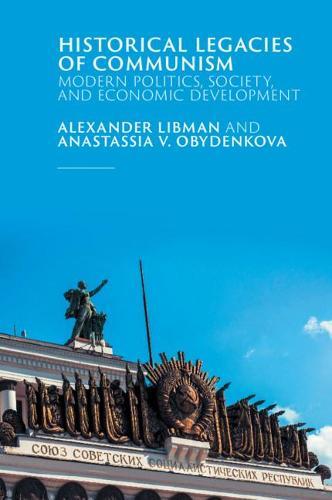
Libman and Obydenkova reveal how legacies of the Communist Party of the Soviet Union (CPSU) have survived in the politics, economic development, culture, and society of post-Communist regions in the 21st Century. The authors show how this impact is not driven by Communist ideology but by the clientelistic practices, opportunism and cynicism prevalent in the CPSU. Their study is built on a novel dataset of the CPSU membership rates in Russian regions in the 1950s-1980s, alongside case studies, interviews and an analysis of mass media previously only available in Russian and discussed here in English for the first time. It will appeal to students and scholars of Russian and Eastern European politics and history, and anyone who wants to better understand countries which live or have lived through Communism: from Eastern Europe to China and East Asian Communist states.
Full Product Details
Author: Alexander Libman (Ludwig-Maximilians-Universität Munchen) ,
Anastassia V. Obydenkova
Publisher: Cambridge University Press
Imprint: Cambridge University Press
Dimensions:
Width: 15.10cm
, Height: 1.90cm
, Length: 23.00cm
Weight: 0.560kg
ISBN: 9781108820486
ISBN 10: 1108820484
Pages: 384
Publication Date: 21 January 2021
Audience:
Professional and scholarly
,
Professional & Vocational
Format: Paperback
Publisher's Status: Active
Availability: Manufactured on demand

We will order this item for you from a manufactured on demand supplier.
Reviews
'In this highly original study, Libman and Obydenkova show that the saturation of Communist Party membership in various regions of Russia during the Soviet period remains associated with such contemporary phenomena as lower levels of inequality and democracy and greater bureaucratic corruption - decades after the demise of the Soviet state. In so doing, they adeptly demonstrate the Communist Party's persisting legacies for contemporary Russia.' Mark R. Beissinger, Henry W. Putnam Professor of Politics, Princeton University 'Libman and Obydenkova's study of Communist Party legacies in Russia takes the discussion of this phenomenon to a new level. An impressive combination of quantitative and qualitative analysis, brimming with thickly descriptive asides about Soviet and post-Soviet life.' Morris and Anna Feldberg Professor of Government and Russian Studies, The Davis Center for Russian and Eurasian Studies, Harvard University
Author Information
Alexander Libman is Professor of Social Sciences and Eastern European Studies at Ludwig Maximilian University of Munich, and a research affiliate at the International Center for the Study of Institutions and Development of the National Research University Higher School of Economics, Moscow. He is the author, co-author or co-editor of ten books. Anastassia V. Obydenkova is a visiting Professor at Barcelona Institute of International Studies, leading research fellow at National Research University Higher School of Economics, research affiliate at Institute for Economic Analysis of Spanish Council for Scientific Research. She was a Fox Fellow at Yale University, Fung Fellow at Princeton University, and Davis Senior Research Scholar at Harvard University. She is the author of multiple articles and books.