Overview
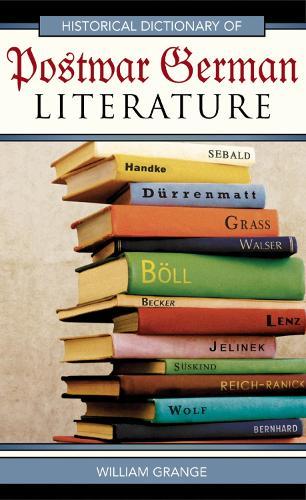
Some authors strongly criticized attempts to rebuild a German literary culture in the aftermath of World War II, while others actively committed themselves to ""dealing with the German past."" There are writers in Austria and Switzerland that find other contradictions of contemporary life troubling, while some find them funny or even worth celebrating. German postwar literature has, in the minds of some observers, developed a kind of split personality. In view of the traumatic monstrosities of the previous century that development may seem logical to some. The Historical Dictionary of Postwar German Literature is devoted to modern literature produced in the German language, whether from Germany, Austria, Switzerland or writers using German in other countries. This volume covers an extensive period of time, beginning in 1945 at what was called ""zero hour"" for German literature and proceeds into the 21st century, concluding in 2008. This is done through a list of acronyms and abbreviations, a chronology, an introductory essay, a bibliography, and hundreds of cross-referenced dictionary entries on writers, such as Nobel Prize-winners Heinrich Böll, Günter Grass, Elias Canetti, Elfriede Jelinek, and W. G. Sebald. There are also entries on individual works, genres, movements, literary styles, and forms.
Full Product Details
Author: William Grange
Publisher: Scarecrow Press
Imprint: Scarecrow Press
Volume: 32
Dimensions:
Width: 14.80cm
, Height: 2.80cm
, Length: 22.80cm
Weight: 0.615kg
ISBN: 9780810859654
ISBN 10: 0810859653
Pages: 370
Publication Date: 09 July 2009
Audience:
General/trade
,
General
Format: Hardback
Publisher's Status: Active
Availability: Awaiting stock

The supplier is currently out of stock of this item. It will be ordered for you and placed on backorder. Once it does come back in stock, we will ship it out for you.
Reviews
The dictionary succeeds in providing a general introduction and understanding of this particularly multifaceted period of German literature and in presenting students with an overview of important authors, defining movements, and events of the German literary scene in 1945. Recommended. CHOICE, January 2010 William Grange has produced another successful historical dictionary... This title is very user friendly... This source is highly recommended for academic libraries. American Reference Books Annual The strength of this work lies in its introduction of authors not included in other reference sources...Recommended for academic libraries supporting programs in German language, literature, and culture as well as libraries with collections of postwar German literature. Booklist, December 2009
The dictionary succeeds in providing a general introduction and understanding of this particularly multifaceted period of German literature and in presenting students with an overview of important authors, defining movements, and events of the German literary scene in 1945. Recommended. Choice, January 2010 William Grange has produced another successful historical dictionary... This title is very user friendly... This source is highly recommended for academic libraries. American Reference Books Annual The strength of this work lies in its introduction of authors not included in other reference sources...Recommended for academic libraries supporting programs in German language, literature, and culture as well as libraries with collections of postwar German literature. Booklist, December 2009
Author Information
William Grange is a cultural historian who has received several awards for his scholarship and teaching. He is Hixson-Lied Professor of Theatre and Film at the University of Nebraska.