Overview
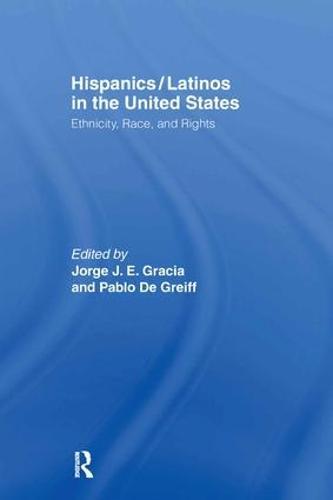
The presence and impact of Hispanics/Latinos in the United States cannot be ignored. Already the largest minority group, by 2050 their numbers will exceed all the other minority groups in the United States combined. The diversity of this population is often understated, but the people differ in terms of their origin, race. language, custom, religion, political affiliation, education and economic status. The heterogeneity of the Hispanic/Latino population raises questions about their identity and their rights: do they really constitute a group? That is, do they have rights as a group, or just as individuals? This volume, called by one reviewer the best set of essays that I have ever read on Latino identity and group rights' addresses these concerns through a varied and interdisciplinary approach. With first-rate scholarship from a group of internationally renowned, established contributors, this collection of cutting-edge material makes a significant contribution to Latin American studies as well as Philosophy and Ethnic studies.
Full Product Details
Author: Jorge J.E. Gracia ,
Pablo De Greiff
Publisher: Taylor & Francis Ltd
Imprint: Routledge
Dimensions:
Width: 15.20cm
, Height: 2.50cm
, Length: 22.90cm
Weight: 0.690kg
ISBN: 9780415926195
ISBN 10: 041592619
Pages: 288
Publication Date: 29 June 2000
Audience:
College/higher education
,
General/trade
,
Tertiary & Higher Education
,
General
Format: Hardback
Publisher's Status: Active
Availability: In Print

This item will be ordered in for you from one of our suppliers. Upon receipt, we will promptly dispatch it out to you. For in store availability, please contact us.
Reviews
That a majority of contributors disagree on a range of issues... makes this volume all the more refreshing... worthy of attention by historians, scholars of ethnic studies and Latino studies, and anyone interested in the general debates about Hispanic/Latino identity and politics. <br>-Journal of American History <br> This diverse collection of excellent essays dealing with Hispanic identity, empowerment, affirmative action, and the people's connection to the political system does a lot to bring understanding to a complex group. <br>- Choice <br> Latino Studies as a discipline has undergone an explosive growth in the last few years, one happily marked by a multiplicity of visions that meddle without restraint in other fields--history, racial policy, immigration, jurisprudence, the culture wars--and raise urgent, inescapable questions. This volume is a generous sampler of eclecticism. That the reader is likely to disagree with several of the individual conclusions is an asset, for what unifies these essays is not their gregariousness but the rigor, passion and independence of thought they emanate, all of which are pushing the young discipline to unexpected heights. <br>-Ilan Stavans, author of The Hispanic Condition <br> This book will break new ground for the emergence in philosophy of ethnic studies not only because the scholarship is first rate but also because it fills a void in the current literature....will probably be required reading in the field for years to come. <br>-Oscar Marti, former editor of Aztlan: International Journal of Chicano Studies Research <br>
That a majority of contributors disagree on a range of issues... makes this volume all the more refreshing... worthy of attention by historians, scholars of ethnic studies and Latino studies, and anyone interested in the general debates about Hispanic/Latino identity and politics. -- Journal of American History This diverse collection of excellent essays dealing with Hispanic identity, empowerment, affirmative action, and the people's connection to the political system does a lot to bring understanding to a complex group. -- Choice Latino Studies as a discipline has undergone an explosive growth in the last few years, one happily marked by a multiplicity of visions that meddle without restraint in other fields--history, racial policy, immigration, jurisprudence, the culture wars--and raise urgent, inescapable questions. This volume is a generous sampler of eclecticism. That the reader is likely to disagree with several of the individual conclusions is an asset, for what unifies these essays is not their gregariousness but the rigor, passion and independence of thought they emanate, all of which are pushing the young discipline to unexpected heights. -- Ilan Stavans, author of The Hispanic Condition This book will break new ground for the emergence in philosophy of ethnic studies not only because the scholarship is first rate but also because it fills a void in the current literature...will probably be required reading in the field for years to come. -- Oscar Marti, former editor of Aztlan: International Journal of Chicano Studies Research
That a majority of contributors disagree on a range of issues... makes this volume all the more refreshing... worthy of attention by historians, scholars of ethnic studies and Latino studies, and anyone interested in the general debates about Hispanic/Latino identity and politics. -Journal of American History This diverse collection of excellent essays dealing with Hispanic identity, empowerment, affirmative action, and the people's connection to the political system does a lot to bring understanding to a complex group. - Choice Latino Studies as a discipline has undergone an explosive growth in the last few years, one happily marked by a multiplicity of visions that meddle without restraint in other fields--history, racial policy, immigration, jurisprudence, the culture wars--and raise urgent, inescapable questions. This volume is a generous sampler of eclecticism. That the reader is likely to disagree with several of the individual conclusions is an asset, for what unifies these essays is not their gregariousness but the rigor, passion and independence of thought they emanate, all of which are pushing the young discipline to unexpected heights. -Ilan Stavans, author of The Hispanic Condition This book will break new ground for the emergence in philosophy of ethnic studies not only because the scholarship is first rate but also because it fills a void in the current literature....will probably be required reading in the field for years to come. -Oscar Marti, former editor of Aztlan: International Journal of Chicano Studies Research
That a majority of contributors disagree on a range of issues... makes this volume all the more refreshing... worthy of attention by historians, scholars of ethnic studies and Latino studies, and anyone interested in the general debates about Hispanic/Latino identity and politics. -Journal of American History This diverse collection of excellent essays dealing with Hispanic identity, empowerment, affirmative action, and the people's connection to the political system does a lot to bring understanding to a complex group. - Choice Latino Studies as a discipline has undergone an explosive growth in the last few years, one happily marked by a multiplicity of visions that meddle without restraint in other fields--history, racial policy, immigration, jurisprudence, the culture wars--and raise urgent, inescapable questions. This volume is a generous sampler of eclecticism. That the reader is likely to disagree with several of the individual conclusions is an asset, for what unifies these essays is not their gregariousness but the rigor, passion and independence of thought they emanate, all of which are pushing the young discipline to unexpected heights. -Ilan Stavans, author of The Hispanic Condition This book will break new ground for the emergence in philosophy of ethnic studies not only because the scholarship is first rate but also because it fills a void in the current literature....will probably be required reading in the field for years to come. -Oscar Marti, former editor of Aztlan: International Journal of Chicano Studies Research
Author Information
Jorge J. E. Gracia is Samuel P. Capen Chair and SUNY Distinguished Professor of Philosophy at SUNY Buffalo. He is the author most recently of Hispanic/Latino Identity (1999). Pablo De Greiff is Assistant Professor of Philosophy at SUNY Buffalo and editor of Drugs and theLimits of Liberalism (1999).