Overview
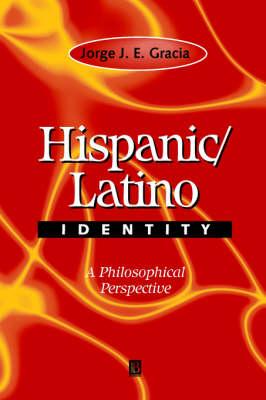
This volume provides a superb introduction to the philosophical, social, and political elements of Hispanic/Latino identity. It is an indispensable tool for anyone interested in issues that concern Hispanics/Latinos, social policy, and the history of thought and culture.
Full Product Details
Author: Jorge J. E. Gracia (State University of New York, Buffalo)
Publisher: John Wiley and Sons Ltd
Imprint: Wiley-Blackwell
Dimensions:
Width: 15.20cm
, Height: 1.80cm
, Length: 23.10cm
Weight: 0.408kg
ISBN: 9780631217640
ISBN 10: 0631217649
Pages: 256
Publication Date: 18 September 1999
Audience:
College/higher education
,
Professional and scholarly
,
Undergraduate
,
Professional & Vocational
Format: Paperback
Publisher's Status: Active
Availability: Out of stock

The supplier is temporarily out of stock of this item. It will be ordered for you on backorder and shipped when it becomes available.
Reviews
"Gracia has written a clear and understandable book that will appeal to general readers and lower-division undergraduates." Choice, March 2000, P. Vila, University of Texas at San Antonio "It would be impossible to overestimate the contribution that Jorge Gracia's book makes to the philosophical fields of ethnic and Hispanic/Latino studies.The book has already succeeded in promoting a lively discussion among leading figures in these fields." The Journal of Speculative Philosophy, Vol. 17, 2003 "In this book Jorge Gracia makes a formidable case for a non-essentialist Hispanic identity. Lurking behind his arguments is a case for rethinking two other kinds of identities - what it means to be an American, and what it means to be a philosopher. Hispanic/Latino Identity: A Philosophical Perspective moves smoothly between these often muddled layers of identity and by the end offers insights that can only be enriching to an American philosophical community typically perceived by non-whites as indifferent, even hostile." Samuel O. Imbo, Essays in Philosophy, Vol. 5, No. 1, January 2004, Book Review
Gracia has written a clear and understandable book that will appeal to general readers and lower-division undergraduates. Choice, March 2000, P. Vila, University of Texas at San Antonio It would be impossible to overestimate the contribution that Jorge Gracia's book makes to the philosophical fields of ethnic and Hispanic/Latino studies.The book has already succeeded in promoting a lively discussion among leading figures in these fields. The Journal of Speculative Philosophy, Vol. 17, 2003 In this book Jorge Gracia makes a formidable case for a non-essentialist Hispanic identity. Lurking behind his arguments is a case for rethinking two other kinds of identities - what it means to be an American, and what it means to be a philosopher. Hispanic/Latino Identity: A Philosophical Perspective moves smoothly between these often muddled layers of identity and by the end offers insights that can only be enriching to an American philosophical community typically perceived by non-whites as indifferent, even hostile. Samuel O. Imbo, Essays in Philosophy, Vol. 5, No. 1, January 2004, Book Review
Author Information
Jorge J. E. Gracia was born in Cuba and educated in Cuba, Europe, and the United States. He is currently Samuel P. Capen Chair and Distinguished Professor of Philosophy at the State University of New York at Buffalo. He is author of ten books and more than 150 articles, and has edited more than a dozen books on metaphysics, historiography, hermeneutics, medieval philosophy, and Hispanic philosophy. He has been President of the Society for Medieval and Renaissance Philosophy, the Society for Iberian and Latin American Thought, the American Catholic Philosophical Association, and the International Federation of Latin American and Caribbean Studies.