Overview
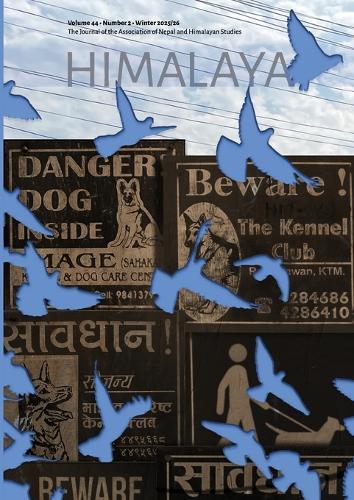
The cover of this issue, designed by Salil Gulal, renders this tension with striking clarity. The image draws from the visual language of Kathmandu's urban landscape, a city dense with warnings, prohibitions, surveillance, and instructional signage. Across this field appear bright blue birds in motion. Their presence unsettles the composition and signals movement where stillness is demanded. Read alongside familiar ""Kennel Club"" signs and other markers of discipline, the birds can be read as suggesting a generational refusal of inherited fear. The image invites us to see Nepal, and the Himalaya more broadly, as a space shaped by contestation and political vitality rather than timeless stasis. Jeevan R. Sharma, editor-atlarge for HIMALAYA, was in Kathmandu during the early days of what came to be widely described as a generational uprising against corruption. The immediate catalyst was associated with sweeping restrictions on a number of digital communication platforms, though the protests quickly exceeded any single grievance. Sharma described a city suspended between grief and resolve, uncertainty and determination. The days that followed were marked by violence and loss, and were followed by rapid political shifts that included changes in leadership and a temporary easing of unrest. No single narrative can contain these events. What they demonstrate is that political life, even under conditions of constraint, remains unsettled and open to disruption. Hope, when it appears, rarely does so cleanly. For HIMALAYA, such moments clarify the journal's task. Since its founding in 1972, the journal has sought to provide a space for careful, historically grounded, and ethically serious scholarship on life in the Himalayan region and its diasporas. Now in our fifty-third year of publication, we remain committed to work that confronts difficulty directly, whether through ethnography, history, or theory. Against the normalisation of political fatalism, we continue to insist on analysis that keeps open questions of responsibility, agency, and possibility. It is in this spirit that we present this issue. The contributions gathered here engage questions of death, ritual, gender, ecology, art, migration, and care. Tara Emily Adhikari's study of the Kichkini legend in Nepal examines how ghost narratives articulate anxieties surrounding gender, sexuality, and social change. Padma Rigzin traces the transformation of the snow leopard into what Karl Polanyi termed a fictitious commodity within Ladakh's tourism economy, attending to questions of visibility, value, and conservation. Austin Simoes-Gomes explores gossip as a form of ritual criticism among Newar Buddhist practitioners, revealing how normative judgments circulate outside formal settings. Elena Neri's ethnography of Bhutanese migration to Australia challenges linear models of detachment by showing how food practices sustain obligation and continuity across distance. Karma Norbu Bhutia and Mitashree Srivastava document the living tradition of Thangka art in Sikkim examining its sacred techniques alongside the pressures that threaten its transmission. The issue also includes a conference report from Entangled Medical Futures which brought together scholars and clinicians to examine plural medical worlds shaped by ecological change, infrastructural precarity, and shifting expectations of care. The reviews that close the volume extend HIMALAYA's long-standing engagement with literature, history, and visual culture across the region. Together, the work in this issue reaffirms the journal's enduring orientation. Scholarship matters, especially in periods marked by violence and epistemic narrowing, because it resists simplification and keeps open spaces for thought, critique, and ethical attention. That commitment has sustained HIMALAYA for over half a century. It continues here.
Full Product Details
Author: Michael T Heneise
Publisher: Association for Nepal and Himalayan Studies
Imprint: Association for Nepal and Himalayan Studies
Dimensions:
Width: 21.00cm
, Height: 0.70cm
, Length: 29.70cm
Weight: 0.367kg
ISBN: 9798295582820
Pages: 108
Publication Date: 23 January 2026
Audience:
General/trade
,
General
Format: Paperback
Publisher's Status: Active
Availability: Available To Order

We have confirmation that this item is in stock with the supplier. It will be ordered in for you and dispatched immediately.