|
|
|||
|
||||
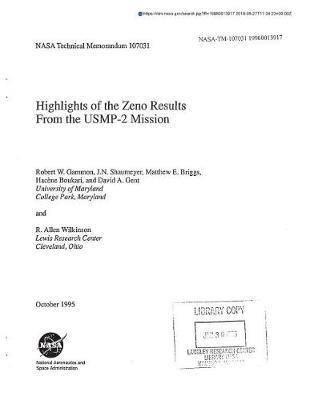
OverviewThe Zeno instrument, a High-precision, light-scattering spectrometer, was built to measure the decay rates of density fluctuations in xenon near its liquid-vapor critical point in the low-gravity environment of the U.S. Space Shuttle. Eliminating the severe density gradients created in a critical fluid by Earth's gravity, we were able to make measurements to within 100 microKelvin of the critical point. The instrument flew for fourteen days in March, 1994 on the Space Shuttle Columbia, STS-62 flight, as part of the very successful USMP-2 payload. We describe the instrument and document its performance on orbit, showing that it comfortably reached the desired 3 microKelvin temperature control of the sample. Locating the critical temperature of the sample on orbit was a scientific challenge; we discuss the advantages and short-comings of the two techniques we used. Finally we discuss problems encountered with making measurements of the turbidity of the sample, and close with the results of the measurement of the decay rates of the critical-point fluctuations. Gammon, Robert W. and Shaumeyer, J. N. and Briggs, Matthew E. and Boukari, Hacene and Gent, David A. and Wilkinson, R. Allen Glenn Research Center NAS3-25370; RTOP 963-50-00... Full Product DetailsAuthor: National Aeronaut Administration (Nasa)Publisher: Createspace Independent Publishing Platform Imprint: Createspace Independent Publishing Platform Dimensions: Width: 21.60cm , Height: 0.20cm , Length: 27.90cm Weight: 0.104kg ISBN: 9781722276300ISBN 10: 1722276304 Pages: 34 Publication Date: 05 July 2018 Audience: General/trade , General Format: Paperback Publisher's Status: Active Availability: Available To Order We have confirmation that this item is in stock with the supplier. It will be ordered in for you and dispatched immediately. Table of ContentsReviewsAuthor InformationTab Content 6Author Website:Countries AvailableAll regions |
||||