Overview
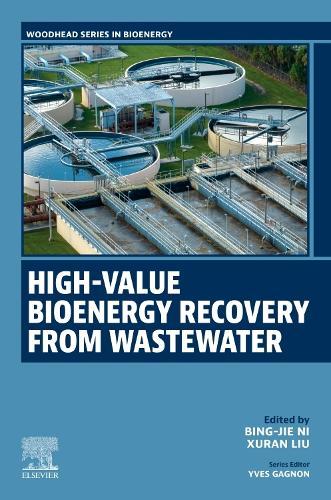
High-Value Bioenergy Recovery from Wastewater presents the science and technologies behind high-value liquid, colloid and solid bioenergy recovery in municipal sewage treatment plants, thus allowing for the easy collection, storage, and transportation of recovered bioenergy. Broken into four parts, the book addresses potential high-value bioenergy from sewage, the science behind and technical module related to high-value liquid bioenergy recovery and high-value colloid and solid bioenergy recovery, and concludes with integrated modules for high-value bioenergy recovery. Academic and industry researchers working in bioenergy, scientists and engineers working in the treatment of wastewater, and industry practitioners who are interested in adding value to the sewage and the sludge obtained in the treatment of wastewater will benefit from this reference, as will advanced graduate and post-graduate students interested in bioenergy and wastewater treatment.
Full Product Details
Author: Bing-Jie Ni (IWA Fellow and Full Professor, The University of New South Wales, Australia) ,
Xuran Liu (Research Fellow, The University of New South Wales, Australia)
Publisher: Elsevier - Health Sciences Division
Imprint: Woodhead Publishing
ISBN: 9780443291272
ISBN 10: 0443291276
Pages: 277
Publication Date: 01 January 2026
Audience:
Professional and scholarly
,
Professional & Vocational
Format: Paperback
Publisher's Status: Forthcoming
Availability: Not yet available

This item is yet to be released. You can pre-order this item and we will dispatch it to you upon its release.
Author Information
Prof. Bing-Jie Ni is an IWA Fellow and Full Professor at The University of New South Wales, in Australia. He works in the field of environmental technology and wastewater treatment, particularly the interface among process engineering, microbial biotechnology, materials science and mathematical modeling, focusing on the integration of these disciplines to develop innovative and sustainable technological solutions to achieve high-levels of pollutant removal from wastewater with a minimised carbon footprint and maximised energy recovery, in order to transform wastes or wastewater from a troublesome pollutant to a valuable resource and save large quantities of greenhouse gas emissions. Prof. Ni has published 2 research books, 30 book chapters, and more than 500 papers in referred ISI journals. He serves as He serves as Editor-in-Chief for Cleaner Water (Elsevier), Editor for Sustainable Horizons (Elsevier), and Associate Editor for the Environmental Chemistry Letters (Springer) and Critical Reviews in Environmental Science and Technology (Taylor). Dr. Xuran Liu is a Research Fellow at the University of New South Wales, Australia. His research focuses on developing sustainable solutions for organic waste treatment and addressing the control of emerging pollutants in natural and engineered environments. Dr. Liu has published over 130 papers in peer-reviewed ISI journals and has been consistently recognized among the World’s Top 2% Scientists by Stanford/Elsevier since 2021.