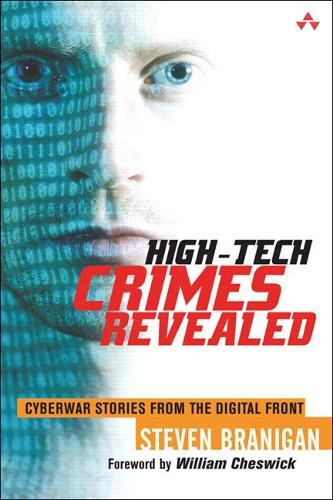
High-Tech Crimes Revealed: Cyberwar Stories from the Digital Front

Author:   Steven Branigan ,  William R. Cheswick
Publisher:   Pearson Education (US)
ISBN:  

9780321218735


Pages:   448
Publication Date:   09 September 2004
Format:   Paperback
Availability:   In Print   Availability explained
Limited stock is available. It will be ordered for you and shipped pending supplier's limited stock.

Our Price $92.37 Quantity:  
Add to Cart

Share |

High-Tech Crimes Revealed: Cyberwar Stories from the Digital Front


Overview

Stories about hacking, stolen credit card numbers, computer viruses, and identity theft are all around us, but what do they really mean to us? The goal of this book, quite simply, is to help educate people on the issues with high-tech crimes. High-Tech Crimes Revealed: Cyberwar Stories from the Digital Front demystifies the risks and realities of high-tech crimes. Demystifying these crimes and raising the awareness of users of technology will make people smarter and safer, and that will make all of us safer in the long run. Steven Branigan shares the inside details on real cases he worked on in his various roles in law-enforcement, information technology, and security. The result is a comprehensive, accessible look at how digital crimes are discovered, what techniques the criminals use and why, and (in some cases) how they can be brought to justice. Inside, you'll find extensive information on*Actual hacker investigations, including the harm caused and how the criminals were tracked and caught*The ins and outs of identity theft, a rapidly growing crime with potential for serious damage*Using the criminology and psychology of hackers to detect and deter attacks*The risks associated

Full Product Details

Author:   Steven Branigan ,  William R. Cheswick
Publisher:   Pearson Education (US)
Imprint:   Addison-Wesley Educational Publishers Inc
Dimensions:   Width: 16.60cm , Height: 2.90cm , Length: 22.70cm
Weight:   0.700kg
ISBN:  

9780321218735


ISBN 10:   0321218736
Pages:   448
Publication Date:   09 September 2004
Audience:   College/higher education ,  Tertiary & Higher Education
Format:   Paperback
Publisher's Status:   Out of Print
Availability:   In Print   Availability explained
Limited stock is available. It will be ordered for you and shipped pending supplier's limited stock.

Table of Contents

Foreword. Preface. 1. An Attack on the Telephone Network.      The First Meeting.      The Beginning.       Follow Up.       Cyber-Tailing.       The Management Update.       A Review of the Data….       Decisions, Decisions….       Off to See the Law.       Building the Search Warrant.       Execution of the Warrant.       The Computer Forensics.       The End Game .       Conclusions. 2. An Attack on an ISP.    Starting Up a Case.       A Simple Call to Customer Support.       Handle the Crisis.       What Are the Options.     You Can Never Find…       The Investigation Begins.       The Search Warrant.       A Method for Performing a Computer Search Without Removing Equipment.       Post-Evidence Collection.      A Surprising Find.       Call in the Feds.       Squeezing the CW Like a Lemon.       Coming to America.      Time for Another Search.       Finding an Unlisted ISP.       Package Up the Data.      Pulling It Back Together.      The Conclusion. 3. If He Had Just Paid the Rent.     The Eviction.      A Simple Twist.      NYECTF.      Time to Collect the Stuff.      The Initial Examination.      The Previous Owner.      The Prosecution.      Why Speeding Is Not Such a Good Idea.      Fugitive Lessons.      The Fugitive’s Choice.      Wesley’s Moves.      Technicalities.      End-Game. 4. Inside a Hacker Sting Operation…     Operation Cybersnare Background.      Being a Confidential Informant.      The Sting Starts.      Forensic Findings.      The Seven Steps of Hacking.      Time to Act.      The Leftovers. 5. Identity Theft.      What Is Identity Theft?      How Did We Get Here?       Purchasing on Credit.      The Resultant Crimes.       Credit Card Fraud.       Utility Subscription Fraud.       Bank Fraud       Employment Fraud.       Loan Frauds.       Government Document/Benefits Fraud.       Other.      What and When Do People Notice?      What To Do if You Are a Victim.       Discover Any Criminal Issues.       Secure Your Credit.      What Else Can Be Done?       Consumer.       Business and Law Enforcement. 6. Let’s Ask the Hackers…     Bob Gets Some Attention.       The Initial Exam of the Drive.       Evaluating the Damage.       The Hacker Interview.       Preferred Target: Technology Companies.       Hacked and Re-Hacked Systems.       Controlled by an Uber-Hacker.      Another Hacker–Alphie.       Off to the Prison.       Hacking Tools.       Motivation for Creating Tools. 7. Why Do Hackers Hack?     Technology Itself Isn’t the Solution.      Know Your Adversary.       Pseudo-Hacker Types.      What Drives Them?      The Hacker Motivations.       Revenge .       Profit .       Hacking Money and Monetary Tools.       Pride.       Intellectual Challenge (Curiosity).     Further Refinements.     Insiders: Motivated by Profit and Revenge.     Outsiders: Motivated by Profit and Curiosity.     What Can Be Done? 8. Setting the Stage.     The Growth of High-Tech Crime.      In the Beginning….       Phone Systems and Voicemail.       Timeshare Systems.       The Drive to Network.      Distributed Computing Begins.       Setting the Corporate Network Stage.       More Useful Networks.       Remote Access to Data.      Today’s Corporate Network.       Computers.      The Result of Network Evolution.       Firewalls.       Virus Scanners.       Web Proxies.       DMZs.       Virtual Private Networks (VPNs).      The Network Growth.      What Upsets Network Security.       Business Partner Connectivity.       Merger or Divestiture.       Introduction of New Services.       Internal Employees That Know a Better Way to Do Something.      Closing Thoughts.       Increased High Technology.       Convenience Reduces Security.       Static Security Policies. 9. High-Tech Crime .     Why Is High Technology Popular?      What Is a High-Tech Crime?       Computer Hacking Attacks.       Viruses.       Technology Used in the Commission of a Crime.       Technology as the Target of a Crime.      The Growing Threat.      Information IS the Target.       Information Copying.       Credit Card Number Theft.       Deleting or Altering Information.       Eavesdropping.      Complexities with High-Tech Crimes.       Jurisdiction Issues.       Corporate Role.       Forensic Examinations.       Intelligence of the Criminal.      What About Private Citizens?      High-Tech Versus Society.       DMCA.      Summary. 10. What Not to Do.      What Could Possibly Go Wrong?        Analyzing the Options.       Trouble on the Horizon.       Mistakes, Mistakes.       Is Everything Lost?      Some Lessons.       Management Team Issues.       Poor Case Management.       Impatience–Rushing Cases.       Lacking of Understanding of the Technology Being Investigated.       Miscommunication.       Bad Luck. 11. How to Run a High-Tech Case.      Some Concerns.      The Basics.      How Does a Case Start?       Unsolicited Report.       Personally Witness.       Automated Detection.       Leads from Another Investigation.       High-Tech Reporting Issues.      Actively Investigating the Case.       Establish the Case Parameters.       Evidence Collection.       Maintain Records.       Issues with Evidence Collection.      Make Your Move.      See the Case Through.      The End Game. 12. What Have We Learned.      A High-Tech Crime Timeline.      Warning Labels.      A Virtual Identity Makes Crime Easier.      Computers in Society.       Business Improvements.       Home Improvements.      Running Ahead of Ourselves.      Is There Hope?      How to Respond.       Improved Laws and Law Enforcement.       Improved Handling of Internal Hackers.       Increased Awareness of High-Tech Crime.      Parting Thoughts. Appendix A.     Additional Information for Part 4, “Inside a Hacker Sting Operation”.       Operation Cybersnare.      Additional Information for Part 6, “Let’s Ask the Hackers”. Bibliography. Index.  

Reviews

Author Information

"High-Tech Crimes Revealed: Cyberwar Stories from the Digital FrontAbout the Author STEVEN BRANIGAN, President of CyanLine LLC, has over 15 years of experience in computer science and forensics. He is internationally recognized as an expert in computer security, and has testified before Congress, qualified as an expert witness for the government and has lectured on network security issues to N.A.T.O., the US Department of Justice and the US Secret Service. In addition to being a founding member of the NY Electronic Crimes task force with Bob Weaver, Branigan worked as a Senior Manager with Bill Cheswick in Bell Labs Computing and Network Research, and together they subsequently founded Lumeta Corporation. In his ""spare"" time, he is pursuing his MBA at Columbia University. A(c) Copyright Pearson Education. All rights reserved."

Tab Content 6

Author Website:  

Countries Available

All regions
Latest Reading Guide

MRGC26


Shopping Cart
Your cart is empty
Shopping cart
Mailing List