Overview
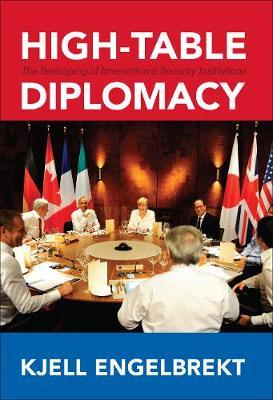
The proliferation of ""minilateral"" summits is reshaping how international security problems are addressed, yet these summits remain a poorly understood phenomenon. In this groundbreaking work, Kjell Engelbrekt contrasts the most important minilateral summits -- the G7 (formerly G8) and G20 -- with the older and more formal UN Security Council to assess where the diplomacy of international security is taking place and whether these institutions complement or compete with each other. Engelbrekt's research in primary-source documents of the G7, G8, G20, and UN Security Council provides unique insight into how these institutions deliberate on three policy areas: conflict management, counterterrorism cooperation, and climate change mitigation. Relatively informal and flexible, GX diplomacy invites more countries to take a seat at the table and allows nontraditional security threats to be placed on the agenda. Engelbrekt concludes, however, that there is a continuing need for institutions like the UN to address traditional security problems. High-Table Diplomacy will provoke discussion and further research on the role of minilateral summits among scholars of international relations, security studies, and international organizations.
Full Product Details
Author: Kjell Engelbrekt ,
Kjell Engelbrekt ,
Kjell Engelbrekt ,
Kjell Engelbrekt
Publisher: Georgetown University Press
Imprint: Georgetown University Press
Dimensions:
Width: 15.20cm
, Height: 1.90cm
, Length: 22.90cm
Weight: 0.572kg
ISBN: 9781626163126
ISBN 10: 162616312
Pages: 288
Publication Date: 10 June 2016
Audience:
Professional and scholarly
,
Professional & Vocational
Format: Hardback
Publisher's Status: Active
Availability: Manufactured on demand

We will order this item for you from a manufactured on demand supplier.
Reviews
Much to his credit, Engelbrekt has sought to provide a unified picture of contemporary global order. He has focused on peace and security matters--his 'High Table' diplomacy approach unites power perspectives with 'order' perspectives. Engelbrekt's analysis integrates formal and informal institutions, great powers and middle powers, in ways much of the literature ignores. Today's global order is far more complex including the actors and their complicated arrangements and Engelbrekt has provided us with a more complete map of global governance than most. --Alan S. Alexandroff, Director of the Global Summitry Project, Munk School of Global Affairs, University of Toronto
Much to his credit, Engelbrekt has sought to provide a unified picture of contemporary global order. He has focused on peace and security matters-his 'High Table' diplomacy approach unites power perspectives with 'order' perspectives. Engelbrekt's analysis integrates formal and informal institutions, great powers and middle powers, in ways much of the literature ignores. Today's global order is far more complex including the actors and their complicated arrangements and Engelbrekt has provided us with a more complete map of global governance than most. -- Alan S. Alexandroff, Director of the Global Summitry Project, Munk School of Global Affairs, University of Toronto
Author Information
Kjell Engelbrekt is a professor in the Swedish Defence University's Department of Political Science and a member of the Royal Swedish Academy of War Studies and a Nonresident Senior Fellow on Global Security at the Chicago Council on Global Affairs.