|
|
|||
|
||||
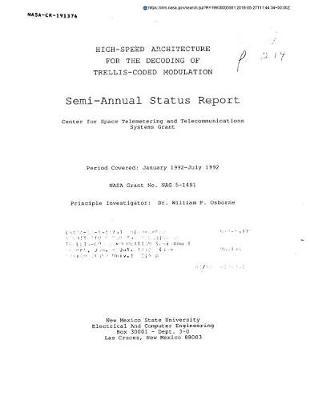
OverviewSince 1971, when the Viterbi Algorithm was introduced as the optimal method of decoding convolutional codes, improvements in circuit technology, especially VLSI, have steadily increased its speed and practicality. Trellis-Coded Modulation (TCM) combines convolutional coding with higher level modulation (non-binary source alphabet) to provide forward error correction and spectral efficiency. For binary codes, the current stare-of-the-art is a 64-state Viterbi decoder on a single CMOS chip, operating at a data rate of 25 Mbps. Recently, there has been an interest in increasing the speed of the Viterbi Algorithm by improving the decoder architecture, or by reducing the algorithm itself. Designs employing new architectural techniques are now in existence, however these techniques are currently applied to simpler binary codes, not to TCM. The purpose of this report is to discuss TCM architectural considerations in general, and to present the design, at the logic gate level, or a specific TCM decoder which applies these considerations to achieve high-speed decoding. Osborne, William P. Unspecified Center NASA-CR-191374, NAS 1.26:191374 NAG5-1491... Full Product DetailsAuthor: National Aeronaut Administration (Nasa)Publisher: Createspace Independent Publishing Platform Imprint: Createspace Independent Publishing Platform Dimensions: Width: 21.60cm , Height: 1.20cm , Length: 27.90cm Weight: 0.513kg ISBN: 9781724236890ISBN 10: 172423689 Pages: 216 Publication Date: 25 July 2018 Audience: General/trade , General Format: Paperback Publisher's Status: Active Availability: Available To Order We have confirmation that this item is in stock with the supplier. It will be ordered in for you and dispatched immediately. Table of ContentsReviewsAuthor InformationTab Content 6Author Website:Countries AvailableAll regions |
||||