Overview
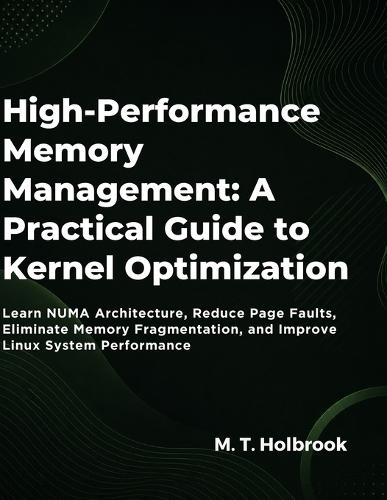
Stop guessing about memory performance. This book teaches you the actual mechanisms Linux uses to manage memory, then shows you exactly how to tune them for your workload. Memory management is the hidden layer between your application and hardware. When it works well, you get incredible performance. When it doesn't, your system stalls, your database becomes slow, and your infrastructure costs skyrocket. Most engineers treat memory tuning as black magic-random sysctls and hope. This book changes that. You'll learn how the Linux kernel actually allocates pages, reclaims memory when pressure rises, handles NUMA architectures, and prevents fragmentation. More importantly, you'll learn when each tuning parameter matters and when it doesn't. You'll understand why changing one sysctl helps your database but breaks your cache server. You'll know the exact commands to diagnose what's happening right now on your production system. This is not a theoretical deep-dive into kernel source code. It's a practical guide written by engineers for engineers. Every concept is grounded in real scenarios you'll encounter: latency spikes every 30 seconds, memory that never gets freed, NUMA systems with uneven performance, applications that work on dev but fall apart in production. Each chapter includes working code, actual system output, and step-by-step troubleshooting procedures you can use immediately. What You'll Learn How Linux memory allocation actually works: From page tables to the buddy allocator, understand what happens when your code requests memory NUMA architecture optimization: Master dual-socket and multi-socket systems where memory distance matters critically Page fault reduction: Identify and eliminate the expensive memory faults that cause latency spikes Memory fragmentation elimination: Understand why your allocator fails to find contiguous memory and how to fix it Real-time system tuning: Change sysctls that actually improve performance, and know exactly why each one works Production troubleshooting: Use the exact commands and scripts that working engineers use to diagnose memory problems at 3 AM Hardware-aware optimization: Match your tuning to your actual hardware instead of generic advice Performance measurement: Quantify memory behavior using perf counters and kernel statistics instead of guessing Who This Book Is For System Administrators running production Linux systems where memory performance directly impacts revenue. DevOps Engineers building infrastructure that handles variable workloads efficiently. Database Administrators tuning PostgreSQL, MySQL, MongoDB for consistent performance. Performance Engineers optimizing latency-sensitive applications. Cloud Engineers understanding resource constraints in containerized environments. Linux professionals who want to understand what's actually happening instead of randomly tweaking parameters. You don't need to be a kernel developer. You don't need C expertise. You just need to run Linux systems where performance matters. Key Features 128 practical commands ready to copy-paste organized by scenario Real system output, not theoretical examples Working code for monitoring, profiling, and automation Decision trees showing exactly which diagnostic path to follow Reference tables matching symptoms to root causes to fixes Hardware discovery guide for identifying your system topology Production-ready monitoring and leak detection scripts Kernel source navigation for understanding actual implementations
Full Product Details
Author: M T Holbrook
Publisher: Independently Published
Imprint: Independently Published
Dimensions:
Width: 21.60cm
, Height: 2.20cm
, Length: 27.90cm
Weight: 0.975kg
ISBN: 9798197502162
Pages: 424
Publication Date: 18 May 2026
Audience:
General/trade
,
General
Format: Paperback
Publisher's Status: Active
Availability: Available To Order

We have confirmation that this item is in stock with the supplier. It will be ordered in for you and dispatched immediately.