Overview
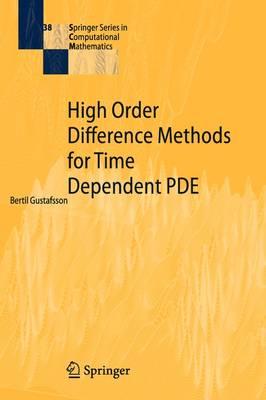
Many books have been written on ?nite difference methods (FDM), but there are good reasons to write still another one. The main reason is that even if higher order methods have been known for a long time, the analysis of stability, accuracy and effectiveness is missing to a large extent. For example, the de?nition of the formal high order accuracy is based on the assumption that the true solution is smooth, or expressed differently, that the grid is ?ne enough such that all variations in the solution are well resolved. In many applications, this assumption is not ful?lled, and then it is interesting to know if a high order method is still effective. Another problem that needs thorough analysis is the construction of boundary conditions such that both accuracy and stability is upheld. And ?nally, there has been quite a strongdevelopmentduringthe last years, inparticularwhenit comesto verygeneral and stable difference operators for application on initial–boundary value problems. The content of the book is not purely theoretical, neither is it a set of recipes for varioustypesof applications. The idea is to give an overviewof the basic theoryand constructionprinciplesfor differencemethodswithoutgoing into all details. For - ample, certain theorems are presented, but the proofs are in most cases left out. The explanation and application of the theory is illustrated by using simple model - amples.
Full Product Details
Author: Bertil Gustafsson
Publisher: Springer-Verlag Berlin and Heidelberg GmbH & Co. KG
Imprint: Springer-Verlag Berlin and Heidelberg GmbH & Co. K
Edition: 1st ed. Softcover of orig. ed. 2008
Volume: 38
Dimensions:
Width: 15.50cm
, Height: 1.80cm
, Length: 23.50cm
Weight: 0.539kg
ISBN: 9783642094392
ISBN 10: 3642094392
Pages: 334
Publication Date: 25 November 2010
Audience:
Professional and scholarly
,
Professional & Vocational
,
Postgraduate, Research & Scholarly
Format: Paperback
Publisher's Status: Active
Availability: Out of print, replaced by POD

We will order this item for you from a manufatured on demand supplier.
Reviews
From the reviews: This book presents the theory and construction principles of high order finite difference methods (FDM) for numerical solving of time dependent partial differential equations. ... Many types of finite difference schemes are completely studied and numerical experiments and graphs are presented. ... The book is written in a clear and comprehensive manner. It is recommended to researchers, PD students and readers interested in effective methods for numerical solving of partial differential equations. (Snezhana Gocheva-Ilieva, Zentralblatt MATH, Vol. 1146, 2008)
From the reviews: This book presents the theory and construction principles of high order finite difference methods (FDM) for numerical solving of time dependent partial differential equations. ! Many types of finite difference schemes are completely studied and numerical experiments and graphs are presented. ! The book is written in a clear and comprehensive manner. It is recommended to researchers, PD students and readers interested in effective methods for numerical solving of partial differential equations. (Snezhana Gocheva-Ilieva, Zentralblatt MATH, Vol. 1146, 2008)
From the reviews: This book presents the theory and construction principles of high order finite difference methods (FDM) for numerical solving of time dependent partial differential equations. ... Many types of finite difference schemes are completely studied and numerical experiments and graphs are presented. ... The book is written in a clear and comprehensive manner. It is recommended to researchers, PD students and readers interested in effective methods for numerical solving of partial differential equations. (Snezhana Gocheva-Ilieva, Zentralblatt MATH, Vol. 1146, 2008)