Awards
- Winner of Named a Best Sci-Tech Book of 1993 by Library Journal.
- Winner of Named a Best Sci-Tech Book of 1993 by ^ILibrary Journal^R.
Overview
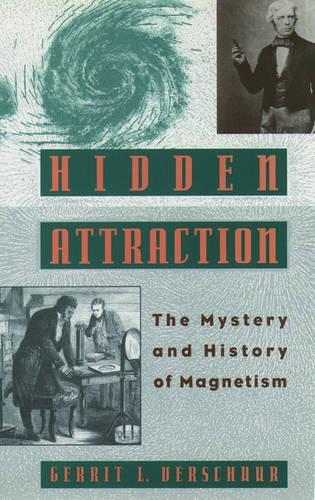
Long one of nature's most fascinating phenomena, magnetism was once the subject of many superstitions. Magnets were thought useful to thieves, effective as a love potion or as a cure for gout or spasms. They could remove sorcery from women and put demons to flight and even reconcile married couples. It was said that a lodestone pickled in the salt of sucking fish had the power to attract gold. Today, these beliefs have been put aside, but magnetism is no less remarkable for our modern understanding of it. In Hidden Attraction, Gerrit L. Verschuur, a noted astronomer and National Book Award nominee for The Invisible Universe, traces the history of our fascination with magnetism, from the first discovery of magnets in Greece, to state-of-the-art theories that see magnetism as a basic force in the universe. The book begins with the early debunking of superstitions by Peter Peregrinus (Pierre de Maricourt), whom Roger Bacon hailed as one of the world's first experimental scientists (Perigrinus held that ""experience rather than argument is the basis of certainty in science""). Verschuur discusses William Gilbert, who confronted the multitude of superstitions about lodestones in De Magnete, widely regarded as the first true work of modern science, in which Gilbert reported his greatest insight: that the earth itself was magnetic. We also meet Hans Christian Oersted, who demonstrated that an electric current could influence a magnet (Oersted did this for the first time during a public lecture) and Andre-Marie Ampere, who showed that a current actually produced magnetism. Verschuur also examines the pioneering experiments and theoretical breakthroughs of Faraday and Maxwell and Zeeman (who demonstrated the relationship between light and magnetism), and he includes many lively stories of discovery, such as the use of frogs by Galvani and Volta, and Hertz's accidental discovery of radio waves. Along the way, we learn many interesting scientific facts, perhaps the most remarkable of which is that lodestones are made by bacteria (a sediment organism known as GS-15 eats iron, converting ferric oxide to magnetite and, over billions of years, forming the magnetite layers in iron formations). Boasting many informative illustrations, this is an adventure of the mind, using the specific phenomenon of magnetism to show how we have moved from an era of superstitions to one in which the Theory of Everything looms on the horizon.
Full Product Details
Author: Verschuur
Publisher: Oxford University Press Inc
Imprint: Oxford University Press Inc
Dimensions:
Width: 15.60cm
, Height: 1.90cm
, Length: 23.40cm
Weight: 0.390kg
ISBN: 9780195106558
ISBN 10: 0195106555
Pages: 272
Publication Date: 03 October 1996
Audience:
General/trade
,
General
Format: Paperback
Publisher's Status: Active
Availability: To order

Stock availability from the supplier is unknown. We will order it for you and ship this item to you once it is received by us.
Reviews
Vershuur provides more than bookends of familiar science history, with flourish and style demonstrating the hidden attraction that pulls us ever closer to the central mystery of the universe. Publishers Weekly ...an absolutely smashing book about magnetism. It sweeps along as it justifies its proposition that the results of studying magnetism - fascinatingly described - alone made our technological civilisation possible. New Scientist
Vershuur provides more than bookends of familiar science history, with flourish and style demonstrating the hidden attraction that pulls us ever closer to the central mystery of the universe. Publishers Weekly ...an absolutely smashing book about magnetism. It sweeps along as it justifies its proposition that the results of studying magnetism - fascinatingly described - alone made our technological civilisation possible. New Scientist
Using the story of magnetism as his framework, Verschuur (The Invisible Universe, 1986 - not reviewed) discusses - from the vantage point of a committed propagandist for the scientific method - our historical journey from superstition to physics. Like a fusty old uncle who's nonetheless immensely learned and ultimately charming, Verschuur takes us by the hand and leads us from the almost alchemical experiments of the first true scientists, who explored the properties of lodestone, through the great pioneers of electricity (Faraday, Oerst, and Ampere, whose Kantian belief in the unity of natural phenomena led to the fusion of electromagnetism) to a brief primer on supersymmetry and the Theory of Everything, as well as on his own work in detecting the magnetic fields of galaxies. Displaying both his prickly disdain for the superstitious and an enthusiastic, almost naive approach to his scientific heroes, Verschuur sprinkles his text with fascinating anecdotes and well-chosen illustrations. Thumbnail biographies of principal scientists cleverly demonstrate how their backgrounds influenced their work (for example, the Protestantism of Faraday insisted on direct experience of the Bible without a priestly interpreter; similarly, the scientist chose to dispense with earlier, eventually disproved, hypotheses about electricity and to begin with the direct experience of experimentation). Repetitive and often stylistically cliched ( to make a long story short ; the moral of the story is, etc.); still, an entertaining, informative history that doubles as a solid guide to the nature of magnetism and electricity. (Kirkus Reviews)
Author Information
Gerrit L. Verschuur is a professional radio astronomer, freelance writer, and contributing editor of Air and Space Magazine. He is the author or editor of nine previous books.